Table of Contents 10 sections
Are you confident that every product in your home and kitchen line meets Amazon's complex FBA eligibility rules? For 7-figure sellers aiming to scale, a single compliance mistake can lead to suspended listings, costly removal orders, and lost momentum. Understanding the nuances of this category is not just about following rules, it's about protecting your investment and unlocking profitable growth.
To sell home and kitchen products through Fulfillment by Amazon (FBA), you must adhere to specific condition guidelines, size and weight classifications, and packaging requirements. Certain subcategories, like cookware or small electronics, may require pre-approval with documentation such as invoices and safety certifications. Navigating these rules is critical for avoiding inventory issues and ensuring your products are eligible for Prime shipping.
Understanding Core FBA Eligibility for Home and Kitchen
The foundation of a successful FBA business in the home and kitchen space is a deep understanding of Amazon's core eligibility criteria. These rules are in place to ensure a consistent and safe customer experience. Before you even think about shipping inventory to a fulfillment center, you must verify that your products meet all general requirements, from their condition to their physical dimensions, as these factors directly impact your fees and logistical process.
General Product Requirements and Condition Guidelines
First and foremost, all products sent to FBA must be in 'New' condition. Unlike some other categories, the Home & Kitchen department generally does not permit the sale of used items through FBA. Each unit must be a complete retail product, including all necessary parts, accessories, and instructions, exactly as a customer would expect to receive it from a traditional store. The product and its retail packaging must be free from damage, dirt, or defects.
Beyond the physical state, your product listing must accurately match the physical item. This includes details like color, size, material, and brand. Any discrepancy can lead to customer complaints, negative reviews, and potential suspension of your listing. It's essential to review the general Amazon FBA eligibility requirements to ensure you cover all bases before creating a shipment.
Size and Weight Tier Classifications
Amazon classifies products into specific size and weight tiers, which determine your fulfillment and storage fees. Home and kitchen items can range from a small standard-size silicone spatula to a large oversize microwave oven. Understanding where your product falls is crucial for calculating profitability. The main tiers are standard-size (under 20 lb) and oversize (over 20 lb or with larger dimensions), with several sub-tiers within each.
To determine your product's size tier, Amazon measures its length, width, height, and unit weight when fully packaged. You should measure and weigh your products accurately before listing them to forecast your fees correctly. An incorrect classification can lead to unexpected charges that erode your margins, so using Amazon's FBA Revenue Calculator is a vital step in your product research and financial planning.
Restricted Product Categories in Home and Kitchen
While the Home and Kitchen category is vast, it's not a free-for-all. Amazon restricts certain subcategories to ensure product safety, quality, and compliance with federal regulations. Selling in these gated categories often requires you to go through an approval process, or 'ungating,' before you can list your products. Failing to secure proper approval can result in immediate listing removal and potential account penalties.
Identifying Subcategories That Require Approval
Several subcategories within Home and Kitchen frequently require approval. These often involve products that have higher safety or regulatory standards. As an expert consultant, I've seen many sellers get tripped up here. It's crucial to check before you invest in inventory.
- Cookware and Bakeware: Items that come into direct contact with food may require testing and certification for food-grade materials.
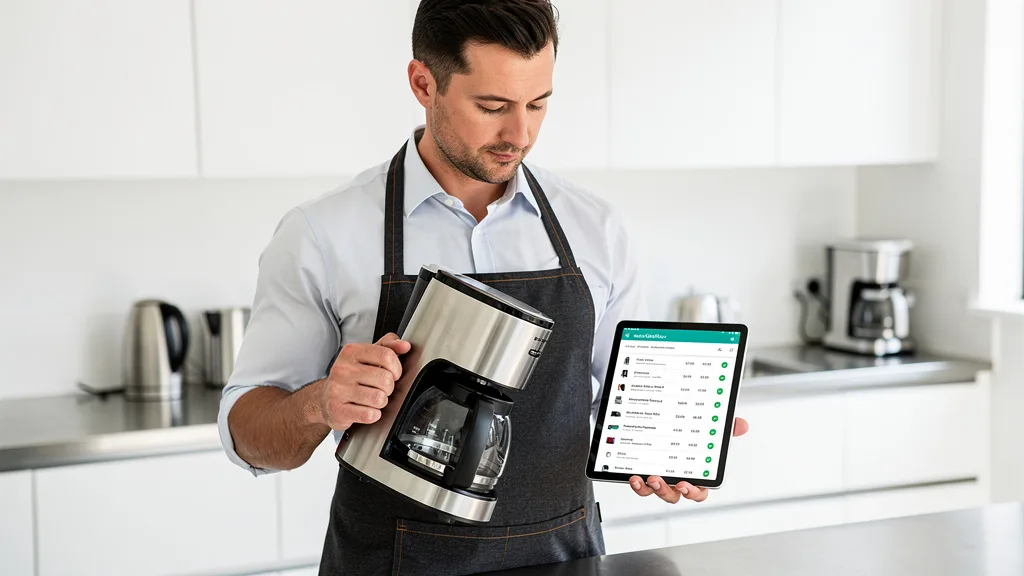
- Small Kitchen Appliances: Electronics like blenders, toasters, or coffee makers must meet electrical safety standards (e.g., UL certification).
- Water Filters and Purifiers: Products making health or filtration claims are heavily scrutinized and require specific performance data and certifications.
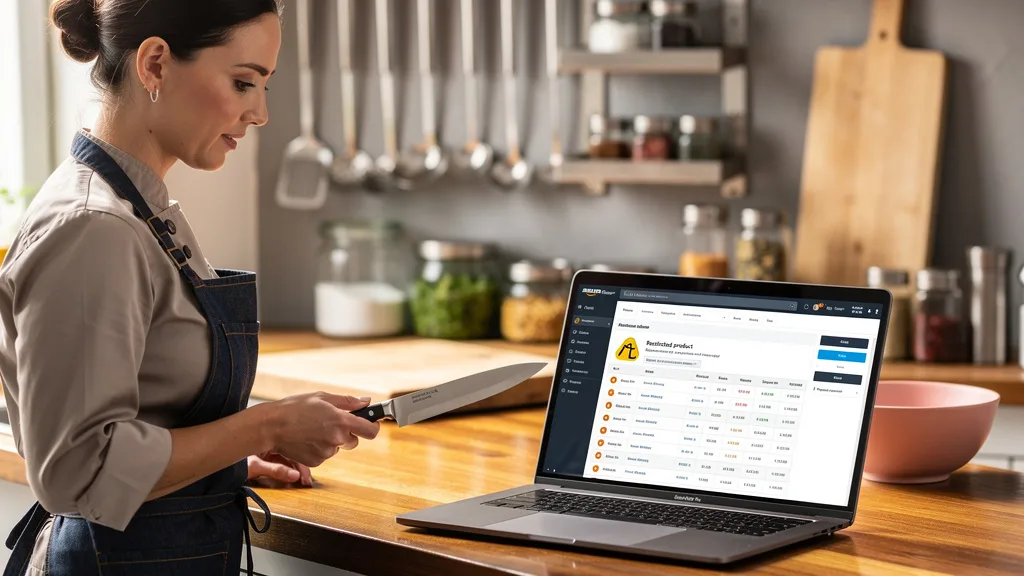
- Knives and Bladed Instruments: While many kitchen knives are permitted, certain types may be restricted, and all require secure, protective packaging.
Commonly Prohibited Items and Materials
Some items are outright prohibited from being sold on Amazon or through FBA due to safety, legal, or policy reasons. For example, any product that contains hazardous materials, such as certain industrial-strength cleaning chemicals or flammable substances, is generally not eligible for FBA. Products making unsubstantiated medical or health claims, like a cutting board that claims to kill all bacteria, are also forbidden.

It is your responsibility as the seller to ensure your products comply with all applicable laws and Amazon's policies. This includes regulations related to product safety, labeling, and materials. For items that come into contact with food, understanding the compliance rules is especially important, similar to the strict guidelines for FBA food eligibility.
How to Get Approval for Gated Home Goods
Successfully navigating the approval process for gated home and kitchen subcategories is a critical skill for scaling your brand. Amazon's goal is to ensure that only qualified sellers with legitimate, safe products are able to list in these sensitive areas. Having your documentation in order and following the process precisely will save you significant time and frustration.
Step-by-Step Application Process in Seller Central
The application process is initiated directly within your Seller Central account. First, find the product you wish to sell by searching for its UPC, EAN, or ASIN under 'Add a Product.' If the item is in a restricted category, you will see a 'Listing limitations apply' notification. Next to this, you will find a 'Request Approval' button.
Clicking this button will take you to an application page. This page will outline the specific requirements for that subcategory. You will be asked to submit various documents and potentially answer a questionnaire about your business and supply chain. Be thorough and honest in your application, as any inconsistencies can lead to denial.
Compiling Necessary Documentation and Invoices
Amazon requires specific documents to verify the legitimacy and safety of your products. While requirements can vary by subcategory, you should be prepared to provide the following:
- Purchase Invoices: You'll need at least one legible invoice from a manufacturer or distributor, dated within the last 180 days. The invoice must show your business name and address matching your Seller Central information, as well as the contact information for your supplier. It must also show a purchase quantity of at least 10 units of the product you're seeking to ungate.
- Safety Certifications: For electronics, this may be a UL certificate. For food-contact items, it could be documentation of compliance with FDA standards.
- Product and Packaging Photos: Clear images of the product and its packaging from all sides, showing branding, safety warnings, and model numbers.
Gathering this information beforehand makes the application process much smoother. Ensure your invoices are not from retail receipts or online order confirmations; they must be proper commercial invoices.
FBA Packaging and Prep Requirements
Proper packaging and preparation are non-negotiable for FBA. Amazon's fulfillment centers are highly automated environments, and your products must be prepared to withstand the rigors of shipping and handling. For the home and kitchen category, which often includes fragile or sharp items, these rules are especially important to prevent damage, protect warehouse workers, and ensure customer satisfaction.
Packaging Fragile Kitchen Items Like Glassware
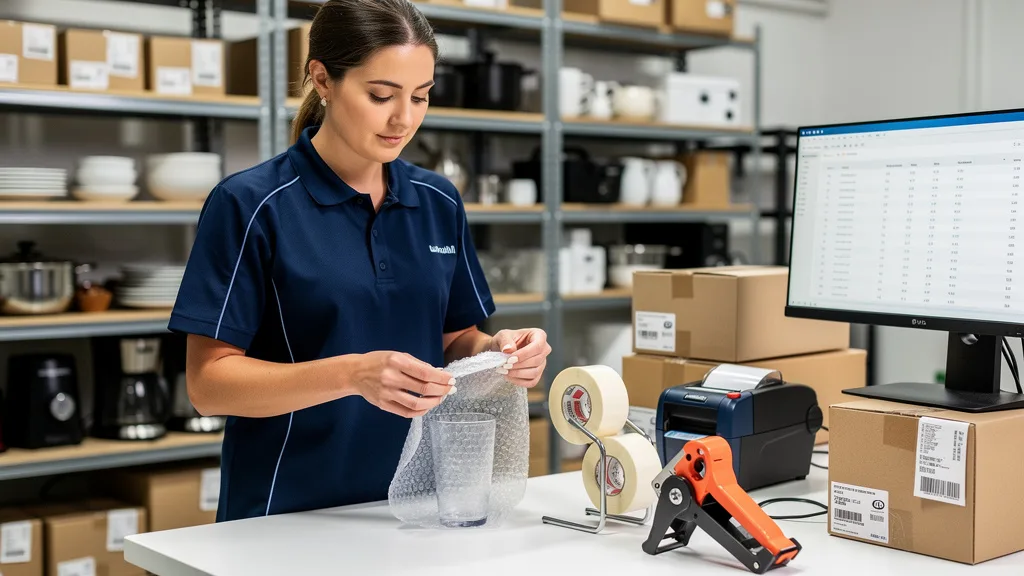
Fragile items such as glassware, ceramic dishes, or any product made of breakable materials require special attention. Each unit must be individually wrapped in bubble wrap, foam, or another form of cushioning. The wrapped item should then be placed in a sturdy, six-sided box to prevent it from breaking during transit.
"Scaling an Amazon business means mastering the details. For home goods, proper prep isn't just a suggestion, it's a requirement for profitability. I've seen brands lose thousands on damaged inventory because they skipped the 3-foot drop test. Protecting your product is protecting your margin."
A key part of this process is the 3-foot drop test. Your packaged item must be able to withstand a drop from three feet onto a hard surface without breaking. You should test this yourself before sending a large shipment. Affixing a 'Fragile' label to the outside of the box is also a best practice.
Labeling Rules for Individual Units and Cartons
Every unit sent to an FBA warehouse needs a scannable barcode. You have two main options: using the manufacturer's barcode (like a UPC or EAN) or applying an Amazon-specific barcode, known as an FNSKU label. For most private label sellers, using an FNSKU is recommended as it directly links the inventory to your seller account, preventing commingling with other sellers' products.
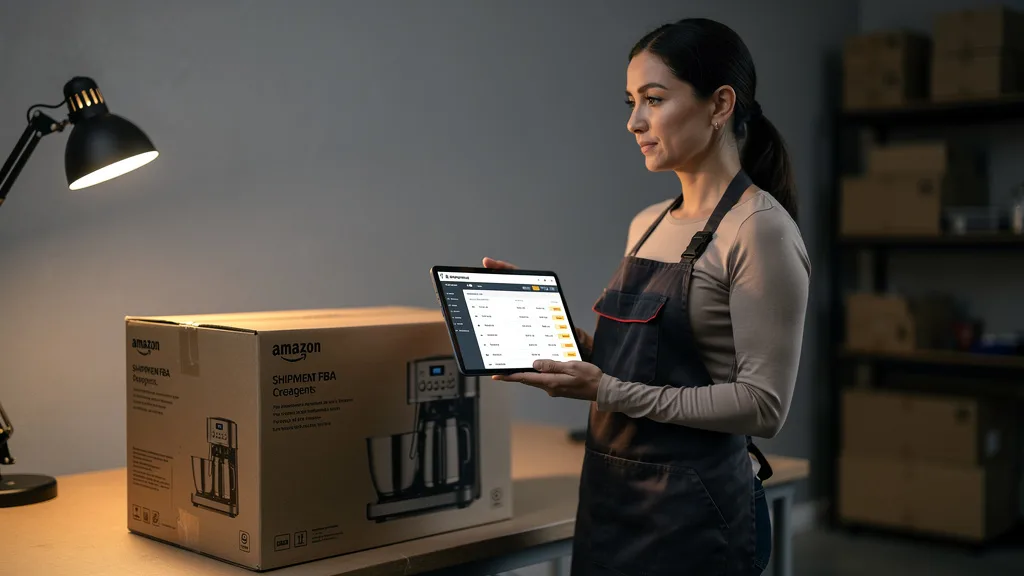
The FNSKU label must be placed on the outside of the product's packaging, covering any other visible barcodes. When you ship your products to Amazon in larger cartons, each carton also requires a specific FBA shipment label generated from your Shipping Plan in Seller Central. These labels tell Amazon what's in the box and which shipment it belongs to, ensuring your inventory is received quickly and accurately.
Navigating FBA Fees for Home and Kitchen Items in 2026
Profitability on Amazon hinges on a clear understanding of the fee structure. For Amazon FBA product eligibility for home and kitchen items, fees are heavily influenced by the product's size, weight, and how long it stays in the fulfillment center. As of 2026, it's more important than ever to accurately calculate these costs to ensure your products have healthy margins.
Calculating Fees for Standard vs Oversized Products
FBA fees are broken down into two main components: fulfillment fees (for picking, packing, and shipping) and monthly storage fees. Both are calculated based on your product's size tier. Standard-size products are significantly cheaper to fulfill and store than oversized items. A small kitchen gadget might cost a few dollars to fulfill, while a small appliance could cost ten times that.
Here is a simplified comparison for 2026:
| Metric | Standard-Size Item (e.g., Garlic Press) | Oversize Item (e.g., Countertop Mixer) |
|---|---|---|
| Size Tier | Small Standard-Size | Small Oversize |
| Dimensions (Packaged) | 8 x 3 x 2 inches | 16 x 10 x 15 inches |
| Weight | 0.5 lb | 15 lb |
| Estimated Fulfillment Fee | $3.80 | $14.50 + $0.45/lb above first lb |
| Monthly Storage Fee (Jan-Sep) | $0.02 | $1.25 |
Avoiding Long-Term Storage Fees
Amazon wants to move products, not store them indefinitely. To that end, they charge long-term storage fees for any inventory that remains in a fulfillment center for more than 365 days. These fees are substantial and can quickly eliminate the profit on slow-moving items. As of 2026, Amazon continues to be strict about inventory turnover.
To avoid these fees, you must actively manage your inventory health. Use the tools in Seller Central to monitor your Inventory Performance Index (IPI) and sell-through rate. If you have aging inventory, consider running promotions, using Amazon Ads to boost sales, or creating a removal order to have the items returned to you or disposed of before the fees are assessed.
FBA vs FBM: Which to Choose for Large Kitchen Appliances
When selling large, heavy items like microwaves, stand mixers, or air fryers, the decision between Fulfillment by Amazon (FBA) and Fulfillment by Merchant (FBM) becomes a critical strategic choice. While FBA offers unparalleled convenience and access to Prime customers, the costs for oversized products can be prohibitive. FBM, on the other hand, gives you more control over logistics and costs but requires significantly more work.
Cost and Logistics Comparison
With FBA, Amazon handles everything from storage to shipping and customer service, but you pay a premium for it. For a large kitchen appliance, FBA fulfillment fees can easily exceed $20-$50 per unit, not including monthly storage fees that are also much higher for large items. This can make it difficult to compete on price.
With FBM, you are responsible for storing the inventory, packing each order, and arranging shipment with a carrier. While this gives you the opportunity to find more cost-effective shipping solutions (especially for regional deliveries), it also adds significant operational complexity. You'll need warehouse space, packing materials, and a reliable shipping process to meet Amazon's delivery timelines.
Impact on Customer Experience and Buy Box Eligibility
The single biggest advantage of FBA is the Prime badge. Products fulfilled by Amazon are eligible for Prime free two-day shipping, a major conversion driver for millions of customers. FBA listings are also heavily favored by Amazon's algorithm for winning the Buy Box, which accounts for the vast majority of sales.
As an FBM seller, you can become eligible for Seller Fulfilled Prime (SFP), which allows you to display the Prime badge while shipping from your own warehouse. However, the performance requirements for SFP are incredibly strict, including nationwide two-day delivery promises that can be expensive to maintain. For most sellers of large appliances, the choice comes down to accepting high FBA fees for better conversion or managing complex logistics with FBM for potentially higher margins.
Latest FBA Policy Changes for Home Goods in 2026
Staying current with Amazon's ever-evolving policies is crucial for long-term success. In 2026, we've seen a continued push towards sustainability and stricter safety compliance in the home and kitchen category. Amazon has introduced new packaging guidelines aimed at reducing waste, encouraging sellers to use right-sized, recyclable packaging and avoid plastics where possible. This is part of the 'Ships in Own Container' (SIOC) program, which is now being expanded to more home goods.
Furthermore, there has been an increased requirement for safety and compliance documentation, especially for small electronic appliances and products intended for use with food. Sellers may be asked proactively to provide documents like a General Certificate of Conformity (GCC) or results from accredited lab tests. Being prepared with this documentation is essential to avoid listing deactivation. These changes underscore the importance of working with reputable suppliers who can provide the necessary paperwork to prove your products are safe and compliant.
Key Takeaways
Successfully selling home and kitchen products on FBA requires careful attention to detail. Here are the most important takeaways for ensuring your products are eligible and profitable in 2026:
- Verify All Requirements First: Before purchasing inventory, confirm your product meets all condition, safety, and category-specific guidelines. Check if the subcategory is gated and what documentation you'll need for approval.
- Master Packaging and Prep: Improper prep, especially for fragile items, leads to damaged inventory and lost revenue. Follow Amazon's guidelines for bubble wrap, drop tests, and proper FNSKU labeling to the letter.
- Calculate Fees Accurately: Your product's size and weight tier dictates your FBA fees. Use the FBA Revenue Calculator to model your costs and ensure your pricing strategy yields a healthy profit margin.
- Manage Inventory Actively: Avoid costly long-term storage fees by monitoring your inventory health. Use promotions, advertising, and removal orders to manage slow-moving stock before it becomes a liability.
- Stay Informed on Policy Changes: Amazon's rules are not static. Keep up with the latest policy updates for 2026, particularly around packaging sustainability and compliance documentation, to keep your business ahead of the curve.
Frequently Asked Questions
What documentation is needed for selling cooking utensils via FBA?
For cooking utensils, especially those made from materials like silicone, plastic, or with non-stick coatings, Amazon may require documentation proving they are food-safe. This typically includes a Certificate of Conformity or test reports from an accredited laboratory showing compliance with regulations from bodies like the FDA for food-contact surfaces.
In addition to safety documents, you will likely need to provide a recent commercial invoice from your manufacturer or distributor. This invoice must show the supplier's and your business's information, be dated within the last 180 days, and reflect a purchase of at least 10 units.
Can I sell used home and kitchen items through FBA?
Generally, no. The vast majority of products in the Home and Kitchen category must be sold in 'New' condition to be eligible for FBA. This policy is in place to ensure customer satisfaction, hygiene, and product safety. Attempting to list used items can lead to listing removal and account penalties.
There are very few exceptions to this rule, and they are not common. If you specialize in refurbished or used goods, the Amazon FBA program is likely not the right fit for your home and kitchen products. You would need to explore selling through Fulfillment by Merchant (FBM) where you have more control over condition notes, but even then, customer expectations are high.
What happens if I send an ineligible product to an FBA warehouse?
Sending an ineligible product to an Amazon fulfillment center will create a stranded inventory event. The inventory will be sidelined and will not be available for sale. Amazon will notify you of the issue, and you will typically have 30 days to resolve it by either fixing the listing issue (if possible) or creating a removal order.
If you fail to act within the given timeframe, Amazon may dispose of the inventory at your expense. This is why verifying Amazon FBA product eligibility for home and kitchen items before you ship is so critical. Stranded inventory ties up your capital and incurs storage fees without generating any sales, and disposal fees add insult to injury.
Are there specific certifications needed for electronic kitchen appliances?
Yes, absolutely. Electronic kitchen appliances sold in the U.S. market must comply with recognized safety standards. Amazon typically requires proof of certification from a Nationally Recognized Testing Laboratory (NRTL), with Underwriters Laboratories (UL) being the most common.
You will need to provide a General Certificate of Conformity (GCC) and supporting test reports to prove your product meets these standards. Selling uncertified electronics is a major compliance violation that can lead to immediate account suspension. Always work with suppliers who can provide this complete documentation.
How does Amazon handle FBA returns for fragile home goods?
When a customer returns a fragile item like a glass or ceramic product, Amazon warehouse staff will inspect it. If the item is unopened and in new, sellable condition, it will be returned to your inventory. However, if the package has been opened or the item is damaged, it will be marked as 'Unfulfillable'.
You can see the status of your returned inventory in the FBA returns report in Seller Central. For unfulfillable items, you must create a removal order to have them sent back to you for inspection or disposed of by Amazon. Because return shipping can cause further damage, proper initial packaging is your best defense against losses from returns.
Conclusion
Mastering Amazon FBA eligibility for home and kitchen items in 2026 is a non-negotiable step for any brand serious about scaling. By proactively addressing product requirements, navigating restricted categories, perfecting your prep and packaging, and managing your fees, you build a resilient and profitable operation. This attention to detail prevents costly errors like stranded inventory and protects your brand's reputation, setting the stage for growth from 7 to 8 figures and beyond.
Ensuring your listings are perfectly optimized and compliant from the start is the most effective way to protect your margins and accelerate your growth. If you're unsure whether your products meet every requirement, a professional review can uncover hidden risks and opportunities. Get a comprehensive analysis of your listings with a Free Audit.