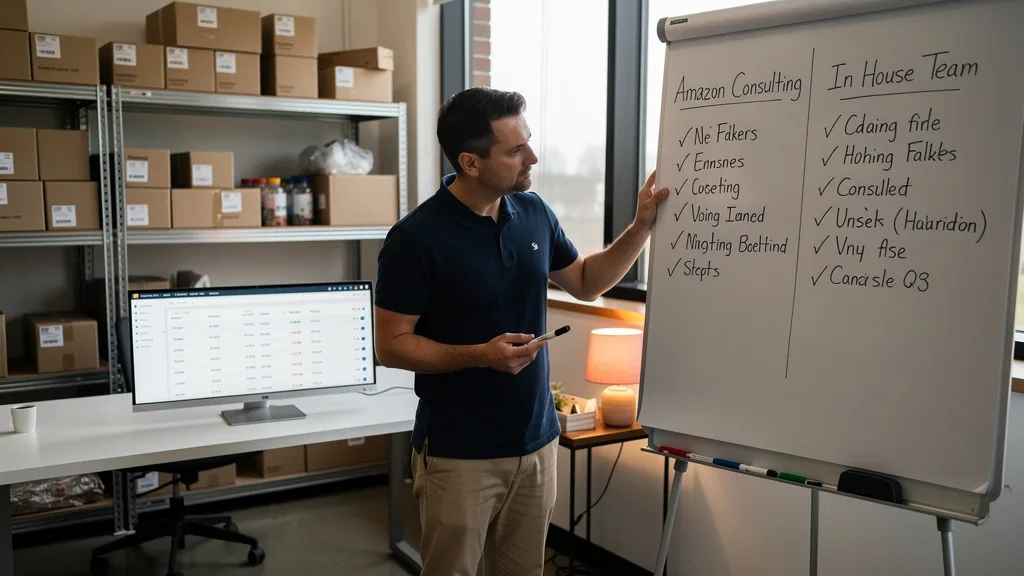
As a 7-figure Amazon brand owner, are you at a crossroads, wondering if an expert consultant or a dedicated in-house team is the key to your 8-figure breakthrough? This decision is one of the most critical you'll make for scaling your business, with significant implications for your budget, growth trajectory, and bottom line.
For most brands looking to scale profitably, the choice between Amazon consulting vs in house: which model saves more? comes down to return on investment. An experienced Amazon consultant often delivers faster results and a higher ROI due to specialized expertise and lower overhead, making it the more cost-effective option for growth. An in-house team provides greater control but comes with significant fixed costs, lengthy recruitment, and the risk of knowledge gaps that can stall momentum.
Understanding the Amazon Consulting Model
An Amazon consulting model involves partnering with an external expert or agency that specializes in managing and growing Amazon businesses. These consultants act as a fractional extension of your team, bringing a wealth of experience from working across numerous accounts and industries. They handle critical functions like PPC advertising, listing optimization, brand management, and strategic growth planning.

For a 7-figure seller aiming higher, a consultant provides access to a team of specialists for less than the cost of a single senior-level employee. The focus is on implementing proven, profit-driven strategies without the administrative burden of hiring. This model is built for speed and expertise, allowing you to leverage top-tier talent immediately to accelerate your sales and profitability.
Pros of Hiring an Amazon Consultant
Partnering with a consultant offers several distinct advantages, particularly for brands poised for rapid growth. One of the primary benefits is immediate access to specialized expertise. Instead of relying on one generalist, you gain a team of experts in PPC, Amazon SEO, copywriting, and logistics who are constantly refining their skills across multiple accounts.
This model is also highly cost-effective. You avoid the substantial expenses associated with a full-time employee, such as salary, benefits, payroll taxes, and training. Furthermore, consultants bring speed and agility; they can diagnose issues and implement growth strategies from day one, drastically shortening the time to see a positive impact on your revenue and ACoS.
Cons of Using an Amazon Agency
While the benefits are significant, there are potential downsides to the consulting model. You will naturally have less direct, day-to-day oversight compared to managing an employee sitting in your office. Effective communication and clear reporting structures are essential to mitigate this and ensure alignment with your brand's goals.
Another consideration is that an agency works with multiple clients. While a professional firm will dedicate ample resources to your account, their attention is inherently divided. It's crucial to vet potential partners to ensure they have the bandwidth and systems in place to give your brand the focus it deserves. The success of the partnership hinges on finding a consultant who truly understands your vision and operates as a seamless extension of your business.
Building and Managing an In-House Amazon Team
The alternative to consulting is to build and manage your own in-house Amazon team. This involves recruiting, hiring, and training one or more employees to handle all aspects of your Amazon channel. This person or team becomes fully embedded in your company culture, dedicating 100% of their time and effort to your brand's success.

This approach gives you maximum control over your Amazon operations. Your in-house specialist can work closely with product development, marketing, and customer service teams, ensuring perfect brand alignment. However, this path requires a significant investment not only in salary but also in management time, continuous training, and the tools necessary for them to succeed.
Pros of an Internal Amazon Team
The most significant advantage of an internal team is its singular focus on your brand. An employee's success is directly tied to your company's success, fostering deep loyalty and product knowledge. This complete immersion can lead to a level of brand cohesion that is sometimes harder to achieve with an external partner.
Direct control and immediate communication are also key benefits. You can walk over to your Amazon manager's desk to discuss a new strategy or get instant feedback on a campaign's performance. This proximity fosters a tight feedback loop and allows for rapid pivots in daily operations, which can be invaluable in the fast-paced Amazon marketplace.
The primary drawback of an in-house team is the substantial cost. Beyond a competitive salary, you are responsible for benefits, taxes, bonuses, software subscriptions, hardware, and ongoing training, which can inflate the total cost to 1.5x the base salary or more. The recruitment process itself is also time-consuming and expensive, with no guarantee of finding the right candidate.
Moreover, you risk creating a knowledge silo. It's rare for a single individual to be a world-class expert in every facet of Amazon, from PPC and DSP to creative and logistics. An in-house employee may excel in one area but have significant gaps in others, potentially limiting your growth. This model is also less flexible; scaling down during slow periods isn't an option, and scaling up requires another lengthy hiring process.
Core Differences: Consulting vs. In-House Head-to-Head
When you place the two models side by side, the differences become starkly clear across several key areas. Your decision should be based on which of these factors are most critical for your brand's current stage and future ambitions. Understanding these trade-offs is essential to making a financially sound choice for your business in 2026.
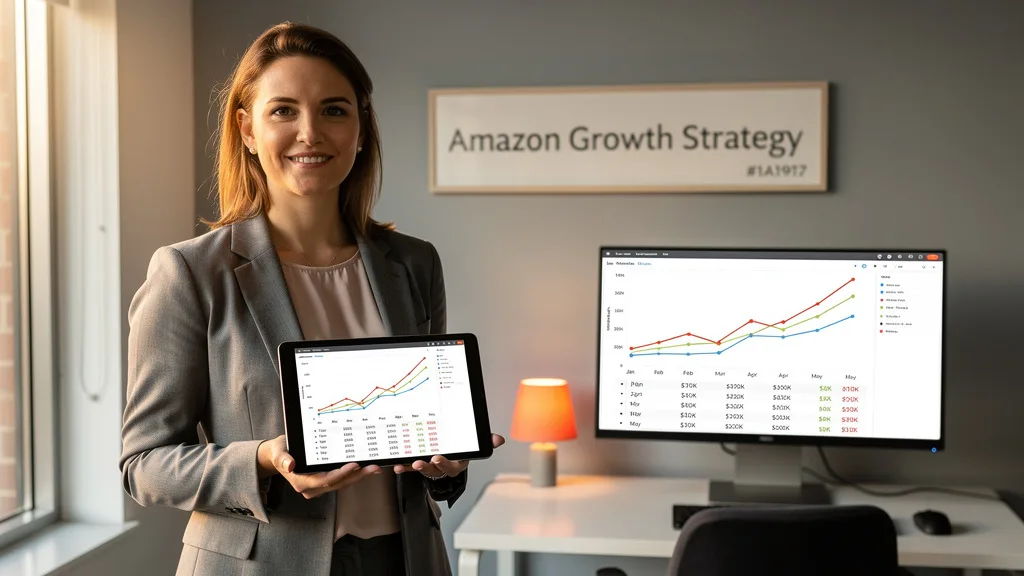
The following comparison breaks down how each model performs in terms of expertise, speed, control, and scalability. This head-to-head analysis will help you visualize where your investment yields the best results based on your specific operational priorities and growth targets.
| Feature | Amazon Consultant / Agency | In-House Team |
|---|---|---|
| Expertise | Access to a team of specialists (PPC, SEO, Creative) | Often a single generalist or small, expensive team |
| Cost Structure | Variable (retainer/performance-based); lower overhead | Fixed (salary, benefits, overhead); high total cost |
| Speed to Impact | Immediate; hits the ground running | Slow; requires recruiting, hiring, and training |
| Scalability | High; easily scale services up or down | Low; rigid structure, slow to change team size |
| Control | Less direct daily oversight; requires strong communication | Full, direct control over tasks and priorities |
| Industry Knowledge | Broad perspective from multiple accounts and niches | Deep knowledge of one brand; risk of tunnel vision |
Expertise and Specialization
An Amazon consulting agency provides a team of specialists for the price of one employee. You get a dedicated PPC manager, a listing optimization expert, a creative strategist, and an account manager. They bring a wealth of cross-industry knowledge and are constantly testing new strategies on different accounts, which benefits your brand directly. This collective intelligence is nearly impossible to replicate with an in-house team without hiring multiple expensive specialists.
Conversely, an in-house hire is often a generalist tasked with managing everything. While they may be strong in one or two areas, they are unlikely to possess elite-level skills across all the disciplines required to scale on Amazon. This can lead to missed opportunities or costly mistakes in critical areas like advanced advertising strategies or Amazon SEO, where deep expertise makes a significant difference.
Speed to Impact and Onboarding
One of the most compelling reasons to hire a consultant is speed. A professional agency can be onboarded and begin optimizing your account within weeks, sometimes even days. They have established processes and tools, allowing them to immediately identify and act on growth levers. This rapid deployment means you start seeing a return on your investment much faster.
Building an in-house team is a marathon, not a sprint. The process involves writing a job description, screening candidates, conducting multiple rounds of interviews, negotiating an offer, and finally, onboarding the new hire. This can take months, during which your growth may stagnate. After they start, there is still a learning curve as they get up to speed with your brand and internal processes.
Control and Brand Integration
This is the area where an in-house team holds a clear advantage. Having an employee on-site allows for unmatched integration with your company culture and other departments. They live and breathe your brand every day, which can lead to a deeper, more nuanced understanding of your products and customers. You have direct control over their priorities and daily workflow.
With a consultant, achieving this level of integration requires a more deliberate effort. It necessitates clear communication channels, regular meetings, and a strong sense of partnership. While a great agency will function as an extension of your team, the relationship is fundamentally different from that with a direct employee. You are guiding a partner rather than managing a subordinate.
Scalability and Flexibility
The Amazon marketplace is dynamic, and your business needs to be able to adapt. Amazon consultants offer superior scalability and flexibility. Most agencies operate on monthly retainers or flexible contracts that allow you to scale services up during peak seasons like Prime Day or Q4, and scale back down if needed. This agility helps you manage cash flow and align your spending directly with your strategic priorities.
An in-house team represents a fixed, long-term cost. Whether sales are booming or slumping, the salary and benefits must be paid. Expanding the team requires another significant investment in time and money, while downsizing is a difficult and often painful process. This lack of flexibility can be a major liability for a growing business navigating unpredictable market conditions.
The Financial Breakdown: A Detailed Cost Comparison for 2026
Ultimately, the decision often comes down to dollars and cents. When comparing Amazon consulting vs in house teams, it's crucial to look beyond the sticker price and analyze the total cost of ownership for each model. A surface-level comparison can be misleading; the true financial impact includes both direct and hidden costs.

In 2026, the economic landscape for hiring and services continues to evolve. Below, we'll dissect the real-world expenses associated with both options to provide a clear, comprehensive financial picture that helps you determine which path truly saves you more money while fueling your growth.
Hiring an in-house Amazon specialist is a significant financial commitment. According to 2026 salary data from sources like Robert Half, an experienced Amazon manager can command a salary between $85,000 and $125,000 per year. However, that's just the beginning. You must also factor in overhead costs, which typically add another 30-40% to their base salary.
These additional costs include:
- Payroll taxes (Social Security, Medicare)
- Health insurance and retirement benefits
- Paid time off and sick leave
- Software licenses (e.g., Helium 10, Jungle Scout), which can cost thousands per year
- Hardware and office space
- Ongoing training and professional development
When you add it all up, a single $100,000 employee can easily represent a total annual cost of $130,000 to $140,000 or more. This is a substantial fixed expense on your profit and loss statement.
Amazon consulting fees are structured to be more flexible. The most common models include a flat monthly retainer, a percentage of ad spend (PoAS), a percentage of total sales, or a hybrid of these. For a 7-figure brand, monthly retainers in 2026 typically range from $3,000 to $10,000, depending on the scope of work.
For example, a $5,000 monthly retainer totals $60,000 per year. This is less than half the true cost of an experienced in-house manager. For this fee, you get access to an entire team of specialists whose sole job is to drive profitable growth. The cost is predictable and directly tied to a suite of services designed to increase your revenue, making it a variable growth investment rather than a fixed operational cost. You can learn more by reviewing a guide on how much Amazon PPC costs to better understand the fee structures.
Uncovering the Hidden Costs of Each Model
Beyond the obvious expenses, both models have hidden costs. For an in-house team, the hidden costs include recruitment fees (which can be 20-25% of the first year's salary), the productivity loss during the months-long hiring process, and the immense cost of a bad hire, which can set your brand back by a year or more.
For consultants, the hidden costs are more about time and risk. There's an initial time investment required from you and your team to onboard the agency and get them up to speed. There's also the risk of choosing the wrong partner, which can lead to wasted months and fees. This is why thorough vetting, checking references, and demanding a clear, profit-focused strategy upfront is non-negotiable.
"The best investment isn't the cheapest one; it's the one that generates the highest profitable return. For scaling brands, expert guidance often unlocks growth an in-house generalist can't, making the ROI on consulting significantly higher."
How to Calculate the ROI for Each Option
To make a data-driven decision, you must calculate the potential Return on Investment (ROI) for both an in-house hire and a consultant. A simple formula to use is: ROI = (Gain from Investment – Cost of Investment) / Cost of Investment. The key is to accurately define the 'Gain' and 'Cost' for each scenario.
For an Amazon consultant, the cost is your monthly retainer and any performance fees. The gain is the incremental profit generated from their efforts, such as increased sales from optimized listings and more efficient ad spend. For an in-house team, the cost is the fully-loaded annual expense (salary plus overhead). The gain is the same incremental profit. Often, the specialist consultant can generate a higher 'Gain' in a shorter period, leading to a superior ROI despite the monthly fee.
Making the Right Choice: When Does Each Model Make Sense?
There is no single right answer for every brand. The optimal choice depends entirely on your business's specific circumstances, including your current revenue, growth goals, internal resources, and risk tolerance. The right decision for a $1 million brand is likely different from that of a $15 million brand.
By evaluating your situation against the common scenarios below, you can identify which model aligns best with your strategic objectives for 2026 and beyond. This framework will help you move from a theoretical comparison to a practical, actionable decision.
When to Choose an Amazon Consulting Agency
Opting for a consulting agency is the logical choice for most 6 and 7-figure brands aiming to scale aggressively. If you need to tap into high-level expertise in Amazon PPC management or advanced optimization techniques immediately, a consultant is your fastest path to results. This model is ideal when your budget can't yet support a six-figure hire plus overhead but you can't afford to let growth stagnate.
You should also choose an agency if you want to maintain flexibility. If you're launching in a new marketplace or testing a high-risk, high-reward strategy, a consultant allows you to access the necessary skills without a long-term commitment. It's the lean, expert-driven approach to achieving 8-figure growth.
When to Build Your In-House Team
Building an in-house team makes sense once your brand has reached a significant scale, typically well into the 8-figure range. At this level, you may have the financial resources and operational complexity to justify the cost of a dedicated, full-time team. If your Amazon operations require deep, daily integration with logistics, product development, and finance, an in-house model can provide that seamless connectivity.
This path is for established brands that have a clear, proven Amazon strategy and are now looking to bring execution and refinement entirely under their own roof. It's an investment in building a long-term internal asset, but it should only be undertaken when the business is mature enough to support it.
When to Consider Switching Models
Businesses evolve, and the right model for you today may not be the right one tomorrow. It's common for brands to switch from an agency to an in-house team once they reach a certain scale. This transition is best made after you've learned from your consulting partner, absorbed their strategies, and feel confident you can replicate their success internally.
Conversely, a brand might switch from an in-house team to an agency. This often happens if an internal team's performance has plateaued, they are struggling to keep up with Amazon's constant changes, or the brand needs a jolt of outside expertise to break into a new level of growth. Recognizing when your current model is no longer serving your goals is key to sustained success. ACoS.
Key Takeaways
- Cost vs. ROI: An in-house team has a higher total cost of ownership than a consultant. The decision should be based on ROI, not just the monthly fee.
- Speed and Expertise: Consultants provide immediate access to specialized expertise, leading to faster results and a quicker return on investment.
- Control and Integration: In-house teams offer maximum control and deep brand integration but come at the cost of flexibility and higher fixed expenses.
- Scalability is Key: The consulting model offers superior flexibility to scale services up or down based on business needs, which is critical for growing brands.
- The Right Choice is Situational: For most 7-figure brands aiming to scale, a consulting agency is the more cost-effective and efficient path. Large 8-figure brands may be better positioned to build an in-house team.
Frequently Asked Questions
Are Amazon consulting services worth it for small businesses?
Yes, especially for small businesses with high-growth potential. A good consultant provides the strategic direction and executional power that a small team lacks, often unlocking growth much faster than they could on their own. The investment can pay for itself many times over by avoiding costly mistakes and accelerating the path to profitability.
What does a typical Amazon consulting retainer include?
A typical retainer for a scaling brand includes a comprehensive suite of services. This usually covers strategic account management, Amazon listing optimization, keyword research and SEO, full management of PPC campaigns, inventory planning guidance, and detailed monthly performance reporting. The exact services are tailored to the brand's specific needs and goals. For more details, you can explore the costs associated with optimizing your Amazon listings.
What is the average salary for an in-house Amazon specialist in 2026?
As of 2026, the average base salary for an experienced in-house Amazon specialist or marketing manager in the US typically falls between $85,000 and $125,000. This can vary based on location, experience, and the size of the brand. Remember, the total cost to the employer is significantly higher once benefits, taxes, and other overhead are included.
How do you choose a reputable Amazon consulting agency?
To choose a reputable agency, look for proof of performance. Ask for case studies, client testimonials, and examples of brands they have scaled. A trustworthy consultant will focus on profit-driven growth, not just vanity metrics like revenue. They should offer transparent reporting, communicate clearly, and be able to articulate a custom strategy for your specific brand and goals. A good first step is often an Amazon PPC audit to assess their analytical skills.
Conclusion
Deciding between an Amazon consultant and an in-house team is a pivotal choice that shapes your brand's financial health and growth potential. While an in-house team offers deep integration, the 2026 data shows that for most brands scaling from 7 to 8 figures, the consulting model is more financially prudent and delivers a faster ROI. It provides access to elite, specialized talent at a fraction of the cost and complexity of hiring, allowing you to focus on what you do best: building your brand.
Ready to see how expert guidance can accelerate your brand's growth without the overhead of an in-house team? We help 7-figure brands scale profitably on Amazon with data-driven strategies. Get a complimentary analysis of your listings to uncover immediate growth opportunities. Your path to 8-figures starts with a single click.
If you want help turning this into a concrete plan for your site or team, take the next step below to apply Amazon Consulting vs In House: Which Model Saves More? with confidence.
Ready to act on Amazon Consulting vs In House: Which Model Saves More?? Free Audit — tell us your goal, and we will help you pick the highest-leverage next step so you are not guessing alone.