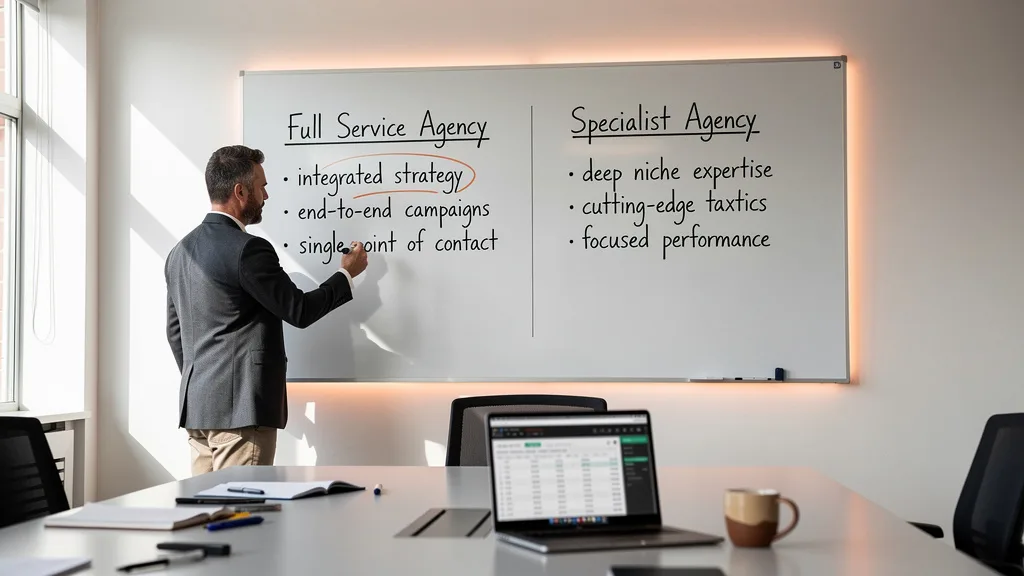
Are you trying to decide between a full-service marketing agency and a niche specialist to scale your brand? The choice you make can significantly impact your growth trajectory, budget efficiency, and overall market position. For ambitious brand owners, especially on competitive platforms like Amazon, this decision is critical for moving from 7 to 8 figures and beyond.
The core of the Full Service Agency vs Specialist Which Is Better debate comes down to your specific needs, current team structure, and primary business objectives for 2026. A full-service agency offers a broad, integrated approach covering multiple marketing channels under one roof, ideal for comprehensive brand launches or overhauls. In contrast, a specialist agency provides deep, focused expertise in a single area, such as Amazon PPC or e-commerce SEO, designed to solve a specific, high-stakes problem with maximum efficiency and impact.
A full-service marketing agency acts as a comprehensive, outsourced marketing department for your business. They provide a wide array of services that span the entire marketing spectrum, from high-level strategy and branding to execution across various digital and traditional channels. This can include everything from search engine optimization (SEO) and pay-per-click (PPC) advertising to content creation, social media management, email marketing, public relations, and web development.

The primary value proposition of a full-service model is integration and convenience. Instead of juggling multiple vendors, contracts, and points of contact, you have a single partner responsible for creating and executing a cohesive, multi-channel strategy. This unified approach ensures that messaging is consistent across all platforms and that different marketing efforts work synergistically. For example, insights from a paid social campaign can inform your SEO content strategy, all managed by one coordinated team.
What Is a Specialist Marketing Agency?
A specialist agency, also known as a boutique or niche agency, concentrates its expertise on a single marketing discipline or platform. Instead of trying to be a jack-of-all-trades, they aim for mastery in one specific area. Examples include agencies that focus exclusively on Amazon PPC management, TikTok Shop growth, technical SEO for e-commerce sites, or email marketing automation for Shopify stores. Their teams are composed of deep subject matter experts who live and breathe their chosen field.

The main advantage of hiring a specialist is their profound depth of knowledge and experience. Because they focus on one thing, they are often at the forefront of the latest trends, algorithm changes, and best practices within their niche. This level of expertise can lead to superior results, greater efficiency, and more innovative solutions for a specific problem. If your Amazon ACoS is too high, a dedicated Amazon PPC management agency will have more advanced tools and proven tactics to solve that issue than a generalist agency might.
Understanding the fundamental differences in scope, expertise, and cost is essential to making an informed decision. While one model might seem better on paper, the right choice depends entirely on your business context. The answer to the full-service agency vs. specialist debate rarely starts with the agency model itself; it starts with a clear diagnosis of your business's primary growth problem.
Scope of Services
A full-service agency offers a broad menu of services, providing a one-stop shop for all your marketing needs. This is ideal for businesses that require a holistic strategy and execution across multiple fronts. They can build a brand from the ground up, manage its online presence, and ensure all marketing activities are aligned. The scope is wide, covering strategy, creative, media, and analytics for numerous channels.

Conversely, a specialist agency has a very narrow and deep scope. They do one or two things exceptionally well. If you hire an Amazon SEO agency, they won't help you with your email newsletter or public relations. Their entire focus will be on improving your product rankings on Amazon. This limited scope ensures that all their resources, training, and technology are dedicated to delivering best-in-class results within that specific domain.
Depth of Expertise
While full-service agencies have teams for different channels, their expertise can sometimes be a mile wide and an inch deep. The account manager might be a generalist, and the specialists on the team may be juggling clients across various industries with different needs. While they are competent, they may not possess the granular, cutting-edge knowledge of someone who spends 100% of their time on a single platform's algorithm changes, like Amazon's A10. Amazon ACoS is too high.
This is where a specialist agency shines. Their team members are true experts with deep, nuanced understanding. An Amazon-focused consultant, for example, will know the intricacies of listing optimization, keyword ranking, and PPC bidding strategies that a general digital marketer would not. This deep expertise is crucial when you need to solve a complex, high-stakes problem or gain a competitive edge in a crowded marketplace. It's the difference between a general practitioner and a heart surgeon; you see the latter for a specific, critical issue.
Cost-Effectiveness and Pricing Models
The pricing for a full-service agency is typically higher, often structured as a significant monthly retainer. This fee covers access to their entire team and a wide range of services. While the upfront cost is substantial, it can be cost-effective compared to hiring multiple specialist agencies or building a large in-house team with the same breadth of skills. The value is in the strategic oversight and integrated management.
Specialist agencies often have more flexible and performance-oriented pricing. This might be a flat fee, a percentage of ad spend (common for PPC management), or a performance-based model where they are compensated based on results. For businesses with a clear goal, like reducing their Amazon PPC cost, this can be a more direct and measurable investment. You are paying for a specific outcome, not just access to a team.
Strategic Integration vs. Execution Speed
Full-service agencies excel at strategic integration. They ensure your paid social ads, email campaigns, and content marketing all tell the same story and work toward the same goals. This long-term strategic alignment is vital for building a strong, consistent brand identity. However, this level of coordination can sometimes slow down execution, as decisions may need to pass through multiple layers of account management and departmental reviews.
Specialist agencies are built for speed and agility within their domain. They can quickly implement changes, run tests, and adapt to new platform features without the bureaucracy of a larger organization. If you need to rapidly scale a Google Ads campaign or fix a sudden drop in organic rankings, a specialist can often deliver results faster. The trade-off is that you or your in-house team are responsible for integrating their work into your broader marketing strategy.
When to Choose a Full-Service Agency
Opting for a full-service partner is a significant strategic move. It's often the right choice for businesses at specific inflection points where broad, coordinated marketing support is more valuable than siloed expertise. This model is particularly effective in certain scenarios that demand a holistic approach to brand growth and market presence.
You Need an Integrated, Multi-Channel Strategy
If your growth plan involves reaching customers across multiple touchpoints—such as social media, search engines, email, and your own website—a full-service agency is invaluable. They can create a unified customer journey where each channel supports the others. For an Amazon brand looking to build a direct-to-consumer (DTC) presence, a full-service agency can manage the Shopify site development, run Google Ads, build an email list, and ensure brand consistency with the Amazon storefront.

This integrated approach prevents the fragmented customer experience that can occur when using multiple, uncoordinated specialists. The agency's central strategy team ensures that every piece of content, every ad, and every email contributes to the overarching business goals, creating a powerful and cohesive brand narrative that drives sustainable growth.
You Are Launching, Relaunching, or Repositioning a Brand
Launching a new brand or repositioning an existing one is a complex undertaking that requires a wide range of marketing skills. You need market research, brand identity development, a go-to-market strategy, creative assets, a media plan, and flawless execution across all channels. A full-service agency is perfectly structured to handle this from start to finish.
They can act as the central command for the entire launch, coordinating everything from the logo design to the day-one social media blitz. This ensures that nothing falls through the cracks and that the brand makes a strong, coherent first impression. Attempting to manage this process with a collection of freelancers or separate specialist agencies can quickly become a logistical nightmare.
You Lack an In-House Senior Marketing Leader
For many scaling businesses, especially those in the 7-figure range, hiring a full-time Chief Marketing Officer (CMO) or VP of Marketing is not yet feasible. A full-service agency can effectively fill this leadership gap. They provide the high-level strategic thinking and oversight that a senior marketing leader would, translating business objectives into a comprehensive marketing plan.
The agency's account director or lead strategist serves as your primary point of contact, offering C-level guidance without the C-level salary. They can manage the marketing budget, provide detailed reporting, and ensure the entire marketing function is aligned with your company's vision. This allows you, the founder or CEO, to focus on other critical areas of the business, confident that your marketing is in expert hands.
When to Choose a Specialist Agency
Choosing a specialist agency is a surgical move designed to address a specific opportunity or challenge with precision. This approach is best when you have a clear understanding of the problem you need to solve and require best-in-class expertise to achieve a particular outcome. It's about adding a high-performance component to your existing marketing engine.
You Need Deep Expertise to Solve a Specific Problem
If your business is facing a clear, channel-specific challenge, a specialist is your best bet. For example, if your product listings are not ranking on the first page of Amazon, you need an Amazon SEO expert, not a generalist digital marketer. Similarly, if your paid social campaigns on TikTok are failing to convert, a dedicated TikTok Shop management agency will have the platform-specific knowledge to turn things around.
These agencies bring a level of focus and experience that a full-service agency can rarely match for a single discipline. They are obsessed with their niche, constantly testing new tactics and staying ahead of platform updates. This deep expertise allows them to diagnose problems more accurately and implement more effective solutions, leading to a faster and higher return on investment for that specific channel. This is often the key difference when deciding between an Amazon consultant vs agency with a broader focus.
You Already Have a Strong In-House Marketing Team
If you have a capable in-house marketing team led by a CMO or marketing director, you may not need the broad support of a full-service agency. Instead, your team might have a specific skill gap or lack the bandwidth to manage a particularly complex channel. In this case, a specialist agency can act as a powerful extension of your existing team.
Your in-house leader can manage the overall strategy and ensure the specialist's work is integrated with other marketing initiatives. This model allows you to maintain strategic control while leveraging external, world-class expertise where it's needed most. The specialist agency can collaborate directly with your team, providing training and insights that elevate your internal capabilities over time.
You Need to Maximize Performance in a Single Channel
When one marketing channel is responsible for the vast majority of your revenue—as Amazon is for many FBA sellers—it makes sense to invest in the absolute best talent to manage it. If 80% of your sales come from Amazon, optimizing your PPC campaigns and product listings is not just one task among many; it is the core driver of your business growth.
A specialist agency dedicated to that channel will have the tools, data, and experience to squeeze every last drop of performance out of it. They can help you dominate your category, defend against competitors, and maximize profitability in a way that a generalist agency simply cannot. For a channel-dependent business, doubling down on a specialist is often the most direct path to scaling revenue.
The Hybrid Approach: Getting the Best of Both Worlds
For many scaling businesses, the optimal solution isn't a strict choice between one model and the other. Instead, a hybrid approach that combines an in-house team with one or more specialist agencies often provides the perfect balance of strategic control and deep executional expertise. This model is becoming increasingly popular for its flexibility and effectiveness.
In a hybrid structure, you might have a small, strategic in-house marketing team led by a marketing manager or director. This core team is responsible for the overall brand strategy, content creation, and project management. They then partner with a handful of carefully selected specialist agencies to execute in key areas like Amazon PPC, Google Ads, or technical SEO. This allows the business to access best-in-class talent for each critical channel while maintaining a cohesive brand vision internally. It provides the strategic oversight of a full-service relationship with the deep expertise of specialists.
Making Your Decision: Key Questions to Ask
Before you sign a contract, take the time to reflect on your business's unique situation. The right partner is the one that best aligns with your immediate needs and long-term goals. Answering these questions honestly will provide the clarity you need to choose confidently between a full-service agency, a specialist, or a hybrid model.
Start by identifying your single biggest marketing challenge right now. Is it a specific, tactical issue like a high ACoS, or a broader strategic problem like inconsistent branding? Then, assess your internal resources. Do you have a marketing leader who can manage multiple vendors and own the overall strategy? Finally, consider your budget and growth goals. Are you aiming for incremental improvements in a key channel or a complete brand transformation? Your answers will point you toward the right agency model for your brand in 2026.
Key Takeaways
- Full-Service Agencies offer a broad, integrated suite of marketing services under one roof. They are best for businesses needing comprehensive, multi-channel strategies, brand launches, or those lacking a senior in-house marketing leader.
- Specialist Agencies provide deep, focused expertise in a single marketing discipline, such as Amazon PPC or e-commerce SEO. They are ideal for solving specific, complex problems and maximizing performance in a critical channel.
- The decision between a full-service agency vs specialist depends on your business's primary challenge, internal resources, and growth goals. A revenue problem rarely starts with a simple solution; it requires diagnosing the real issue first.
- A Hybrid Approach, combining a core in-house team with select specialist agencies, offers a flexible and powerful model that leverages the strengths of both, providing strategic control and deep executional expertise.
- Before choosing, clearly define your problem, assess your team's capabilities, and align the agency's model and pricing with your budget and desired outcomes.
Frequently Asked Questions
What are the three main types of marketing agencies?
The three main types of marketing agencies are full-service agencies, specialist (or boutique) agencies, and creative agencies. A full-service agency provides a wide range of services. A specialist agency focuses on one area, like PPC or SEO. A creative agency concentrates on branding, design, and advertising campaign concepts.
Each type serves a different purpose. Businesses often choose a partner based on whether they need a broad strategic overhaul, deep tactical expertise in one channel, or standout creative work to cut through the noise. Understanding these distinctions is the first step in finding the right fit for your brand's specific needs.
How do you know if an agency has true deep expertise?
True deep expertise reveals itself through case studies with specific, verifiable results in your industry, not just vanity metrics. Ask for examples of how they solved a problem similar to yours. A true expert will speak with precision, referencing platform-specific nuances, recent algorithm changes, and advanced strategies that a generalist wouldn't know.
Look for thought leadership like detailed blog posts, webinars, or conference talks. Finally, during the sales process, pay attention to the questions they ask you. A specialist with deep expertise will probe to understand the root cause of your problem, rather than immediately pitching a one-size-fits-all solution.
Can a small business afford a full-service agency?
While full-service agencies typically have higher retainers, some do offer tiered packages or project-based work that can be accessible to small businesses. However, it's often more cost-effective for a small business to start with a specialist agency or freelancer to tackle their most pressing marketing need first.
This allows you to allocate your limited budget to the area with the highest potential ROI, such as optimizing your primary sales channel. As your business grows and your needs become more complex, you can then consider graduating to a full-service partner or adopting a hybrid model. For more on agency options, see this full-service vs. niche specialist comparison.
What is the 3-3-3 rule in marketing?
The 3-3-3 rule is a guideline for capturing audience attention quickly. It suggests you have 3 seconds to grab someone's attention with a headline or visual, 30 seconds to engage them with your core message, and 3 minutes to convince them to take the desired action. It's a framework for structuring communication in a world of short attention spans.
This rule is particularly relevant in digital advertising and content creation. It forces marketers to be concise, impactful, and clear about the value they offer and the action they want the user to take. Whether it's a social media ad or a product detail page, applying the 3-3-3 rule can significantly improve engagement and conversion rates.
Conclusion
Ultimately, the debate over a full-service agency vs. a specialist doesn't have a single right answer. The best choice for your brand in 2026 hinges on an honest assessment of your unique situation: your primary growth bottleneck, the strength of your internal team, and your budget. A full-service agency offers a powerful, integrated solution for complex, multi-channel challenges, while a specialist provides the surgical precision needed to dominate a single, critical channel.
The key takeaway is to diagnose your problem before you prescribe a solution. Don't be swayed by a model that sounds better on paper; choose the partner whose structure and expertise directly address your most significant opportunity for growth. For many 7-figure Amazon sellers aiming for 8-figures, this often means starting with a specialist to maximize your core sales channel before expanding.
Making the right choice saves you more than just money; it saves you time and accelerates your path to achieving your goals. A mismatched partnership can lead to months of frustration and stalled growth, whereas the right partner becomes a true extension of your team, driving tangible results and providing a clear return on your investment.
If your primary channel is Amazon and you need clarity on where your biggest opportunities lie, the first step is a thorough diagnosis. We can help you identify the specific areas for improvement in your listings and advertising that will have the greatest impact on your profitability. Get started with a complimentary Free Audit to gain actionable insights for your brand.