Table of Contents 5 sections
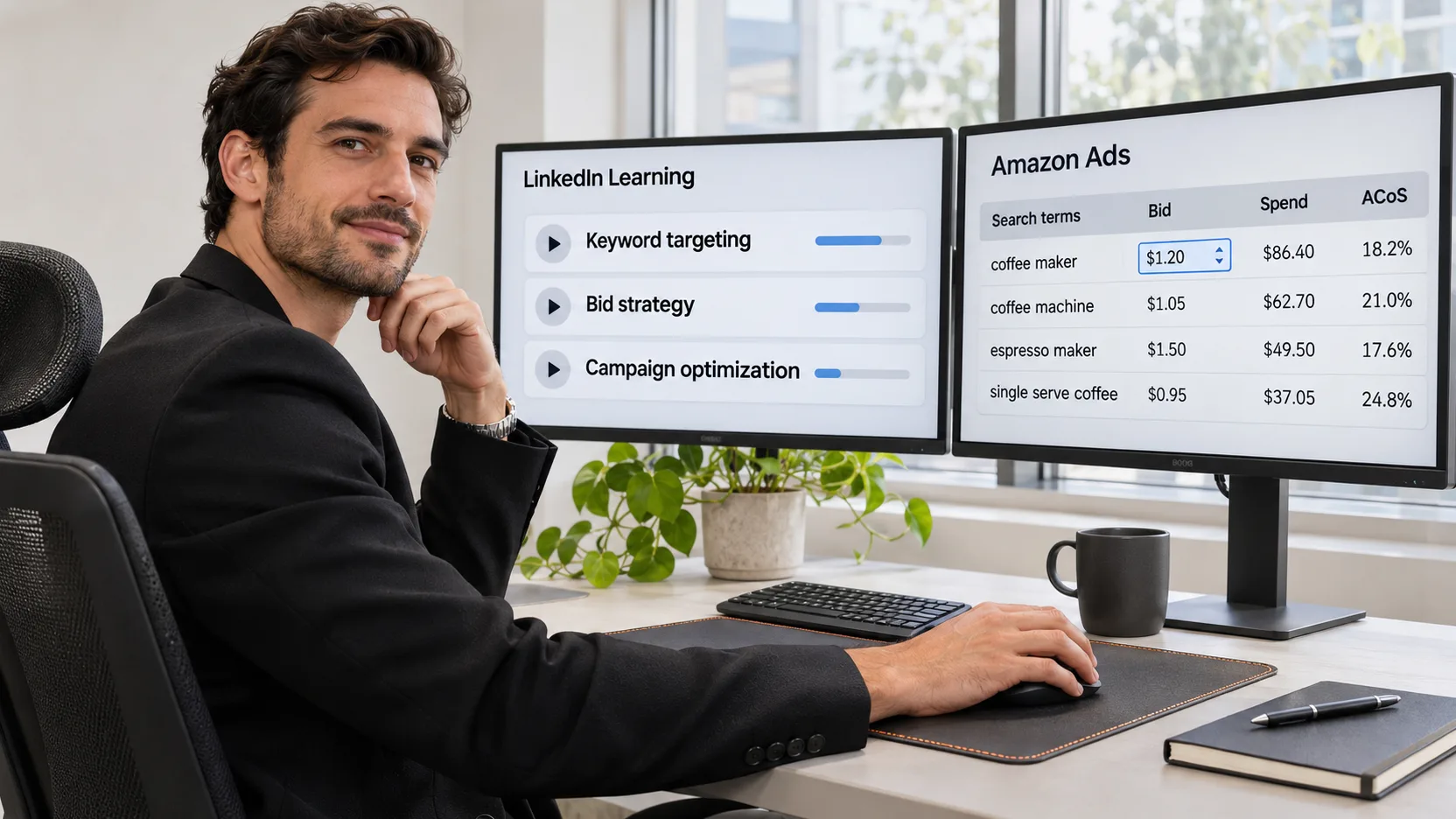
A product with a 25% contribution margin before ads has a break even advertising cost of sales of 25% under the same cost and sales assumptions. That number can change how you judge an ad campaign that looks successful in a course exercise. LinkedIn Learning Paths for Amazon PPC Mastery can build your strategy and measurement skills, while Amazon Ads training and a controlled campaign teach you to apply those skills to your catalog.
Start with LinkedIn Learning courses on marketing strategy and analytics, then use Amazon Ads Academy to learn Sponsored Products. Put both into practice with one retail-ready product, a capped budget, and a weekly search term review. Calculate your break even advertising cost of sales before increasing spend so you know how much room you have to pursue growth.
Start with courses on marketing strategy and analytics that teach you to define an audience, set an objective, and measure a result. Look for an exercise that asks you to explain why a campaign may be underperforming. That skill transfers directly to the decisions you make when reviewing a seller account.

A broad digital marketing learning path can show where search fits alongside social media, content strategy, and SEO principles. Prioritize modules you can apply to a product you already sell. Use these LinkedIn courses for sellers to narrow your study plan.
Marketing Strategy for Sponsored Ads
Use marketing strategy coursework to give each campaign a clear job. You might capture searches for an established product, test interest in a new use case, or reach shoppers browsing a similar item. Each goal calls for different targets and a different way to judge the results.
Write a one-line brief before you open Campaign Manager. Name the shopper, the product benefit, and the result you want to measure. If you sell a premium kitchen scale, for example, you might test whether searches for espresso scales bring in orders at an acceptable cost.
Measurement Skills for Campaign Analysis
Choose analytics lessons that teach you to interpret rates and trace changes back to their inputs. Click-through rate is clicks divided by impressions, and cost per click is spend divided by clicks. An attributed order rate uses orders divided by clicks, so use compatible dates and report fields.
Build a spreadsheet that keeps clicks, orders, spend, and sales beside your calculated rates. A rate based on a handful of clicks can swing sharply after a single order. The raw totals help you judge how much weight to put on a change.
Amazon PPC Skills Beyond General Marketing
Learn campaign structure, targeting, bidding, and reporting in Amazon Ads so you can apply your broader marketing skills to live campaigns. Each control changes where your ads can appear, what data you collect, or how quickly you spend. Practice connecting each change to the report you will use to evaluate it.

Check stock, pricing, and the product detail page before your first test. A listing with unclear images or a weak offer can attract relevant clicks and still struggle to convert. Document those conditions before launch so you can spot changes that might affect your results.
Sponsored Products Structure for Your Catalog
Structure Sponsored Products campaigns around products that share an objective and can sensibly share a budget. The campaign holds the budget, while ad groups organize advertised products and their targeting. Separate products when their margins or inventory constraints call for independent spending decisions.
Use names that tell you which product and targeting method the campaign covers. For a test with one ASIN, include the marketplace, a product shorthand, and the test objective. That makes exports easier to scan and lets another team member pick up the review.
Keyword and Product Targeting
Use manual keyword targeting to bid on relevant search themes and product targeting to select specific products or categories. Automatic targeting can help uncover opportunities by matching ads to relevant searches and products. Review the resulting data before moving a promising target into a more controlled test.
Start with terms that accurately describe the item, its size, and its intended use. If a search suggests a feature you lack, consider a negative keyword where the campaign supports it. Check the proposed exclusion against valuable searches before applying it.
Bid and Budget Decisions
Set bids using the value you expect from a click and choose a campaign budget that keeps the test within your spending tolerance. A bid influences auction participation, while the budget governs campaign spending. Review both if a campaign spends quickly without yielding enough relevant traffic.
Start by estimating what a sale can contribute and how many clicks it ordinarily takes to generate one. Use those assumptions to evaluate your Amazon PPC cost estimates. Record bid and budget edits separately so you can interpret the response.
Your Amazon PPC Learning Roadmap for 2026
Follow a three-stage roadmap in 2026. Build a foundation on LinkedIn Learning, learn campaign controls through Amazon Ads Academy, and apply both to one product. Give each stage an output you can review with the person responsible for account performance. product detail page.

Finish the coursework with a campaign brief and a spreadsheet you can reuse. In the platform training, check where to create targets and where to pull the reports you need. After launch, keep a record of what you changed and what evidence supported it.
- Write one product objective and one success metric.
- Plan your targets and agree on a spend limit.
- Review search terms and log one decision at a time.
A Practice Campaign for One Product
Choose one in-stock ASIN with known margins and a detail page that has already generated sales. Pick a narrow theme that aligns with how buyers use the product. If your team manages several marketplaces, start in the one where you understand fees, pricing, and shopper language best.
Write down your hypothesis, planned test duration, and spending limit before you launch. Keep a stable baseline by logging price changes and promotions during the test. Review the Amazon PPC budget mistakes most relevant to the design before you commit spend.
A Weekly Search Term Review
Review the search term report weekly to see which shopper queries or product matches generated clicks and orders. Group entries by relevance, then compare their spend and sales. Give recent clicks time to accrue attributed orders before making decisions from incomplete data.
Pick actions you can defend from the report. Test a relevant query in its own target when it has earned enough traffic, or exclude a clearly irrelevant query when the targeting settings allow it. Record the date and the reason beside each change.
Amazon PPC Skills to Validate Before Scaling
Before you scale, show that you can explain how the campaign affects contribution and why the product can absorb more demand. Check the margin calculation, conversion evidence, and stock coverage together. A campaign that meets its efficiency goal still needs enough inventory to support a higher sales pace.
Review each ASIN in the currency and cost context of its marketplace. Give the person approving spend a short summary of the proposed increase, the reason, and the condition that would trigger a reset. Include the date when you will review the decision.
Break Even Advertising Cost of Sales
Break even ACoS is the percentage of attributed revenue you can spend on advertising before the sale's contribution reaches zero. A $40 sale with $30 in costs before advertising leaves $10 for ads, or 25% of revenue. If you want $4 left after ads, the target becomes 15% on those assumptions.
Use consistent revenue definitions and include relevant variable costs such as product cost, Amazon fees, and fulfillment. Factor in discounts and expected returns where they affect the margin you can keep. Stress-test the target with your Amazon PPC budget calculator inputs.
Conversion Data for Budget Decisions
Increase budget when a campaign consistently reaches its spend limit and has enough attributed orders to judge against your margin target. Compare similar periods and look for changes in price, stock, and promotions. A single order can make a low-volume campaign look unusually efficient.
Set a review point after any increase and watch order volume, cost per order, and remaining stock. Check total sales alongside attributed ad sales for a fuller view of the account. When a campaign regularly underspends its current budget, investigate targeting, bids, and product eligibility before raising the cap.
Frequently Asked Questions
Choose training according to the decision you need to make next. A broad course can help you interpret performance across channels. Platform training is the better starting point when you need to understand a campaign setting.
Check the syllabus for a practical assignment before committing your time. A good assignment produces something your team can use, such as a campaign brief or a documented bid decision. Set aside time to review that work with the person who manages your catalog.
Is there an Amazon PPC training course available?
Yes. Amazon Ads Academy offers training on Amazon advertising, including Sponsored Products. Start with sponsored ads fundamentals if you are new to the platform.
If you already run campaigns, choose a lesson on the workflow that slows you down. Work through one example using a product from your catalog. Save your notes so you can repeat the process independently.
Are there any free courses for PPC advertising?
Yes. Amazon Ads Academy offers free training for Amazon advertising. Google Skillshop also offers free learning for Google Ads.
Pick the platform that matches where you plan to run ads. Amazon's materials are the closer fit for Sponsored Products. If you're comparing search advertising across platforms, Google Skillshop can broaden your understanding of paid search.
What is the best digital marketing course on LinkedIn?
For a broad overview, start with LinkedIn Learning's Master Digital Marketing learning path. It suits sellers who want to understand how paid search fits alongside other channels. Check the course descriptions for analytics exercises.
If you already have a marketing background, choose individual strategy or measurement courses. Match the exercise to a decision your team faces. For example, practice explaining why higher traffic produced fewer orders.
Where is the best place to get hands-on Amazon PPC practice?
Amazon Ads Campaign Manager is the best place to practice if you have authorized access to an active seller account. You can learn from actual traffic and attributed orders. Agree on a spending limit with the account owner first.
If you lack account access, ask your team for an anonymized report export. Rehearse your analysis in a spreadsheet. Note what extra information you would need before recommending a live change.
Conclusion
LinkedIn Learning Paths for Amazon PPC Mastery give you a foundation for making better decisions in your own ad account. Pair LinkedIn's strategy and analytics coursework with Amazon Ads training, then use your product's contribution margin to set a spending target. This week, choose one in-stock ASIN, calculate its break even ACoS, and schedule your first search term review before you launch.
If you're growing an established Amazon brand, start with a listing review to see where the product page may be losing buyers your ads bring in. You'll get a closer look at the listing and where to focus your optimization efforts. Request your Free Audit.