
Table of Contents 8 sections
Are you pouring money into Amazon ads without a clear strategy, unsure if your ad spend is generating real profit? For ambitious brands aiming to scale from 7 to 8 figures, a haphazard PPC budget is a critical roadblock. Calculating your ad spend correctly is the foundation of profitable growth, separating the brands that scale from those that stagnate.
An Amazon PPC budget calculator is a framework or tool used to determine the optimal advertising spend for your campaigns based on your revenue goals, profit margins, and target advertising cost of sale (ACoS). Instead of guessing, you can use a data-driven approach to allocate funds effectively, ensuring every dollar spent contributes to your bottom line and supports sustainable growth on the platform.
Understanding the Fundamentals of an Amazon PPC Budget
Your Amazon PPC budget is more than just a number you set and forget. It is a dynamic financial plan that dictates how much you are willing to invest in promoting your products through Amazon's advertising network, which includes Sponsored Products, Sponsored Brands, and Sponsored Display ads. This budget directly influences your campaigns' visibility, reach, and ultimately, your sales velocity and market share.
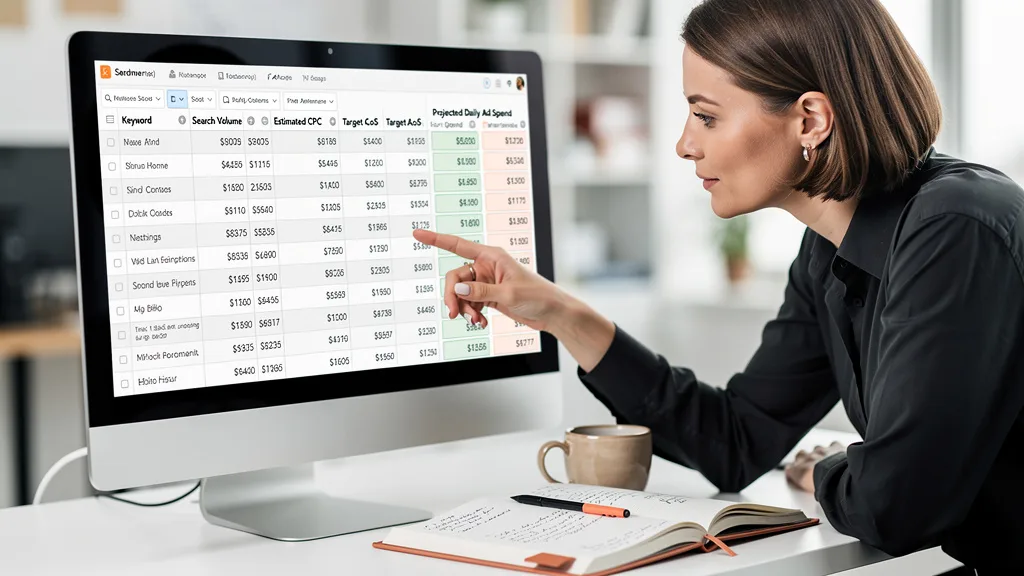
A well-structured budget acts as a control mechanism, preventing overspending while ensuring your campaigns have enough fuel to achieve their objectives. It requires a deep understanding of your business's financial health, particularly your product profit margins. Without a clear budget, you risk running campaigns that are unprofitable, eroding your margins and hindering your brand's ability to scale effectively. A strategic approach to budgeting is a core component of successful Amazon PPC management.
Key Factors That Influence Your PPC Ad Spend
Setting an effective Amazon PPC budget is not a one-size-fits-all process. Several critical factors unique to your products and business goals will determine the right level of investment. Ignoring these variables can lead to wasted ad spend or missed growth opportunities. A comprehensive budget considers everything from your product's maturity to the competitive landscape.
Your Product's Lifecycle Stage
The stage your product is in—launch, growth, maturity, or decline—heavily impacts your budget strategy. During a product launch, a more aggressive budget is often necessary to generate initial sales, gather data, and build visibility. You might accept a higher ACoS (Advertising Cost of Sale) to gain traction. Conversely, for a mature product with established organic rank and sales history, the PPC budget might be focused on profitability and defending market position, requiring a lower, more controlled spend.
Profit Margins and Target ACoS
Your product's profit margin is the most crucial factor in determining a sustainable ad budget. Before you spend a single dollar on ads, you must know your break-even ACoS. This is the point at which your ad spend equals your profit margin on a sale. Your target ACoS should be set below this break-even point to ensure profitability. For example, if your pre-ad profit margin is 30%, your break-even ACoS is 30%. A profitable target ACoS would be 25% or lower, leaving you with at least a 5% net profit on ad-generated sales.
Overall Campaign Goals and Objectives
Your advertising goals will shape your budget allocation. Are you aiming for brand awareness, rapid sales growth, or maximizing profitability? A goal of aggressive growth will demand a higher budget and potentially a higher ACoS tolerance. If your primary objective is to maximize profit from every sale, you'll implement a tighter budget with a lower target ACoS. Defining clear objectives, such as achieving a certain number of sales per day or maintaining a specific Total Advertising Cost of Sale (TACoS), provides a clear direction for your budgeting decisions.
Marketplace Competition and Seasonality
The level of competition in your niche directly affects advertising costs. Highly competitive categories often have higher average Cost-Per-Click (CPC), requiring a larger budget to achieve meaningful impression share. You must also account for seasonality. During peak seasons like Q4 or Prime Day, CPCs can skyrocket as competition intensifies. A flexible budget that can be increased during these high-traffic periods is essential to capitalize on increased buyer demand and avoid being outbid by competitors.

How to Calculate Your Amazon PPC Budget Step-by-Step
Calculating your Amazon PPC budget can be broken down into a methodical, data-driven process. Following these steps will help you move from guesswork to a strategic financial plan that aligns with your business objectives. This ensures your ad spend is both intentional and effective.
Step 1: Define Your Advertising Goals
First, clarify what you want to achieve. Your goals will dictate your entire strategy. Are you launching a new product and need to generate initial traction (Launch/Growth)? Are you trying to maximize profit on a best-seller (Profitability)? Or are you trying to liquidate old inventory (Liquidation)? Each goal requires a different approach to budgeting and ACoS targets. Be specific and set measurable key performance indicators (KPIs) for each goal.
Step 2: Determine Your Target ACoS and TACoS
As discussed, your break-even ACoS is your starting point. Calculate it by dividing your product's profit per unit by its selling price. Then, set a Target ACoS that ensures profitability. For example, if your product sells for $50 with a $15 pre-ad profit, your break-even ACoS is 30% ($15 / $50). A profitable Target ACoS might be 20-25%. Also, consider your Target TACoS (Total Advertising Cost of Sale), which measures ad spend against total sales (both organic and ad-driven). A healthy TACoS indicates that your ad spend is positively influencing your overall sales growth, not just cannibalizing organic sales.
Step 3: Research Keywords and Estimate CPC
Use tools like Amazon's own keyword research tool, Helium 10, or Jungle Scout to identify relevant keywords for your product. These tools provide estimated CPC ranges for your target keywords. This research is vital for forecasting your potential spend. Prioritize keywords based on relevance, search volume, and estimated CPC. A mix of high-volume, competitive keywords and long-tail, less expensive keywords often provides a balanced approach to traffic and cost.
Step 4: Calculate Your Daily and Monthly Budget
With your target ACoS and estimated CPC, you can now calculate a starting budget. A simple formula to estimate the required clicks to get one sale is `1 / Conversion Rate`. For example, if your conversion rate is 10%, you need 10 clicks for one sale. If your average CPC is $1.50, the cost per acquisition is $15 (10 clicks * $1.50). To hit a target ACoS of 25% on a $60 product, your ad spend per sale should be no more than $15. This confirms your CPC and conversion rate align with your goals. From here, you can set a daily budget. For example, aiming for 5 ad-driven sales per day would require a daily budget of $75 ($15 * 5), translating to a monthly budget of approximately $2,250.

While manual calculations are valuable for understanding the mechanics of your budget, using a dedicated tool can save significant time and improve accuracy. An Amazon PPC budget calculator automates the formulas, allowing you to quickly model different scenarios and find an optimal spend level. These tools are designed to process key business metrics and deliver a recommended budget.
"Many sellers treat their PPC budget as an expense. The top 1% treat it as an investment. A budget calculator helps you model the return on that investment before you spend a dime, shifting your focus from cost to profitability."
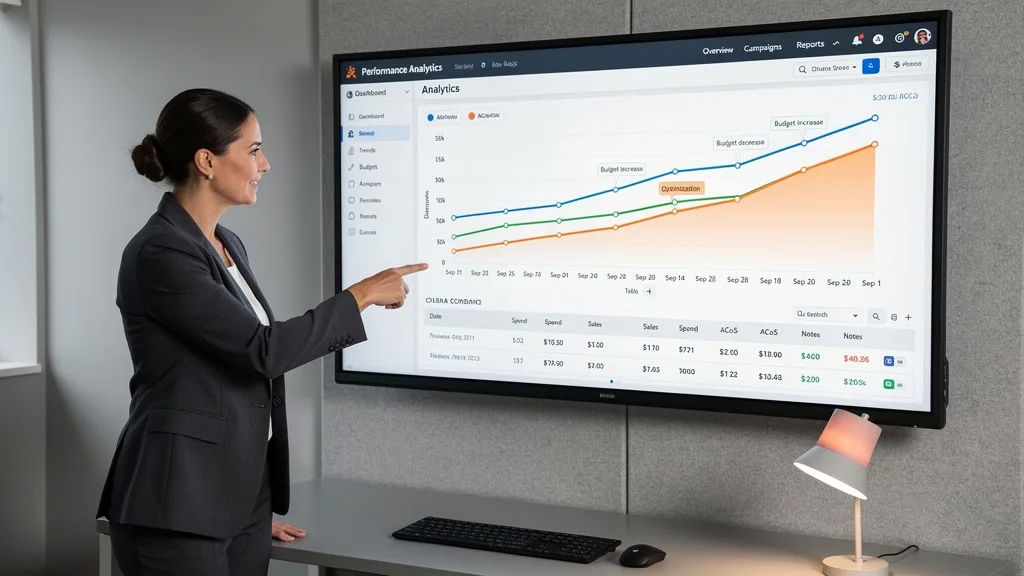
These calculators can range from simple spreadsheets to sophisticated software. For a straightforward and effective solution, you can use our purpose-built PPC budget calculator to streamline this entire process. It's designed to help you make data-driven decisions quickly.
Common Inputs for a Budget Calculator
Most budget calculators require a few key pieces of data to provide an accurate recommendation. Being prepared with this information will make the process seamless. You will typically need to input the following:
- Average Product Sale Price: The price customers pay for your product.
- Cost of Goods Sold (COGS): This includes manufacturing costs, shipping to Amazon, and other direct costs.
- Amazon Fees: Referral fees, FBA fees, and any other associated platform costs.
- Target ACoS: The advertising cost of sale you are aiming for to remain profitable.
- Estimated Conversion Rate: The percentage of clicks that result in a sale, typically between 5% and 15% for well-optimized listings.
- Estimated Average Cost-Per-Click (CPC): The average amount you expect to pay for each click on your ad.
How to Interpret the Calculator's Output
The output from a budget calculator will typically provide a recommended daily and monthly budget. It may also show you projected ad sales, profit per sale, and your break-even ACoS. It is crucial to view this output not as a rigid rule but as a strategic starting point. Use the recommendation to set your initial campaign budgets, but be prepared to adjust based on actual performance data. If your real-world ACoS is higher than your target, you may need to optimize your campaigns or adjust your budget downward. If you are hitting your targets easily, you might consider increasing your budget to scale your results.
Effective Amazon PPC Budgeting Strategies for 2026
Once you have calculated a starting budget, you need a strategy for managing and allocating it. In 2026, successful Amazon sellers use a variety of methods tailored to their specific goals. The right strategy will help you stay agile and respond to market changes, ensuring your ad spend remains efficient and effective over the long term.
The Percentage of Revenue Method
This common strategy involves allocating a fixed percentage of your total revenue to advertising. For example, you might decide to dedicate 10% of your total monthly sales to your PPC budget. This method is straightforward and ensures that your ad spend scales up or down in line with your overall business performance. It is a safe and sustainable approach, particularly for established brands with predictable revenue streams. The key is to choose a percentage that aligns with your profit margins and growth ambitions.
The Goal-Oriented Bidding Method
This approach ties your budget directly to specific, measurable goals. Instead of a fixed percentage, you set a budget designed to achieve a particular outcome, such as generating 100 sales for a new product or achieving a top-of-search placement for a primary keyword. This method is highly flexible and performance-driven. It requires you to work backward from your goal, calculating the clicks and impressions needed and budgeting accordingly. It's an excellent strategy for product launches or aggressive market-share campaigns where achieving a specific objective is the top priority.
The Competitor-Based Spend Method
In this strategy, you base your budget on the estimated ad spend of your main competitors. Using competitive intelligence tools, you can analyze which keywords competitors are bidding on and estimate their impression share. Your goal might be to match or exceed their visibility on critical keywords. This is an aggressive strategy aimed at capturing market share but can be costly. It's best used for short periods in highly competitive niches where brand visibility is paramount to success.
| Strategy | Best For | Pros | Cons |
|---|---|---|---|
| Percentage of Revenue | Stable, established businesses | Simple, scalable, predictable | Can be too restrictive during growth phases |
| Goal-Oriented Bidding | Product launches, specific promotions | Highly flexible, performance-focused | Requires careful calculation and monitoring |
| Competitor-Based Spend | Highly competitive markets | Can quickly increase market share | High risk of unprofitability, can be expensive |
Monitoring and Optimizing Your Ad Spend Over Time
Setting your initial budget is only the beginning. Continuous monitoring and optimization are what truly drive profitable results. The Amazon marketplace is constantly changing, with new competitors, shifting customer behavior, and fluctuating ad costs. A static budget will quickly become ineffective. Proactive management is essential for long-term success.
Regularly Reviewing Campaign Performance Metrics
You should conduct regular reviews of your key PPC metrics. This includes monitoring your ACoS, TACoS, click-through rate (CTR), conversion rate (CVR), and cost-per-click (CPC). Set a schedule, whether daily, weekly, or bi-weekly, to dive into your advertising reports. This consistent analysis will help you identify what's working and what isn't, allowing you to reallocate budget from underperforming campaigns or keywords to those that are driving profitable sales. A thorough Amazon PPC audit can reveal hidden opportunities for optimization.
When to Increase or Decrease Your Budget
Knowing when to adjust your budget is a critical skill. You should consider increasing your budget when a campaign is performing well below your target ACoS and you want to scale up sales. It's also wise to increase budgets during peak traffic events like Prime Day or the holiday season to capture more demand. Conversely, you should decrease or pause your budget for campaigns that are consistently exceeding your target ACoS despite optimization efforts. Avoiding common PPC budget mistakes, like letting unprofitable campaigns run unchecked, is key to protecting your margins.
Key Takeaways
Effectively managing your Amazon PPC budget is a cornerstone of scaling your brand profitably. Instead of relying on guesswork, a structured, data-driven approach will yield far better results. Here are the most important points to remember:
- Base Your Budget on Profitability: Always start by calculating your break-even ACoS based on your product's profit margins. Your budget must be built on a foundation of profitability.
- Align Budget with Goals: Your advertising objectives—whether for growth, profit, or brand awareness—should directly inform your budget allocation and strategy.
- Use a Step-by-Step Calculation: Follow a clear process to determine your budget, factoring in goals, target ACoS, keyword CPCs, and conversion rates.
- Leverage Calculator Tools: Use an Amazon PPC budget calculator to automate complex calculations, save time, and model different spending scenarios before you commit funds.
- Monitor and Optimize Continuously: A budget is not a static number. Regularly review campaign performance and be prepared to increase or decrease spend based on real-world data to maximize your return on investment.
Frequently Asked Questions
What is a good starting budget for Amazon PPC?
There is no single magic number, but a common recommendation for new sellers or new campaigns is to start with a budget of at least $30-$50 per day. This amount is generally sufficient to gather enough click and conversion data within a few weeks to begin making informed optimization decisions. For established brands launching a key product, this starting figure could be significantly higher.
Ultimately, your ideal starting budget depends on your product's price, your category's competitiveness, and your initial goals. The key is to allocate enough to run your campaigns consistently without running out of budget early in the day, which would limit your data collection and scaling potential.
How much do Amazon ads typically cost in 2026?
In 2026, the average cost-per-click (CPC) on Amazon can range from as low as $0.50 to over $5.00, depending heavily on the product category and keyword competition. Niches like supplements, electronics, and cosmetics tend to have higher CPCs due to intense competition. Your total cost will be a function of these CPCs and the volume of clicks you aim to generate.
Instead of focusing on average costs, it's more productive to focus on what cost is sustainable for your business. Understanding the true cost of Amazon PPC involves looking at your ACoS and ensuring your ad spend leads to profitable growth, regardless of the CPCs in your market.
What is ACoS and how does it affect my budget?
ACoS stands for Advertising Cost of Sale, a key metric calculated by dividing your total ad spend by your total ad sales and expressing it as a percentage (Ad Spend / Ad Sales = ACoS). It measures the efficiency of your advertising campaigns. For example, if you spent $20 on ads and generated $100 in sales from those ads, your ACoS would be 20%.
ACoS directly affects your budget because it determines the profitability of your ad spend. You must set a target ACoS that is lower than your product's pre-ad profit margin. This target dictates how much you can afford to spend to acquire a sale, which in turn helps you set a realistic and sustainable overall budget.
Should I set a daily or a monthly PPC budget?
On Amazon, you primarily set a daily budget at the campaign level. Amazon's system uses this daily budget to pace your ad spend throughout the day. While you set it daily, you should always plan your budget from a monthly perspective. Calculate your total desired monthly spend and then divide it by 30.4 (the average number of days in a month) to arrive at your total daily budget allocation across all campaigns.
This approach gives you high-level control over your monthly investment while allowing you to use Amazon's daily budgeting tools to manage campaign delivery. Amazon may sometimes spend slightly more than your daily budget on high-traffic days but will never exceed your monthly limit (daily budget x 30.4).
Can I run a successful Amazon PPC campaign with a small budget?
Yes, it is possible to run a successful campaign with a small budget, but it requires a highly focused strategy. With limited funds, you should concentrate on very specific, long-tail keywords that have lower competition and cost but high purchase intent. You might also focus on just one or two of your best-selling products rather than advertising your entire catalog.
The key to success with a small budget is patience and meticulous optimization. Your goal is to achieve profitability and then strategically reinvest those profits back into your ad budget to scale your campaigns over time. It's a slower path to growth but can be very effective if managed carefully.
Conclusion
Mastering your Amazon PPC budget is not about finding a magic number, it's about implementing a data-driven system that aligns with your brand's financial health and growth objectives. By understanding the key factors that influence ad spend, following a step-by-step calculation process, and continuously optimizing based on performance, you can transform your PPC campaigns from an unpredictable expense into a powerful engine for profitable scaling. This strategic approach ensures every dollar you invest works to expand your market share and drive your brand toward that 8-figure goal.
Ready to ensure your PPC budget is optimized for maximum profitability and scale? A professional audit can uncover hidden opportunities and eliminate wasted ad spend. We invite serious Amazon brand owners to get a comprehensive, data-backed analysis of their advertising strategy. Claim your Free Audit today and get a clear roadmap for profitable growth.