
Are you leaving money on the table by choosing the wrong products to sell or failing to adapt to your competition? For Amazon sellers aiming to scale from seven to eight figures, effective product comparison is not just a research task; it is the foundation of a profit-first growth strategy. Understanding how your offerings stack up against competitors directly impacts your pricing, marketing, and overall market positioning.
Effectively comparing products on Amazon: a seller's guide involves a systematic analysis of key performance metrics, customer sentiment, and listing quality. This process allows you to identify market gaps, validate product ideas, and uncover competitor weaknesses you can exploit. By using a mix of manual research and specialized software, you can gather the data needed to make informed decisions that drive sales velocity and protect your profit margins in 2026.
Why Product Comparison Is Essential for Amazon Sellers
Product comparison is the cornerstone of a successful Amazon business because it minimizes risk and maximizes opportunity. In a marketplace with millions of items and fierce competition, launching a product without a deep understanding of the existing landscape is a recipe for failure. By meticulously analyzing what top sellers are doing, you can gauge a niche's viability, estimate potential revenue, and avoid overly saturated markets where profit margins are razor-thin.
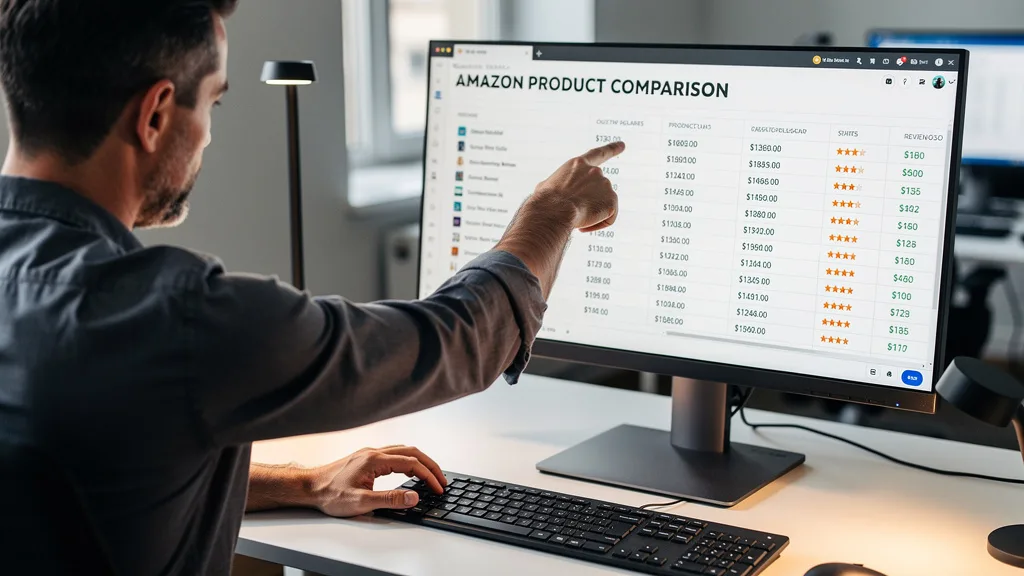
Furthermore, ongoing competitor analysis informs every aspect of your Amazon strategy. It reveals the keywords your rivals are ranking for, guiding your Amazon SEO and PPC campaigns. It highlights pricing strategies that resonate with customers, helping you position your product for optimal sales. This continuous intelligence gathering ensures your business remains agile, allowing you to adapt to market shifts, capitalize on new trends, and consistently outmaneuver your competition. The insights gained from this process are invaluable for anyone serious about building a sustainable, profitable brand.
To conduct a thorough and effective product comparison, you must focus on a specific set of data points. These metrics provide a holistic view of a product's performance and market position, allowing you to make data-driven decisions rather than relying on intuition. Tracking these indicators consistently is what separates amateur sellers from professional brands that achieve scalable growth.
Analyzing Sales Velocity and Best Sellers Rank (BSR)
A product's Best Sellers Rank, or BSR, is a powerful indicator of its current sales velocity within a specific category. A lower BSR number signifies higher sales. For example, a product with a BSR of #100 is selling significantly more units than one with a BSR of #10,000 in the same category. When comparing products, look at both the main category BSR and the sub-category BSR to get a more accurate picture of demand.

However, BSR is a snapshot in time and can fluctuate hourly. To get a true sense of sales velocity, you should track the BSR of competing products over several weeks. This reveals sales consistency and helps you identify seasonal trends. Tools and Chrome extensions can automate this tracking, providing historical data charts that make it easy to estimate monthly sales volume and revenue for any given product.
Evaluating Customer Reviews, Ratings, and Feedback
Customer reviews are a goldmine of competitive intelligence. Beyond the overall star rating, you should dive deep into the written feedback for top-selling products. Analyze the most common positive comments to understand a product's key strengths and selling points. More importantly, scrutinize the negative reviews to identify recurring complaints, product flaws, or unmet customer needs.
This qualitative analysis can directly inform your product development or sourcing strategy. If customers consistently complain that a competitor's product breaks easily or lacks a certain feature, you have found a clear opportunity. Sourcing or developing a product that solves these specific pain points gives you a powerful marketing angle and a distinct competitive advantage from day one.
Assessing Price Points and Potential Profit Margins
Price is a critical factor in a customer's purchasing decision, but it's only one part of the profitability equation. When comparing products, note the price range of the top competitors. Identify the average price point and any significant outliers. This helps you understand customer price sensitivity in the niche and where your product might fit in.
Next, you must calculate your potential profit margin at various price points. This involves accounting for your landed cost (manufacturing, shipping, and duties), Amazon's referral fees, and fulfillment costs (FBA fees). Using a profitability calculator, which can be found among various free Amazon seller tools, is essential for accurately projecting your net profit per unit. A product that sells for a high price but has slim margins may be less attractive than a lower-priced item with a healthier profit.
"In 2026, scaling on Amazon isn't about finding a 'hot' product. It's about finding a profitable position within a competitive market. A thorough product comparison is your roadmap to that position, revealing opportunities in pricing, features, and marketing that others have missed."
Scrutinizing Listing Quality, Keywords, and Imagery
A product's success is heavily dependent on the quality of its listing. When comparing competitors, evaluate their product titles, bullet points, and descriptions. Are they using relevant, high-volume keywords? Is the copy persuasive and benefit-driven? Use tools to check which keywords they are ranking for organically and through PPC.
Imagery and A+ Content are equally important. High-quality product photos, infographics, and lifestyle images can dramatically increase conversion rates. Analyze the quality and type of images your competitors are using. Identifying weaknesses, such as blurry photos, a lack of infographics, or poor-quality A+ Content, presents an immediate opportunity for you to create a superior, more compelling listing. Understanding the difference between Amazon listing optimization and SEO is key to dominating your niche.
Investigating Fulfillment Methods: FBA vs. FBM
The fulfillment method a competitor uses, Fulfillment by Amazon (FBA) or Fulfillment by Merchant (FBM), impacts their logistics, costs, and eligibility for Prime. Most top sellers use FBA because the Prime badge builds customer trust and typically leads to higher sales velocity. When analyzing competitors, check if they are using FBA or FBM.
If a top competitor is using FBM, it could signal an opportunity. By offering your product via FBA, you can gain an immediate advantage with Prime eligibility and faster shipping times. Conversely, if all competitors are using FBA, you will need to ensure your pricing and operations can compete within that model. Understanding their fulfillment choice helps you anticipate their cost structure and customer service levels. Amazon (@amazon) · Seattle, WA.
| Metric | What to Look For | Why It Matters |
|---|---|---|
| Best Sellers Rank (BSR) | Low, stable number; historical trends | Indicates current and consistent sales demand |
| Customer Reviews | Sentiment analysis; recurring complaints/praises | Reveals product weaknesses and market gaps |
| Price Point | Market average; price range of top sellers | Determines market positioning and revenue potential |
| Profit Margin | Calculation after all fees (FBA, referral) | Ensures business viability and scalability |
| Listing Quality | Keyword usage, image quality, A+ Content | Identifies opportunities to create a higher-converting listing |
Manual Methods for Comparing Products on Amazon
Before investing in paid tools, you can gather a wealth of information using manual research methods directly on Amazon's platform. These foundational techniques help you develop a keen eye for what makes a product successful and provide a solid baseline for your analysis. While more time-consuming, manual comparison builds an intuitive understanding of a market that software alone cannot provide. avoid overly saturated markets.
Using Amazon's Native Search and Filtering Tools
Amazon's own search bar is your starting point. Begin by typing in your main product keyword and see what products appear on the first page. These are your primary competitors. Use the filters on the left-hand sidebar to narrow down the results. You can filter by average customer review (e.g., 4 stars & up), brand, price, and other product-specific attributes.

This filtering process helps you segment the market and understand what features are standard at different price points. For example, filtering for the highest-priced items can reveal premium features that customers are willing to pay for. Analyzing the top results for your most important keywords gives you a clear picture of the current market leaders.
Analyzing the 'Customers Also Bought' Section
On any given product detail page, scrolling down reveals several valuable sections, including 'Products related to this item' and 'Customers who bought this item also bought'. These carousels are driven by Amazon's algorithm and provide direct insight into customer behavior. They show you which products are considered direct alternatives by shoppers.
This section is invaluable for expanding your list of competitors beyond the initial search results. It can also uncover opportunities for product bundling or reveal complementary products in adjacent niches. Paying close attention to these recommendations helps you understand the product ecosystem from the customer's perspective.
Creating a Competitor Analysis Spreadsheet
The most effective manual method is to consolidate your findings into a competitor analysis spreadsheet. Create a simple sheet with columns for essential data points: Product Name, Brand, Price, BSR, Review Count, Average Rating, URL, and a 'Notes' column for qualitative observations. Populate this sheet for the top 10-20 competitors in your niche.
This organized approach allows you to compare products at a glance and identify patterns. You can easily sort by price, review count, or BSR to see who is leading in each area. In your notes, document observations about listing quality, negative review themes, and unique selling propositions. This spreadsheet becomes your strategic blueprint for entering or competing in the market.
Top Tools and Apps for Amazon Product Comparison in 2026
While manual research is foundational, leveraging specialized software is essential for scaling your analysis and gaining a competitive edge in 2026. These tools automate data collection, provide historical insights, and offer predictive analytics that are impossible to replicate manually. They save you hundreds of hours and provide a much deeper layer of intelligence.

The most common tools come in the form of Chrome extensions that overlay data directly onto Amazon's search and product pages, or more comprehensive web applications with robust databases and analytics dashboards. These platforms can track BSR history, estimate monthly sales and revenue, analyze keyword performance, and evaluate listing quality scores. Investing in a reputable tool is a non-negotiable for serious sellers aiming for significant growth. You can explore a curated list of the best Amazon niche research tools to find one that fits your needs. Many sellers also get insights from following major brands like Amazon (@amazon) · Seattle, WA on social media to see how they position products.
A Step-by-Step Guide to Comparing Amazon Products
A structured process ensures your product comparison is efficient, thorough, and actionable. Following a step-by-step guide prevents you from getting lost in the data and helps you move from raw information to a concrete business strategy. This systematic approach is key to making profitable decisions.
Step 1: Define Your Product Niche and Category
Before you can compare products, you must clearly define your area of focus. Start with a broad category, like 'kitchen gadgets' or 'pet supplies,' and then narrow it down to a specific niche, such as 'silicone baking mats' or 'interactive dog toys.' A well-defined niche prevents your analysis from becoming too broad and unmanageable. Your goal is to understand a specific competitive arena, not the entire Amazon marketplace.
Step 2: Shortlist Top Competitors for Analysis
Once your niche is defined, identify the top 5-10 competitors. These are typically the products that consistently appear on the first page of search results for your main keywords. They have the highest sales velocity (lowest BSR) and often a significant number of reviews. These are the market leaders whose strategies you need to deconstruct.
Step 3: Collect and Compare Data Across Key Metrics
Using your manual spreadsheet or a software tool, begin collecting data for each shortlisted competitor. Populate the key metrics discussed earlier: BSR, price, review count and quality, listing quality, and fulfillment method. Place the data side-by-side to make direct comparisons simple. Look for the averages, the outliers, and any clear patterns that emerge from the data.
Step 4: Synthesize Findings to Inform Your Strategy
This is the most critical step. Data without interpretation is useless. Synthesize your findings to answer key strategic questions. Where is the gap in the market? Can you compete on price, or should you focus on adding value? What are the common customer complaints you can solve? The answers will form the basis of your product sourcing, branding, and marketing strategy, including your approach to Amazon PPC management.
Key Takeaways
Effectively comparing products is a critical skill for any Amazon seller looking to build a profitable and scalable business. By moving beyond simple price checks and adopting a data-driven approach, you can uncover hidden opportunities and mitigate risks. Here are the essential takeaways from this guide:
- Focus on Key Metrics: Your analysis should center on BSR for sales velocity, customer reviews for market gaps, price points for positioning, and listing quality for conversion opportunities.
- Use a Mix of Methods: Combine manual research on Amazon with specialized software tools. Manual methods build intuition, while tools provide speed, scale, and historical data.
- Follow a Structured Process: A four-step process (Define Niche, Shortlist Competitors, Collect Data, Synthesize Findings) turns raw data into an actionable strategy.
- Analysis Informs Action: The ultimate goal of comparison is not just to gather data but to inform critical business decisions, from product development and sourcing to pricing and PPC campaigns.
- It's an Ongoing Process: The Amazon marketplace is dynamic. Regular competitor analysis, at least quarterly, is necessary to stay ahead of market trends and maintain your competitive edge.
Frequently Asked Questions
Are there specific websites or apps for comparing Amazon products?
Yes, there is a robust ecosystem of software tools designed specifically for Amazon sellers to compare products. These tools generally fall into two categories: browser extensions and web-based applications. Browser extensions, like those from Jungle Scout or Helium 10, overlay data such as BSR, estimated sales, and historical pricing directly onto the Amazon website as you browse, making on-the-fly analysis quick and easy.
Web-based applications offer more powerful, in-depth features. They contain vast product databases that you can search and filter based on criteria like category, price, review count, and monthly revenue. These platforms are essential for discovering new product opportunities and conducting deep-dive competitive analysis away from the clutter of Amazon's own site.
What is considered a good Best Sellers Rank (BSR) on Amazon?
A "good" BSR is entirely relative and depends on the size of the product category. In a massive category like 'Books' or 'Electronics,' a BSR of 10,000 might represent hundreds of sales per month. However, in a small, niche sub-category like 'Calligraphy Pens,' a BSR of 500 could mean just a handful of sales per day. There is no universal number that defines a good BSR.
Instead of focusing on a specific number, it is more effective to look at the BSR of the top 10 products in the specific sub-category you are targeting. This gives you a realistic benchmark for the sales volume required to be a top competitor in that niche. The goal is to find a product with a BSR that indicates sufficient demand to meet your revenue goals but isn't so competitive that market entry is prohibitively difficult.
How can I compare products if I'm a new seller with no sales data?
As a new seller, you compare products by focusing entirely on market and competitor data, not your own. Your goal is to learn from the successes and failures of established sellers. Start by identifying the top-performing products in your chosen niche and use the methods in this guide to deconstruct why they are successful. Analyze their BSR history to estimate their sales, read their reviews to find customer pain points, and dissect their listing to understand their marketing angles.
Product research tools are particularly valuable for new sellers, as they provide the sales estimates and historical data you lack. This external data allows you to validate a product idea and forecast potential revenue before you invest a single dollar in inventory. Your initial comparison is about assessing the opportunity, not measuring your own performance.
Should I focus more on price or customer reviews when comparing?
Both price and customer reviews are critical, and the right balance depends on your brand strategy. If you aim to be a low-cost leader, then analyzing competitor pricing to find a way to be the most affordable option is paramount. However, this is often a difficult strategy to sustain due to price wars and thin margins.
For most brands aiming for long-term, profitable growth, customer reviews hold more strategic weight. A deep analysis of reviews can reveal opportunities to create a superior product by improving features, quality, or packaging. A product that effectively solves customer complaints can often command a higher price point, leading to healthier profit margins and a more defensible market position. A value-driven strategy is generally more scalable than a price-driven one.
How often should I conduct competitor product comparisons?
Product comparison should be an ongoing business process, not a one-time task. For a newly launched product, you should monitor your main competitors weekly to track any changes in their pricing, BSR, or marketing strategies. This allows you to react quickly during the critical launch and ranking phase.
For established products in your portfolio, a comprehensive competitor review should be conducted at least once per quarter. The Amazon marketplace evolves rapidly with new sellers, changing trends, and algorithm updates. A quarterly check-in ensures you are aware of emerging threats and new opportunities, allowing you to proactively adjust your strategy rather than being caught off guard. Some of the best talent to help with this can be found via portals like Amazon Careers, showing the level of expertise in the field.
Conclusion
Mastering the art of comparing products on Amazon is a seller's guide to sustainable growth and profitability in 2026. By systematically analyzing key metrics like BSR, customer reviews, and listing quality, you move from guesswork to a data-driven strategy. This process empowers you to identify lucrative market gaps, build superior products, and create high-converting listings that outshine the competition. Making this analysis a core, recurring part of your business operations is fundamental to scaling from seven to eight figures.
Ready to turn these analytical insights into real-world profit? My team and I specialize in this data-driven approach, helping serious 7-figure Amazon brands scale to 8 figures and beyond. We can perform a deep-dive analysis of your products and competitors to uncover your single biggest growth opportunity. Get a comprehensive evaluation of your current listings and market position with a Free Audit.
If you want help turning this into a concrete plan for your site or team, take the next step below to apply Comparing Products on Amazon: A Seller's Guide with confidence.
Ready to act on Comparing Products on Amazon: A Seller's Guide? Free Audit — tell us your goal, and we will help you pick the highest-leverage next step so you are not guessing alone.