
Are you prepared to navigate the complex and ever-changing landscape of selling supplements on Amazon? The dietary supplements category is one of the most lucrative yet challenging markets on the platform. To succeed, you must master the stringent requirements Amazon enforces to protect its customers and maintain marketplace integrity.
The core Amazon FBA supplement and vitamin eligibility rules for 2026 demand strict adherence to documentation, product safety, and labeling accuracy. You must provide a Certificate of Analysis (CoA) and proof of Good Manufacturing Practices (GMP) for each product. Furthermore, you must be prepared for random third-party testing and ensure your product labels and detail pages are free of prohibited medical claims to gain and maintain approval.
Core Requirements for Selling Supplements on Amazon in 2026
Before you can even think about listing a dietary supplement, you must meet Amazon's foundational requirements for sellers. These rules are designed to ensure that only reputable and responsible brands are permitted to sell in this sensitive category. Amazon's primary goal is customer safety, and its vetting process reflects this priority.
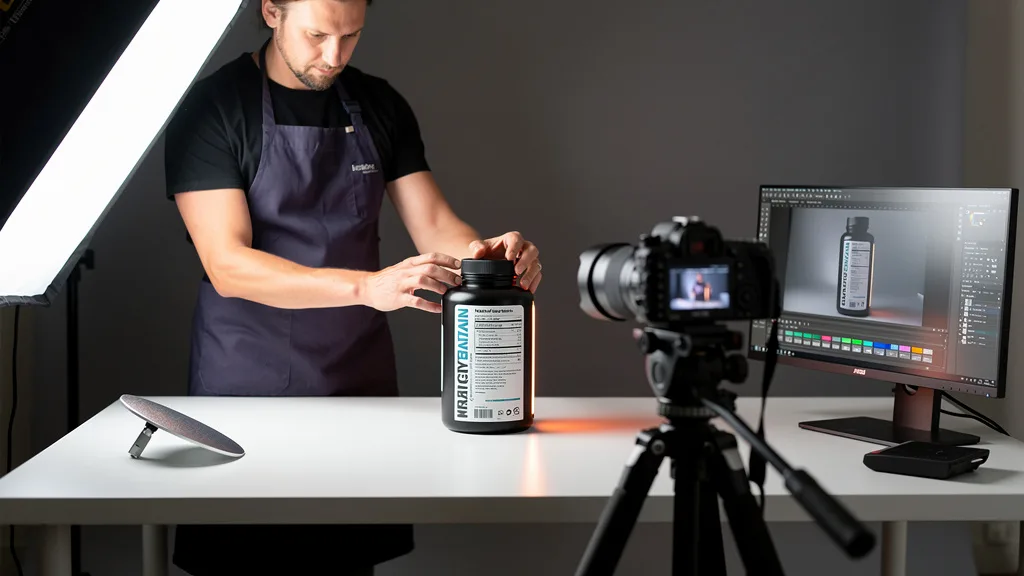
Successfully entering this market requires a proactive approach to compliance. You cannot simply list a product and hope for the best. You must have all your documentation in order from day one and maintain pristine account health to be considered a trustworthy partner in Amazon's eyes. As an Amazon consultant, I've seen many brands fail by underestimating these initial hurdles.
Seller Account Health and Performance Metrics
Your seller account must be in excellent standing. Amazon will scrutinize your performance metrics, including an Order Defect Rate (ODR) below 1%, a Pre-fulfillment Cancel Rate below 2.5%, and a Late Shipment Rate below 4%. Any significant issues with your account health will likely result in an immediate rejection of your application to sell supplements.
Think of your account health as your business's credit score. A strong history of positive customer feedback, timely shipping, and quick responses to customer inquiries demonstrates your reliability. For high-risk categories like supplements, Amazon is unwilling to take chances on sellers with a poor track record, as the potential for customer harm is too great.
Product-Level Gating and Category Approval
The Dietary Supplements category is gated, meaning you need explicit permission from Amazon before you can sell. The application process involves submitting a request through Seller Central and providing all the required documentation, which we will cover in detail. This gating process acts as a critical checkpoint to filter out non-compliant products.
Be prepared for a thorough review. Amazon's team will examine your documents, your manufacturer's credentials, and your product's formulation. Approval is not guaranteed and can take several weeks. Any missing information or inconsistencies will lead to delays or denial, making it essential to have everything perfectly organized before you apply.
Adherence to Good Manufacturing Practices (GMP)
Amazon requires that all dietary supplements be manufactured in a facility that adheres to the FDA's Current Good Manufacturing Practices (GMP) as outlined in 21 CFR 111. GMP ensures that your products are produced and controlled according to strict quality standards, covering everything from raw material sourcing to facility cleanliness and record-keeping.
You will be required to submit proof that your manufacturer is GMP-certified. This is not a suggestion but a mandatory requirement. This documentation validates that your products are consistently safe, pure, and contain what they claim to contain. Without verified GMP certification, your application to sell supplements on Amazon will not proceed.
Mandatory Documentation and Certification for Dietary Supplements
Once you've confirmed your account health is strong and your manufacturer is GMP-compliant, the next step is to gather the specific documents Amazon demands for every supplement ASIN. This paperwork is the backbone of your compliance strategy, proving the safety and quality of your products to Amazon.
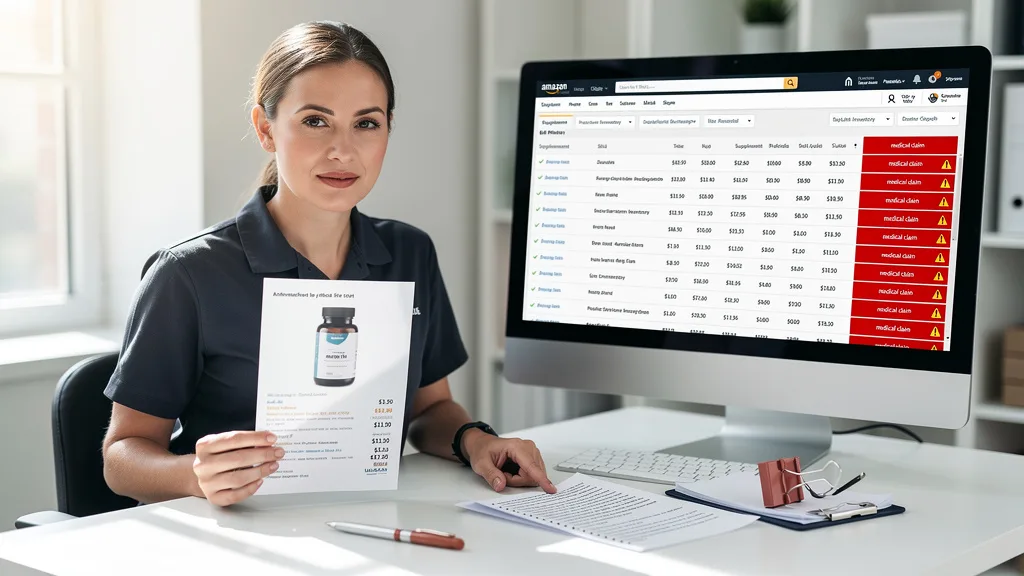
Each document serves a specific purpose in verifying your product's integrity. Failure to provide any of these items, or submitting documents that are incomplete or expired, is one of the most common reasons for rejection. Accuracy and attention to detail are paramount during this stage of the process.
Providing a Certificate of Analysis (CoA)
You must provide a Certificate of Analysis (CoA) for each dietary supplement you intend to sell. This document, issued by an ISO/IEC 17025 accredited laboratory, confirms that the product meets its label claims for the dietary ingredients listed. The CoA must be dated within the last twelve months and show the lab's name and accreditation details.
The CoA acts as a scientific guarantee of your product's contents. It must verify the identity and quantity of active ingredients and often includes testing for contaminants like heavy metals, microbes, and pesticides. This document demonstrates that you have performed due diligence on your product's quality and purity before listing it for sale.
Submitting Proof of GMP Registration or Certification
Alongside the CoA, you must submit proof of your manufacturer's GMP registration. Amazon accepts certification from a select few third-party programs, such as NSF/ANSI 173, UL, or USP. A simple letter from your manufacturer stating they are GMP-compliant is not sufficient; you need the official certificate from one of these recognized bodies.
This certification is Amazon's assurance that your supply chain is credible and adheres to the highest industry standards for safety and quality control. It's a critical piece of the puzzle that connects your product back to a vetted, reliable manufacturing source. Ensure the certificate is current and the manufacturer's name and address match your other documentation perfectly.
Ensuring Product Images Meet All Compliance Standards
Your product images must be crystal clear and fully compliant. This includes providing images of the entire product label, including the Supplement Facts panel, ingredients list, and manufacturer's contact information. The information on the physical label shown in the images must exactly match the information on your product detail page.
Amazon's bots and human reviewers will compare your images to your listing data. Any discrepancies, such as a different ingredient list or a missing warning, can trigger a listing suspension. Furthermore, your main image must be on a pure white background and cannot include any extra text, badges, or graphics that are not part of the physical product packaging.
Understanding Amazon's Third Party Testing Requirements
Beyond the initial documentation, Amazon has implemented a program of ongoing verification through third party testing. This program is designed to ensure that supplements sold on the platform continue to meet safety and purity standards long after they are first listed. All sellers in this category must be prepared for these random checks.

This requirement underscores Amazon's commitment to consumer safety and places the onus on sellers to maintain quality control throughout the product's lifecycle. Understanding how this process works, from triggers to submission, is essential for long-term success and avoiding unexpected and costly listing removals.
What Triggers a Third Party Testing Requirement
Amazon's third party testing program is often initiated through random selection. An ASIN can be flagged for testing at any time, without any specific trigger related to performance or customer complaints. This proactive surveillance means that every supplement seller must be prepared to have their products verified at a moment's notice.
In some cases, testing may be triggered by a specific event, such as a spike in negative customer reviews mentioning side effects, a safety complaint, or changes in Amazon's internal risk assessment algorithms. Regardless of the trigger, the process is the same: you will receive a notification in your 'Manage Your Compliance' dashboard and will be required to submit your product for testing.
Selecting an Amazon-Approved TIC Organization
When your product is selected for testing, you cannot use just any laboratory. You must work with a Testing, Inspection, and Certification (TIC) organization from Amazon's approved list. These labs have been vetted by Amazon to ensure they meet the necessary standards for accuracy and reliability.
Amazon provides a directory of approved TIC labs within Seller Central. You are responsible for contacting the lab, arranging for product samples to be sent, and covering the cost of the testing. It's wise to familiarize yourself with these providers and their pricing before you are required to use them, so you can act quickly when a request comes through.
"In 2026, proactive compliance is the only way to scale a supplement brand on Amazon. Waiting for Amazon to flag your product for third party testing is a reactive strategy that puts your entire business at risk. The smartest sellers build ongoing testing into their operational budget and quality control processes from the start."
How to Submit Your Test Results for Verification
Once the approved lab completes its analysis, you will receive a detailed test report. You must then upload this report directly to the 'Manage Your Compliance' dashboard in Seller Central, corresponding to the specific compliance case that Amazon opened for your ASIN. The lab does not submit the results for you.
The submission process is straightforward, but the details are critical. Ensure you are uploading the correct, complete document to the correct case file. After submission, Amazon's product safety team will review the report. If the results confirm your product meets all standards and matches the label claims, the compliance case will be closed and your listing will remain active.
| Compliance Area | Key Requirement | Common Pitfall |
|---|---|---|
| Documentation | Valid GMP Certificate and ISO 17025 CoA | Submitting expired or incomplete documents |
| Labeling | Accurate Supplement Facts panel, no medical claims | Using words like 'cure', 'prevent', or 'treat' |
| Detail Page | Content must match the physical label exactly | Adding unapproved claims to A+ Content or bullets |
| Testing | Pass random third-party testing from an approved lab | Failing to respond to a testing request in time |
Product Labeling and Detail Page Compliance Rules
Your product's physical label and its digital counterpart, the Amazon product detail page, are subject to intense scrutiny. The information presented must be 100% accurate, transparent, and compliant with both FDA regulations and Amazon's specific policies. This is one of the most common areas where supplement sellers make costly mistakes.
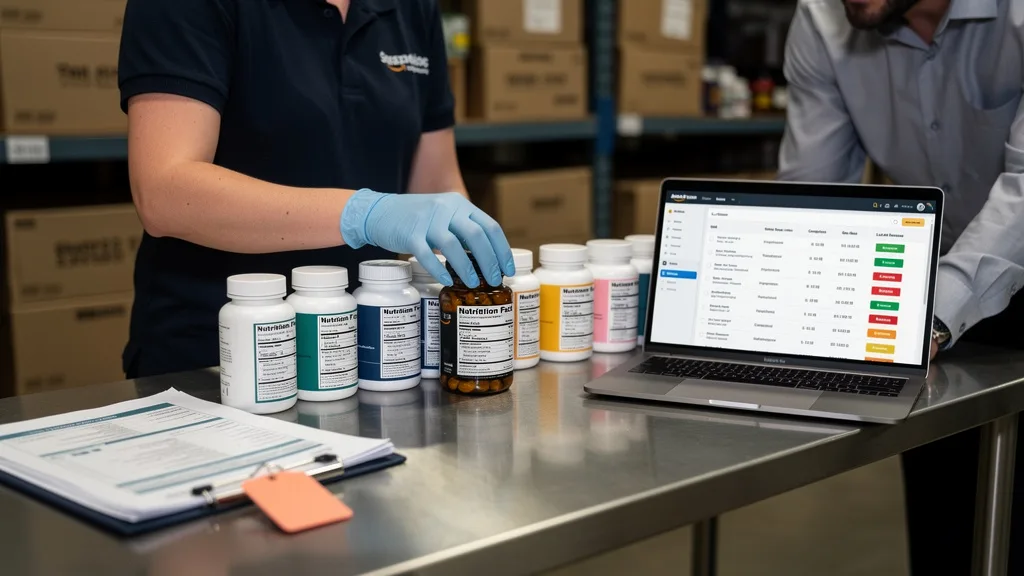
Every word and image you use to market your product must be carefully considered. Misleading information or prohibited claims can lead to immediate listing removal, loss of selling privileges, and even legal action. A deep understanding of these rules is fundamental to building a sustainable supplement business.
Required Information for Supplement Labels
Every supplement label must contain several key pieces of information. This includes the product's statement of identity (e.g., 'Vitamin C Supplement'), the net quantity of contents, a complete Supplement Facts panel, a full list of all other ingredients, and the name and address of the manufacturer, packer, or distributor.
The Supplement Facts panel must be formatted correctly and accurately declare the serving size, servings per container, and the names and quantities of each dietary ingredient. Any deviation from the required format or content can result in your product being deemed misbranded and subsequently removed from the marketplace.
Avoiding Prohibited Medical Claims and Keywords
This is a critical rule that many sellers violate, often unintentionally. You are strictly prohibited from making any claim that your supplement can treat, cure, prevent, mitigate, or diagnose a disease. This includes both explicit claims (e.g., 'lowers cholesterol') and implied claims (e.g., using images of a heart monitor).
Instead, you are limited to making permissible 'structure/function' claims, which describe the role of a nutrient in supporting the body's normal functions (e.g., 'Calcium helps build strong bones'). Mastering the language of compliance is a key part of effective Amazon SEO for supplements, as using forbidden keywords can get your listing suppressed or removed entirely.
Keeping Your Product Detail Page Fully Compliant
The rules against medical claims extend to every part of your product detail page. This includes the title, bullet points, product description, and all A+ Content. Amazon's systems constantly scan these text fields for prohibited keywords. You must ensure that all marketing copy is compliant and factually supported.
Furthermore, all information on the detail page must be consistent with the product label. For example, you cannot list an ingredient in your bullet points that is not present on the Supplement Facts panel. A compliant and well-optimized listing is key; a thorough Amazon listing optimization process should always include a full compliance check.
Navigating the 'Manage Your Compliance' Dashboard
The 'Manage Your Compliance' dashboard in Seller Central is your central command for all things related to product safety and regulations. This tool is where Amazon will communicate with you about documentation requests, testing requirements, and any compliance-related issues with your listings. Ignoring this dashboard is not an option.
Regularly monitoring this section of your account is a crucial business practice. It allows you to stay ahead of potential problems and respond quickly to any requests from Amazon, minimizing the risk of listing suspensions and protecting your revenue stream. It provides a transparent view of your compliance status across your entire catalog.
Monitoring the Compliance Status of Your Listings
The dashboard provides a list of your ASINs that have compliance requirements. It will show you what is required for each product, whether it's submitting initial documentation or responding to a testing request. The status for each item (e.g., 'Information Required' or 'Under Review') gives you a clear picture of where you stand.
By checking this dashboard daily, you can ensure that you never miss a deadline. Amazon provides a specific timeframe for you to submit the required information. Failure to respond within this window will result in the automatic removal of your listing, so proactive monitoring is essential for maintaining your active offers.
Steps to Appeal a Compliance-Related Listing Removal
If your listing is removed for a compliance issue, the 'Manage Your Compliance' dashboard is where you will manage the appeal. The first step is to thoroughly understand the reason for the removal, which will be detailed in the case file. Do not appeal until you have identified the root cause of the problem. I've seen many brands fail.
Next, gather the correct and updated documentation to address the issue. For example, if your CoA was rejected, obtain a new one that meets all requirements. Finally, submit your appeal with the new documents and a brief, professional explanation of the corrective actions you have taken. A clear and concise appeal has a much higher chance of success.
Resolving Issues Through Seller Support
While the dashboard is the primary tool, you may sometimes need to contact Seller Support for clarification or to escalate an issue. When doing so, always be prepared. Reference the specific case ID from your compliance dashboard and clearly state your question or the problem you are facing.
Communicating effectively is key. Be polite, professional, and persistent. If the first representative is unable to help, you can politely request that the case be escalated to a specialist on the product safety and compliance team. Keep detailed records of all your communications, including case numbers and dates.
Recent Policy Updates for Amazon Supplements in 2026
The rules for selling supplements on Amazon are not static. Amazon frequently updates its policies to align with new regulations, scientific findings, and emerging safety concerns. Staying informed about these changes is crucial for any brand that wants to maintain its presence in the category for the long term. Amazon SEO.
As of 2026, we've seen a continued push towards greater transparency and stricter verification. Amazon is investing heavily in its compliance programs to build consumer trust, and sellers are expected to keep pace. Ignoring these updates can quickly render your products non-compliant, even if they were previously approved.
Key Changes to Safety and Purity Standards
In 2026, Amazon has tightened its standards for product purity. This includes lower acceptable limits for heavy metals like lead, arsenic, and mercury in certain product types. Sellers are now required to provide testing that specifically demonstrates compliance with these new, stricter thresholds.
This change means that sellers must work closely with their manufacturers and testing labs to ensure their CoAs and third-party test reports reflect these updated standards. Products that may have passed testing in previous years might now fail, requiring reformulation or sourcing of purer raw materials.
New Requirements for Specific Ingredients
Amazon continues to monitor and regulate specific dietary ingredients. In 2026, new documentation requirements have been introduced for popular ingredients like NMN (Nicotinamide Mononucleotide) and certain types of adaptogenic herbs. Sellers of products containing these ingredients may be asked for additional evidence of safety or identity.
It's vital to monitor Amazon's Prohibited Products list and policy pages for announcements regarding specific ingredients. An ingredient that is permissible one day can become restricted or prohibited the next, and Amazon expects you to adapt immediately. For more information, you can review the official Amazon Dietary Supplements Seller Requirements.
Impact of New Policies on Existing and New Listings
These new policies affect both new and existing listings. For new products, you must ensure they are developed and documented in accordance with the very latest 2026 rules from day one. For existing ASINs, you may be required to re-submit updated documentation or conduct new testing to prove ongoing compliance.
Successful brands are conducting proactive audits of their entire supplement catalog. They are reviewing their CoAs, confirming their labels are still compliant, and ensuring their manufacturers can meet the tightened purity standards. This proactive stance prevents sudden listing suspensions and protects valuable sales history and ranking.
Key Takeaways
Successfully navigating the Amazon FBA supplement and vitamin eligibility rules in 2026 requires a diligent and proactive approach. Here are the most critical points to remember:
- Documentation is King: Your application lives and dies by your ability to provide a valid Certificate of Analysis (CoA) from an ISO 17025 lab and proof of Good Manufacturing Practice (GMP) certification.
- Compliance is Continuous: Be prepared for random third-party testing at any time. Use only Amazon-approved labs and submit results promptly through the 'Manage Your Compliance' dashboard.
- Language Matters: Strictly avoid all prohibited medical claims on your product labels and detail pages. Focus on permissible structure/function claims to avoid immediate listing removal.
- Stay Informed: Amazon's policies are constantly evolving. Regularly monitor the Seller Central news, policy pages, and your compliance dashboard for updates that could impact your business.
- Proactive Audits are Essential: Don't wait for Amazon to flag an issue. Regularly audit your listings, labels, and supplier documentation to ensure they align with the latest 2026 requirements.
Frequently Asked Questions
Do you need a specific license to sell vitamins on Amazon?
While there isn't a single government 'license to sell vitamins on Amazon,' the platform's requirements function as a de facto licensing system. You must gain category approval from Amazon, which requires submitting extensive documentation like a Certificate of Analysis (CoA) and proof of Good Manufacturing Practices (GMP).
Essentially, your license is the approval granted by Amazon after you have proven your products are safe, properly manufactured, and correctly labeled. Without this approval, you are not permitted to list or sell dietary supplements on the platform.
How often does Amazon update its dietary supplement policies?
Amazon updates its dietary supplement policies frequently. You can expect at least one major policy update per year, with smaller adjustments and clarifications being rolled out continuously. These changes are often made with little advance notice to sellers.
Because of this constant evolution, it is critical to regularly monitor the Seller Central news, your email notifications from Amazon, and the official policy pages. Staying informed is a key part of maintaining compliance and protecting your business from unexpected policy-related disruptions.
Can I sell supplements on Amazon that are manufactured outside the US?
Yes, you can sell supplements on Amazon that are manufactured in other countries, such as through an Amazon FBA Pakistan setup. However, they must meet all the same requirements as US-manufactured products. This includes being manufactured in a facility that is GMP-certified to a standard recognized by Amazon.
The product must also comply with all US FDA labeling regulations, and you must be able to provide a valid CoA from an ISO 17025 accredited lab. The logistics may be more complex, but the compliance standards are identical regardless of the country of origin.
What happens if my supplement fails third party testing?
If your supplement fails Amazon's third-party testing, your listing for that product will be removed immediately. Depending on the severity of the failure, such as the presence of a dangerous unlisted substance, you could also face a full account suspension.
To resolve the issue, you must work with your manufacturer to identify and fix the root cause of the failure. Once corrected, you can commission a new test from an approved lab. If the new test passes, you can appeal the listing removal by submitting the new, compliant report to Amazon.
Is it safe for customers to order vitamins from Amazon?
For customers, ordering from compliant brands on Amazon is generally very safe. Amazon's strict eligibility rules, including the requirements for GMP certification, CoAs, and random third-party testing, are all designed to ensure the products sold are safe, authentic, and accurately labeled.
These rigorous checks help filter out bad actors and low-quality products. As a seller, adhering to these rules not only allows you to sell on the platform but also helps build the consumer trust that makes Amazon a viable marketplace for health products in the first place.
Conclusion
Mastering the Amazon FBA supplement and vitamin eligibility rules is a non-negotiable requirement for success in 2026. The path is paved with strict documentation, continuous testing, and zero tolerance for non-compliant claims. By embracing a strategy of proactive compliance, from securing your CoA and GMP certificates to constantly monitoring policy updates, you can build a resilient and profitable supplement brand on the world's largest marketplace.
Are your listings fully compliant and optimized for growth in this competitive category? Ensuring every detail is correct can be the difference between scaling to 8-figures and a sudden account suspension. A professional review can uncover hidden risks and opportunities. Get a comprehensive, no-obligation audit of your Amazon listings today.
If you want help turning this into a concrete plan for your site or team, take the next step below to apply Amazon FBA Supplement and Vitamin Eligibility Rules with confidence.
Ready to act on Amazon FBA Supplement and Vitamin Eligibility Rules? Free Audit — tell us your goal, and we will help you pick the highest-leverage next step so you are not guessing alone.