Table of Contents 8 sections
Are you ready to tap into the massive apparel market on Amazon, but feel uncertain about whether your products meet the platform's strict Fulfillment by Amazon (FBA) requirements? Navigating the specific rules for textiles can be complex, and a single misstep can lead to rejected shipments, stranded inventory, and lost revenue. Understanding the nuances of this category is the first step toward profitable growth.
To meet Amazon FBA eligibility for clothing and apparel, sellers must maintain excellent account health metrics, adhere to stringent product quality and condition guidelines, and ensure full brand and trademark compliance. Additionally, all apparel items must be prepped according to Amazon's specific packaging requirements for textiles, including proper poly bagging, labeling, and handling of accessories before being sent to a fulfillment center.
Understanding Amazon's Clothing and Apparel Category
The Clothing and Apparel category on Amazon is one of the most popular and competitive, offering immense sales potential for brands that can navigate its specific rules. Unlike other categories, apparel involves unique challenges such as sizing variations, high return rates, and specific packaging needs. Success requires a deep understanding of Amazon's policies, which are designed to ensure a consistent and positive customer experience.
Before listing your products, it's essential to familiarize yourself with the category's structure, including which subcategories may require special permission to sell in. Amazon continuously updates its policies, so staying informed about the latest requirements for 2026 is critical for maintaining compliance and keeping your listings active and competitive. This proactive approach helps prevent account issues and ensures your products are always eligible for FBA.
Gated vs. Ungated Subcategories in 2026
As of 2026, the general Clothing, Shoes, and Jewelry category is largely ungated for sellers with a professional selling plan and strong performance metrics. This means most sellers can list common apparel items without needing to go through a formal application process. Amazon has streamlined this to encourage more brands to join the platform, increasing selection for customers.
However, certain niche or high-end subcategories may still be gated. These often include luxury brands, specialized athletic wear, or collectible items. Gating these areas helps Amazon protect customers from counterfeits and ensure that sellers meet higher standards of quality and authenticity. If you plan to sell in one of these subcategories, you will need to apply for approval through Seller Central, which may involve providing invoices, brand authorization letters, or other documentation.
Key Policies for Selling Apparel on Amazon
Adhering to Amazon's key policies is non-negotiable for anyone selling apparel. The most critical area is intellectual property (IP) compliance. You must either own the brand you are selling or have explicit permission from the brand owner, which is best managed through Amazon's Brand Registry program. Selling counterfeit products or infringing on trademarks will lead to swift account suspension.
Product safety and quality are also paramount. All items must be new and unused, free from defects, stains, or damage. For children's apparel, you must comply with all applicable safety standards, such as the Consumer Product Safety Improvement Act (CPSIA). Furthermore, your product listings must be highly accurate, with truthful descriptions and images that precisely represent the item the customer will receive. Misleading information is a common cause of customer dissatisfaction and high return rates.
Core Amazon FBA Eligibility Requirements for Clothing
Meeting the core FBA eligibility requirements is the foundation for successfully selling clothing on Amazon. These requirements are not just initial hurdles but ongoing standards you must maintain. Amazon's algorithms constantly monitor seller performance, and failing to meet these benchmarks can result in your FBA privileges being restricted or revoked, especially in a sensitive category like apparel.
These core tenets revolve around three main pillars: your performance as a seller, the quality and condition of your products, and your legal right to sell them. Mastering these areas ensures your business operates smoothly within the Amazon ecosystem, builds customer trust, and positions your brand for long-term growth and profitability.
Seller Account Health and Performance Metrics
Your seller account health is a primary factor in determining your eligibility. Amazon tracks several key performance metrics, and you must keep them within acceptable targets. The most important of these is the Order Defect Rate (ODR), which must remain below 1%. ODR is a combination of A-to-z Guarantee claims, negative feedback, and credit card chargebacks.
"Maintaining impeccable account health isn't just a suggestion; it's the foundation of your eligibility to sell in competitive categories like apparel. Amazon trusts sellers who consistently deliver an excellent customer experience."
Other vital metrics include the Pre-fulfillment Cancel Rate (must be under 2.5%) and the Late Shipment Rate (must be under 4%). While using FBA eliminates concerns about late shipments, your overall account health is still a holistic measure. Consistently poor performance can disqualify you from selling in certain categories, including clothing and apparel.
Product Quality and Condition Guidelines
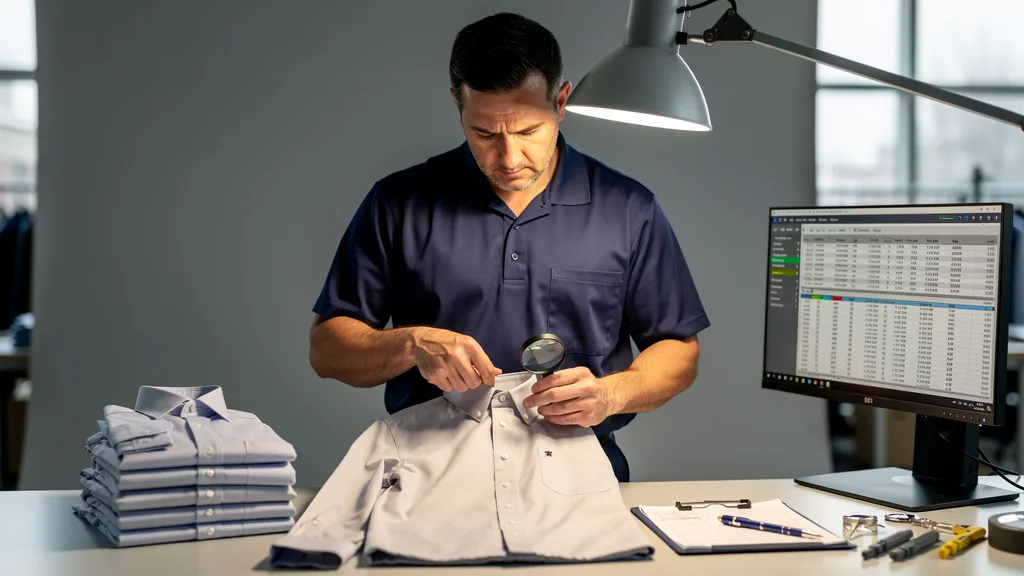
For the apparel category, all items listed as 'New' must be precisely that: brand new, in pristine condition, and in their original packaging. This means the clothing must be free of any signs of wear, defects, stains, odors, or damage. The product tags should be intact and unaltered.
Amazon has a zero-tolerance policy for listing used clothing as new. Any customer complaint suggesting an item is used or defective can trigger an investigation and potentially lead to the suspension of your listing. It's crucial to have a robust quality control process with your manufacturer to inspect items before they are ever shipped to an Amazon fulfillment center.
Brand and Trademark Compliance Rules
Brand and trademark compliance is a critical component of your eligibility. You cannot sell clothing under a brand name unless you are the brand owner or have received official authorization to do so. The best way to protect your brand and gain access to enhanced selling tools is through Amazon Brand Registry.
To enroll in Brand Registry, you need a registered trademark. This process helps prevent other sellers from hijacking your listings and selling counterfeit versions of your products. If you are reselling products from other brands, you must be prepared to provide letters of authorization or valid invoices from official distributors to prove authenticity if Amazon requests them.
How to Sell Apparel on Amazon: A Step-by-Step Guide
Breaking into the Amazon apparel market requires a methodical approach. Following a clear, step-by-step process ensures you meet all requirements from the outset, saving you time and preventing costly mistakes. This guide will walk you through the essential stages, from initial approval to creating listings that convert and preparing your products for FBA.
Each step is designed to build on the last, creating a solid foundation for your apparel business on the platform. By paying close attention to these details, you can navigate the complexities of the category and position your products for maximum visibility and sales.
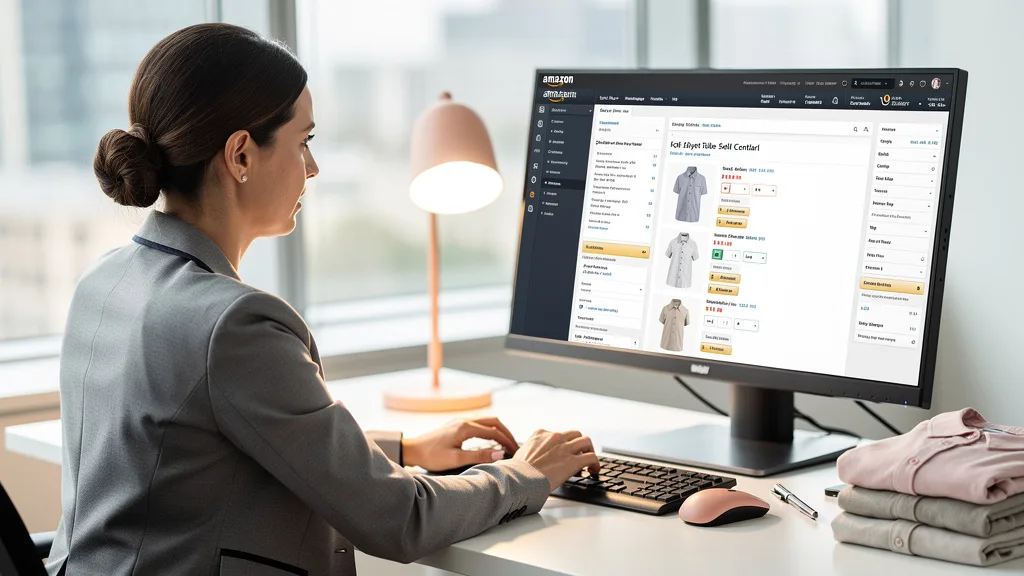
Step 1: Apply for Category Approval if Required
First, determine if the specific type of apparel you intend to sell falls into a gated subcategory. You can check this by attempting to create a new product listing in Seller Central for that item. If the category requires approval, the system will prompt you to begin an application.
The application process typically involves submitting documentation to prove your product's authenticity and your legitimacy as a seller. This may include purchase invoices from a manufacturer or distributor, a letter of authorization from the brand owner, or other business information. Ensure your documents are clear, legible, and contain all the required information before submitting them.
Step 2: Create Compliant Product Listings
A high-quality product listing is essential for success. This starts with compelling, high-resolution images that show the product from multiple angles, on a model, and with close-ups of fabric and details. Your listing title, bullet points, and description should be rich with relevant keywords while accurately describing the product's features, material, and fit.
Your product detail page must comply with all of Amazon's listing policies. This includes avoiding prohibited claims, using appropriate language, and ensuring all information is truthful. Investing in professional copywriting and photography can significantly impact your conversion rates and reduce returns. For advanced sellers, using the best Amazon listing optimization tools can provide a competitive edge in a crowded market.
Step 3: Follow Sizing and Variation Best Practices
Incorrect sizing is the number one reason for returns in the apparel category. To combat this, you must use Amazon's standardized sizing templates. When creating your listing, select the appropriate template for your product type (e.g., Men's Shirts) and provide accurate measurements for each size. Include a detailed sizing chart as one of your product images.
You must also use variations correctly. Create a single parent listing for a product and then add child variations for each available size and color. This groups all options onto one product detail page, improving the customer experience and consolidating your sales data and reviews. Do not create separate listings for each size or color of the same item.
Step 4: Prepare Products for FBA Shipment
Once your listings are live, you need to prepare your physical inventory for shipment to Amazon's fulfillment centers. This FBA prep process is highly specific for clothing and textiles. Each unit must be individually packaged and labeled according to strict guidelines to ensure it can be received, stored, and shipped correctly.
Failure to follow these prep requirements can result in Amazon rejecting your shipment, charging you for unplanned prep services, or even losing your inventory within the warehouse. The next section will cover these packaging and labeling rules in detail.
FBA Prep and Packaging Requirements for Textiles
Properly preparing your apparel for FBA is a non-negotiable step that directly impacts your Amazon FBA eligibility for clothing and apparel. Amazon's fulfillment centers are highly automated, and they rely on standardized packaging and labeling to process millions of items efficiently. Any deviation from these standards can cause delays, incur extra fees, and damage your inventory.
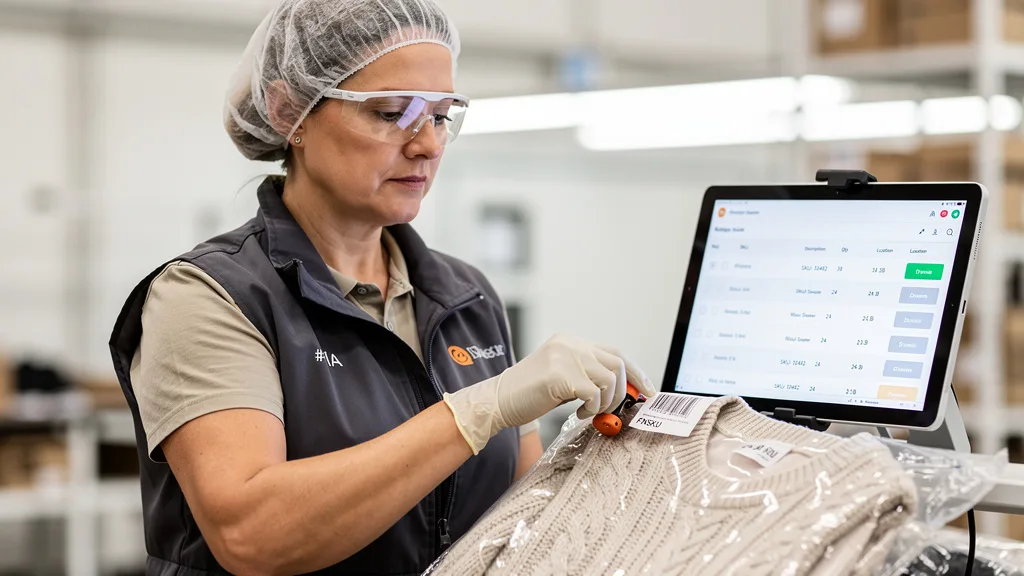
Think of FBA prep as the final quality check and the protective measure that ensures your product reaches the customer in the same condition you sent it. For textiles, which can easily get wrinkled, dirty, or damaged, this step is especially critical. Mastering these requirements is essential for a smooth and profitable FBA experience.
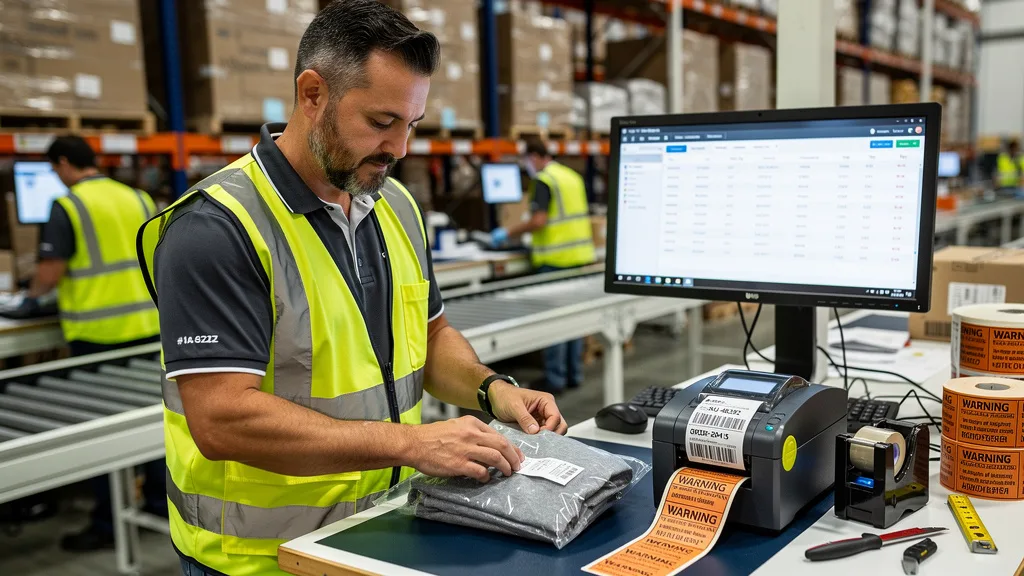
Poly Bagging and Suffocation Warning Labels
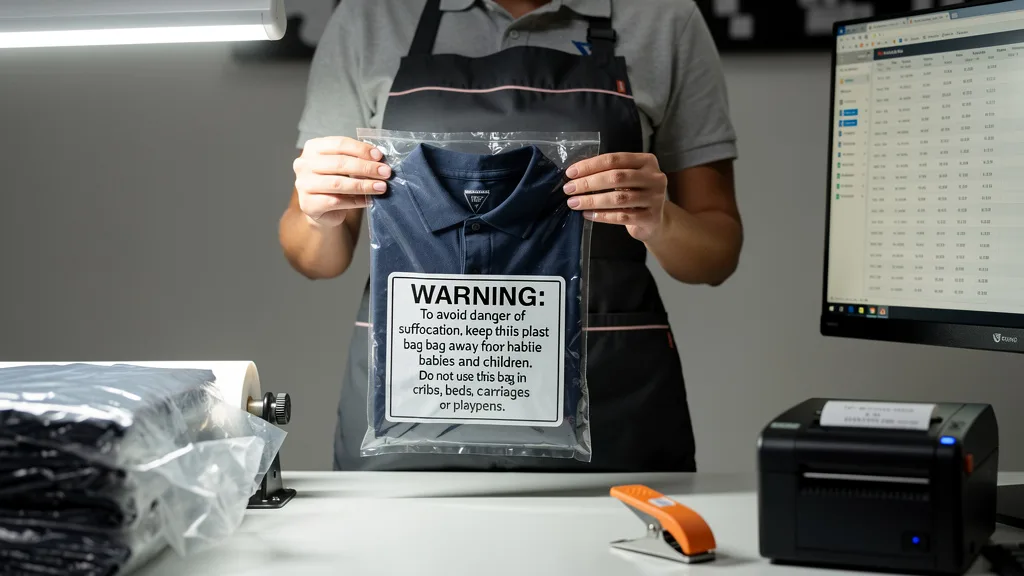
Each piece of clothing must be individually enclosed in a secure, transparent poly bag. The bag must be at least 1.5 mil thick to protect the garment from dust, moisture, and tearing during storage and handling. The bag must be completely sealed to prevent the item from falling out.
Crucially, if the poly bag has an opening of 5 inches or more when laid flat, it must have a suffocation warning label. This warning can be printed directly on the bag or applied as a sticker. The text must be legible and placed in a prominent location. This is a strict safety requirement, and failure to comply will result in your shipment being rejected.
Proper Labeling with FNSKU Barcodes
Every unit you send to FBA needs an Amazon-specific barcode, called the FNSKU (Fulfillment Network Stock Keeping Unit). This label is unique to your product and your seller account, and it's how Amazon tracks your inventory. You must print these FNSKU labels from your shipping plan in Seller Central.
The FNSKU label must be placed on the outside of the sealed poly bag, making it easy to scan without opening the package. It is critical that this label covers any other scannable barcodes on the product, such as a manufacturer's UPC. Having multiple barcodes visible can cause confusion at the fulfillment center and lead to receiving errors.
Handling Hangers, Tags, and Loose Items
In most cases, Amazon does not accept apparel on hangers. Hangers add bulk, can break easily, and are difficult to handle in the automated warehouse environment. Unless the hanger is an integral part of the product (e.g., a suit sold with a custom hanger), you must remove it before bagging the item.
All price tags, brand tags, and any other attached labels must be securely fastened to the garment. If an item comes with a loose accessory, like a belt, it must be included inside the same sealed poly bag as the garment to ensure they are not separated. This ensures the customer receives the complete product as described in the listing.
Common Pitfalls to Avoid When Selling Clothes via FBA
While the opportunity in the apparel category is significant, so are the potential pitfalls. Many sellers, especially those new to the category, make common mistakes that can quickly derail their efforts. Being aware of these challenges ahead of time allows you to create strategies to avoid them, protecting your profits, your seller metrics, and your brand's reputation.
From inaccurate listings to mismanaged returns, these issues can create a poor customer experience, leading to negative reviews and suppressed listings. Proactively addressing these common problems is key to long-term success and scaling your apparel brand on Amazon.
Inaccurate Sizing Charts and Fit Information
The single biggest pitfall in selling apparel online is managing customer expectations around sizing and fit. If your sizing chart is inaccurate or your product description fails to mention if an item runs large or small, you will experience a high volume of returns. This not only costs you money in return shipping and processing fees but also hurts your listing's ranking and can lead to negative reviews.
To avoid this, invest time in creating a highly detailed and accurate sizing chart. Measure your products meticulously and consider providing measurements for key areas like chest, waist, and length. Use customer feedback and return reason data to identify any sizing discrepancies and update your listings accordingly.
Poor Quality Product Photography and Listings
In eCommerce, your product photos are your storefront. For apparel, customers need to see high-quality images that showcase the garment's color, texture, and fit. Low-resolution photos, poor lighting, or images that don't accurately represent the product will lead to low conversion rates and customer disappointment.
Your entire listing must be optimized for both customers and Amazon's search algorithm. This includes writing clear, benefit-driven bullet points and a detailed product description. A poorly constructed listing will fail to attract shoppers and won't convert the traffic it does get. If you struggle with this, working with an Amazon consultant can help optimize your listings for maximum impact.
Mismanaging High Customer Return Rates
The apparel category naturally has a higher return rate than most others, often ranging from 20% to 40%. While you can't eliminate returns entirely, you must manage them effectively. A high return rate can trigger an Amazon investigation into your listing's quality or accuracy.
Regularly analyze your return reports in Seller Central to understand why customers are sending items back. Are they citing 'wrong size,' 'not as described,' or 'defective'? This data is invaluable for improving your product and listing. Additionally, be aware of programs like Apparel now eligible for FBA Grade and Resell, which can help you recover some value from returned items that are still in good condition.
Key Takeaways
Successfully navigating Amazon FBA eligibility for clothing and apparel in 2026 hinges on meticulous attention to detail across several key areas. To ensure your products are accepted and your business thrives, focus on these critical takeaways:
- Maintain Excellent Account Health: Your eligibility is directly tied to your performance metrics. Keep your Order Defect Rate below 1% and monitor all aspects of your account health dashboard vigilantly.
- Ensure 100% Compliance: Adhere strictly to Amazon's policies on brand authenticity, intellectual property, and product safety. Use Amazon Brand Registry to protect your brand.
- Create Accurate and Detailed Listings: Prevent returns by providing precise sizing charts, high-quality images, and honest descriptions. Correctly use variations for size and color.
- Master FBA Prep Requirements: Every apparel item must be individually poly-bagged with a suffocation warning (if applicable) and labeled with the correct FNSKU barcode covering any other barcodes.
- Monitor and Manage Returns: Analyze return data to identify and fix problems with your product or listing. A high return rate can jeopardize your listing's viability.
Frequently Asked Questions
Can I make $1000 a month selling clothing on Amazon?
Yes, making $1000 a month in profit selling clothing on Amazon is an achievable goal, but it requires careful planning and execution. Success depends on factors like product selection, sourcing costs, competition, and marketing effectiveness. You need to find a profitable niche with manageable competition, source high-quality products, and create optimized listings that convert.
Profitability also hinges on managing your costs, including Amazon's referral fees, FBA fees, and advertising spend. To reach this goal, you'll need to generate several thousand dollars in monthly revenue. Using a strategic approach to find low-competition Amazon niches can significantly increase your chances of reaching and exceeding this income level.
What is the Amazon dress code policy for sellers?
The term 'Amazon dress code policy for sellers' can be misleading. There is no personal dress code for individuals who sell on the platform. This phrase typically refers to the content and imagery allowed on product detail pages for apparel. Amazon has strict policies against any imagery that is obscene, provocative, or otherwise inappropriate.
Your product photos and listing content must be professional and accurately represent the item being sold. All models used in photography should be dressed appropriately for the product type. Essentially, the 'dress code' is about maintaining a professional and family-friendly marketplace, not about what you wear while managing your business.
How do I handle clothing returns with Amazon FBA?
When you use FBA, Amazon handles the entire customer return process on your behalf. When a customer initiates a return, Amazon provides them with a prepaid shipping label and processes the item when it arrives back at the fulfillment center. The funds are then debited from your seller account.
Your responsibility is to monitor your FBA return reports to understand why items are being returned. Amazon will assess the returned item's condition. If it's deemed sellable, it will be placed back into your inventory. If it's damaged or defective, it will be marked as 'Unfulfillable.' You must then decide whether to have Amazon dispose of the unfulfillable inventory or have it returned to you for inspection.
Are there specific fees for selling apparel through FBA?
Yes, there are specific fees associated with selling apparel. First, the referral fee for the Clothing & Accessories category is typically higher than many other categories, often around 17% of the total sales price. This is the commission Amazon takes for each sale made on its platform. You should always check the current Seller Central fee schedule for the most up-to-date rates.
In addition to the referral fee, you will pay FBA fees, which cover the costs of storing, picking, packing, and shipping your products. These fees are based on the size and weight of your packaged item. It's crucial to understand the complete Amazon FBA fee structure and factor it into your pricing to ensure profitability.
Can customers try on clothes purchased from Amazon?
Yes, customers can effectively 'try on' clothes purchased from Amazon. Under Amazon's standard return policy, customers can return most apparel items within 30 days for a full refund, for any reason. This allows them to order clothing, try it on at home, and return it if it doesn't fit or meet their expectations.
Furthermore, Amazon offers a specific program called Prime Try Before You Buy. This service allows eligible Prime members to order multiple clothing items without being charged upfront. They have a 7-day try-on period at home to decide what they want to keep. They are only charged for the items they decide to keep and can return the rest for free. This program further facilitates the at-home try-on experience for customers.
Conclusion
Meeting the 2026 Amazon FBA eligibility for clothing and apparel is a matter of precision and diligence. Success isn't just about having a great product; it's about flawlessly executing Amazon's operational requirements. By maintaining pristine account health, creating accurate listings, and mastering the specific FBA prep for textiles, you build a resilient business that can thrive in the competitive apparel marketplace. Your next step is to audit your current processes against these standards and identify any gaps before your next shipment.
If you are a 7-figure brand owner serious about scaling to 8 figures, ensuring every aspect of your FBA process is optimized is non-negotiable. An expert review can uncover hidden profit leaks and compliance risks in your listings and FBA prep. Take the first step towards securing your brand's growth and profitability on Amazon. Get your complimentary, no-obligation listing and account audit today. Free Audit.