Are you leaving money on the table by neglecting your customer service? For ambitious Amazon sellers scaling towards eight figures, delivering exceptional support isn't just a courtesy, it's a core pillar of profitable growth. Mastering this can be the difference between winning the Buy Box and fighting off account-damaging negative feedback.
To provide excellent Amazon seller customer service, you must respond to all inquiries within 24 hours, proactively solve problems to prevent negative feedback and A-to-z claims, and use approved communication channels. Leveraging helpdesk software and automation is key to maintaining high performance metrics, protecting your account health, and scaling your FBA business efficiently in 2026. This approach directly impacts your seller rating, product visibility, and ultimately, your bottom line.
Why Excellent Customer Service Is Crucial for Amazon Sellers
Excellent customer service on Amazon is a non-negotiable component of a successful FBA business. It directly influences your store's reputation, visibility, and sales velocity. In Amazon's customer-obsessed ecosystem, sellers who prioritize support are rewarded with better rankings and more sales, while those who neglect it face penalties that can cripple growth. For brands aiming to scale, treating service as a profit center is a critical mindset shift.

Amazon's algorithm closely monitors how you interact with buyers. Every message, every return request, and every piece of feedback is a data point that feeds into your overall performance score. Consistently positive interactions signal to Amazon that you are a reliable seller, worthy of greater exposure and trust within the marketplace. This trust is the foundation upon which sustainable, long-term growth is built.
Impact on Seller Ratings and the Buy Box
Your seller feedback rating is a direct reflection of the customer experience you provide. A high rating, ideally above 98%, significantly increases your chances of winning the Buy Box. Since over 80% of Amazon sales happen through the Buy Box, maintaining a stellar service record is essential for maximizing revenue. Negative feedback, especially if it goes unaddressed, can quickly lower your rating and cause you to lose this crucial placement to competitors.
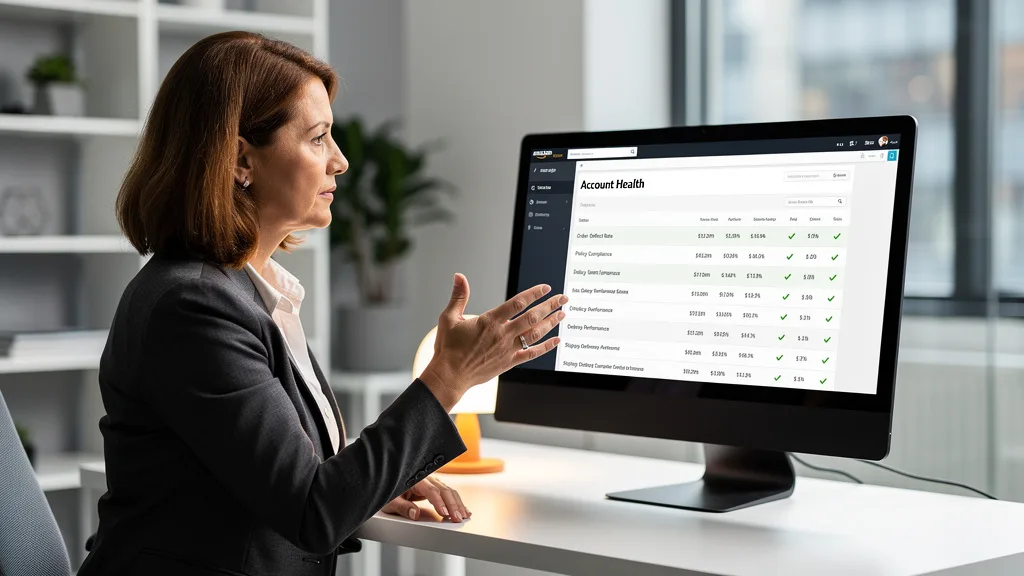
Furthermore, your customer service performance is a key factor in your overall Account Health. Metrics like the Order Defect Rate (ODR), which includes negative feedback, are scrutinized by Amazon. Consistently meeting and exceeding Amazon's service standards not only helps you secure the Buy Box but also contributes to better organic ranking, an area explored in our complete Amazon SEO guide. A strong service record enhances the trust that both customers and Amazon's algorithm place in your brand.
Reducing A-to-z Claims and Negative Feedback
Proactive and empathetic communication is your best defense against damaging A-to-z Claims and negative reviews. Most negative customer experiences escalate because the buyer feels ignored or misunderstood. By responding to messages promptly, professionally, and with a clear intention to solve the problem, you can de-escalate situations before they harm your metrics. A simple, helpful message can turn a potentially one-star review into a five-star compliment.
When a customer reaches out with an issue, see it as an opportunity to build brand loyalty. Swiftly processing returns, offering partial refunds where appropriate, or simply providing clear information can prevent a buyer from filing a claim. A well-managed service interaction not only protects your account but can create a repeat customer who trusts your brand, a vital asset for any growing business.
Core Principles for Delivering Top-Notch Amazon Support
Delivering top-notch support on Amazon hinges on three core principles: speed, proactivity, and personalization. The platform's expectations are high, and sellers must build a system that can consistently meet them. Mastering these fundamentals ensures your brand is perceived as reliable and customer-focused, which is essential for maintaining a healthy seller account and fostering long-term growth.

Think of your customer service as an extension of your product and brand. Just as you invest in quality manufacturing and compelling listings, you must invest in quality communication. These principles are not just about avoiding penalties; they are about actively building a positive reputation that drives sales and creates a competitive advantage in a crowded marketplace.
Mastering Fast and Professional Communication
Amazon requires sellers to respond to all buyer messages within 24 hours, including on weekends and holidays. Failing to meet this service level agreement (SLA) negatively impacts your Contact Response Time metric and can lead to account warnings. The best practice is to respond much faster, ideally within 12 hours. Speed demonstrates professionalism and respect for the customer's time, immediately setting a positive tone for the interaction.
Professionalism extends beyond speed to the content and tone of your messages. Always use clear, concise language, and maintain a helpful, polite demeanor, even when dealing with a frustrated customer. Use templates for common inquiries to ensure consistency and speed, but always leave room to customize the message with the buyer's name and specific order details. This balance of efficiency and personal touch is the hallmark of professional Amazon communication.
Proactively Resolving Issues to Build Trust
The most effective customer service strategy is a proactive one. This begins with your product listings. Clear, detailed descriptions, high-quality images from all angles, and a comprehensive FAQ section can answer questions before they are asked, preventing a significant number of inbound messages. For a deeper dive, consider reviewing our beginner's guide to Amazon listing optimization to ensure your product pages are working for you.
When issues do arise, aim to resolve them on the first contact. Empower your support team or yourself to make decisions, such as issuing a refund or sending a replacement, without lengthy delays. If a shipment is delayed, consider proactively messaging the customer to inform them of the situation and apologize for the inconvenience. This transparency builds immense trust and can turn a negative experience into a positive one, often leading to glowing reviews about your brand's integrity.
"As an Amazon consultant scaling brands to 8 figures, I've seen firsthand that a 1% improvement in seller feedback can have a compounding effect on Buy Box ownership and sales velocity. Exceptional service is not a cost center; it's your most powerful conversion tool."
Personalizing Responses Within Amazon's Guidelines
While automation and templates are essential for efficiency, a purely robotic response can feel dismissive to a buyer. Personalization is key to making customers feel heard and valued. Always address the customer by their name and reference their specific order number or the product they purchased. Acknowledging their specific problem shows you have read and understood their message, which is the first step toward a successful resolution.
However, all communication must happen within Amazon's strict guidelines. Never ask for positive reviews, direct customers to your off-Amazon website, or include marketing promotions in your messages. All communication should be routed through the Buyer-Seller Messaging service in Amazon Seller Central. Personalization should focus on the customer's problem and the solution, not on external marketing efforts, to ensure you remain compliant and protect your account.
Navigating Amazon's Customer Service Policies in 2026
Staying compliant with Amazon's ever-evolving customer service policies is fundamental to protecting your seller account in 2026. Amazon continuously refines its rules to enhance the buyer experience, and sellers who fail to keep up risk suspension. The core of these policies revolves around response times, appropriate language, and the strict prohibition of directing sales or communication off the Amazon platform. Understanding and adhering to these rules is not optional; it's a requirement for survival and growth.

The platform's primary goal is to create a seamless and uniform experience for its customers, regardless of who they buy from. This means your communication style must align with Amazon's standards. Regularly reviewing the Communication Guidelines in Seller Central and staying informed about updates is a critical operational task for any serious Amazon brand.
Key Updates to Seller Communication Policies
As of 2026, Amazon has further tightened its policies around proactive messaging and the use of external links. Sellers are now more restricted in initiating contact with buyers, with communication largely limited to resolving order-related issues. Unsolicited messages, even for legitimate purposes like providing extra user guides, may be flagged if not sent using the appropriate templates provided by Amazon.
Additionally, Amazon's systems have become more sophisticated at detecting any attempt to divert customers off-platform. This includes subtle hints, email addresses disguised with spaces, or links to social media. All communication must be strictly for completing an order or responding to a customer service inquiry. For the most current information, always refer to the official Amazon Communication Guidelines directly within Seller Central. Violations can lead to temporary message restrictions or even account suspension.
Understanding Account Health and Performance Metrics
Your customer service performance is quantified through several key metrics on your Account Health page. The three most critical are the Order Defect Rate (ODR), the Contact Response Time (CRT), and the Pre-fulfillment Cancel Rate. Amazon requires your ODR, which is a combination of A-to-z claims, negative feedback, and credit card chargebacks, to remain below 1%.
The Contact Response Time metric tracks the percentage of customer-initiated messages you respond to within 24 hours. The target is to keep this above 90%, but successful sellers aim for 100%. These metrics are not just numbers; they are direct inputs into the algorithm that determines your visibility and Buy Box eligibility. Consistently poor performance in these areas will trigger warnings and can ultimately lead to the loss of selling privileges.
Choosing Your Support Model: In-House vs. Outsourced
As your Amazon business scales, you'll face a critical decision: should you manage customer service in-house or outsource it to a specialized agency? There is no one-size-fits-all answer. The right choice depends on your order volume, budget, complexity of inquiries, and your desire to control brand voice. Both models have distinct advantages and disadvantages that you must weigh carefully to support your growth trajectory.

An in-house team offers maximum control but requires significant investment in hiring, training, and management. Outsourcing can be more cost-effective and provide 24/7 coverage, but it requires finding a partner who truly understands your brand and Amazon's policies. Analyzing this trade-off is a key strategic step for any 7-figure seller aiming for the next level.
Pros and Cons of an In-House Team
An in-house customer service team provides unparalleled brand and product knowledge. Your own employees will understand the nuances of your products better than any third party, allowing them to handle complex technical questions with expertise. This model gives you complete control over the tone of voice and the quality of support, ensuring every interaction aligns perfectly with your brand identity.
However, the costs and management overhead can be substantial. You are responsible for salaries, training, and providing coverage across all time zones, weekends, and holidays. For a growing business, this can divert focus and resources away from core activities like product development and marketing. Scalability can also be a challenge, as hiring and training new staff to handle peak seasons like Prime Day or Q4 can be slow and difficult.
Benefits and Considerations of a Third-Party Service
Outsourcing your Amazon customer service to a specialized agency can provide immediate access to a trained team, often at a fraction of the cost of hiring internally. These services offer 24/7 coverage, ensuring you never miss Amazon's 24-hour response SLA. This is a huge advantage for sellers who want to step away from their business without worrying about customer inquiries piling up. It allows you to focus on high-level strategy, similar to how many brands use an agency for their Amazon PPC management.
The main consideration is finding the right partner. A poor-quality service can damage your brand reputation and account health with generic, unhelpful responses. It's crucial to vet agencies thoroughly, checking their reviews, their familiarity with Amazon's policies, and their training processes. You must ensure they can represent your brand professionally and effectively. Loss of direct control over customer interactions is a trade-off that requires trust in your chosen partner.
Software and Automation for Efficient Amazon Support
As your order volume grows, manually managing customer messages through Seller Central becomes inefficient and prone to error. Implementing specialized software and automation is the key to providing consistently fast and accurate support at scale. These tools centralize communication, automate repetitive tasks, and provide valuable data to help you improve your service over time. For a scaling FBA business, investing in a helpdesk system is not a luxury, it's a necessity.
Automation allows you to handle a higher volume of inquiries without a proportional increase in headcount. It frees up your time to focus on complex issues that require a human touch, while the software handles common questions like "Where is my order?". This strategic use of technology is fundamental to building a lean, profitable, and scalable Amazon operation in 2026.
How to Automate Support for Your FBA Business
Automation can be implemented in several powerful ways. The most common is through the use of templates and automated responses within a helpdesk platform. You can create rules that automatically send a specific template based on keywords in the customer's message, such as "return" or "damaged." This ensures an instant, though templated, first response while the ticket is routed to a human agent for follow-up.
Another key automation is linking order information directly to customer messages. Instead of manually looking up order details in Seller Central, a good helpdesk will automatically display the customer's order history, tracking information, and product purchased right next to their message. This saves a tremendous amount of time per ticket and allows for a much faster and more informed response, dramatically improving efficiency.
The Role of AI Chatbots for Common Amazon Inquiries
The role of AI chatbots in Amazon customer service is evolving rapidly in 2026. While full AI takeover is not yet a reality due to Amazon's strict communication policies, AI is becoming incredibly effective as a co-pilot for human agents. AI can analyze an incoming message, suggest the most relevant template, and even draft a personalized response for an agent to review, edit, and send. This significantly speeds up response times while keeping a human in the loop for quality control.
AI is also powerful for analyzing customer sentiment and categorizing messages at scale. By understanding the intent behind thousands of messages, you can identify recurring product issues or gaps in your listing information. This data is invaluable for making strategic business improvements, turning your customer service department from a reactive cost center into a proactive source of business intelligence. better organic ranking.
Exploring Alternatives to Amazon's Default Messaging System
While Amazon's native Buyer-Seller Messaging system is functional, it lacks the features needed for efficient management at scale. It offers no tagging, no analytics, no team collaboration features, and no automation. Relying solely on the default system is a common bottleneck for growing brands. The leading alternatives are dedicated e-commerce helpdesks that integrate directly with your Amazon account.
Platforms like eDesk, Zendesk, and Gorgias are designed specifically for this purpose. They consolidate messages from Amazon, as well as other channels like your own website or social media, into a single, unified inbox. They provide the automation, collaboration, and reporting tools necessary to run a professional customer service operation. Moving to one of these platforms is a critical step in professionalizing your support function.
Best Amazon Helpdesks: eDesk vs. Zendesk vs. Gorgias
Choosing the right helpdesk is a critical decision that impacts your team's efficiency and your customers' experience. The three leading contenders for Amazon sellers are eDesk, Zendesk, and Gorgias. While all three aim to streamline customer communication, they have different strengths, pricing models, and levels of native Amazon integration. The best choice for your brand depends on your sales channels, ticket volume, and specific feature requirements.
| Feature | eDesk | Zendesk | Gorgias |
|---|---|---|---|
| Primary Focus | E-commerce (Marketplaces & Webstores) | General Purpose / Enterprise | DTC E-commerce (Shopify-centric) |
| Amazon Integration | Deep, native integration | Requires third-party app/integration | Good, but less focus than eDesk |
| Key Advantage for Amazon | Built for marketplace sellers; auto-links order data | Highly customizable and scalable for large teams | Excellent Shopify integration and social media support |
| Best For | Sellers who are primarily on Amazon and other marketplaces | Large brands selling across many platforms with complex workflows | Brands with a strong Shopify presence and active social media |
eDesk for Amazon Sellers
eDesk is purpose-built for e-commerce sellers, with a particularly strong focus on marketplaces like Amazon and eBay. Its key advantage is its deep, native integration with Amazon Seller Central. It automatically pulls in all relevant order and customer data, presenting it alongside the customer's message in a single view. This eliminates the need to switch back and forth between your helpdesk and Amazon, saving significant time on every ticket.
The platform includes features specifically for Amazon sellers, such as smart templates that can auto-populate with order details and AI-powered response suggestions. eDesk is often the top choice for brands whose primary sales channel is Amazon, as its entire workflow is optimized for the marketplace environment. It helps you stay compliant with Amazon's SLAs and provides the tools to manage support efficiently as you scale.
Zendesk for Amazon Sellers
Zendesk is one of the most well-known and powerful customer service platforms in the world, but it's a general-purpose tool, not an e-commerce specialist. To connect it with Amazon, you need to use a third-party app from the Zendesk marketplace, which can add complexity and cost. While highly customizable and scalable, Zendesk may require more setup to achieve the same out-of-the-box functionality that eDesk provides for Amazon sellers.
Zendesk shines for very large enterprises that sell across numerous channels and have complex internal workflows. Its robust reporting, extensive integrations with other business software (like Salesforce), and advanced customization capabilities make it a good fit for mature companies with a dedicated IT or operations team to manage the software. For a typical 7 or 8-figure FBA brand, it can sometimes be overkill. You can find more details on their integration options on the official Zendesk App Marketplace.
Gorgias for Amazon Sellers
Gorgias is another top-tier helpdesk that has gained immense popularity, primarily within the Shopify ecosystem. It excels at integrating with Shopify and social media channels like Instagram and Facebook, making it a fantastic choice for direct-to-consumer (DTC) brands that have a strong off-Amazon presence. Its Amazon integration is solid, allowing you to manage Amazon messages within the same inbox as your other support channels.
However, its feature set is more tailored to the Shopify environment. While it can handle Amazon support effectively, it may lack some of the Amazon-specific nuances found in eDesk. Gorgias is the ideal choice for a brand that sees Amazon as one important channel among many, especially if the brand's primary focus and customer interaction hub is its own Shopify store and social media pages.
Key Takeaways
Mastering customer service on Amazon is a critical lever for growth. As you scale your brand, keeping these key points in mind will help you build a robust and profitable support system.
- Protect Your Metrics: Excellent customer service directly impacts your Order Defect Rate and Seller Feedback, which are crucial for winning the Buy Box and maintaining account health.
- Speed is Everything: Always respond to buyer messages within Amazon's 24-hour SLA, but aim for under 12 hours to exceed expectations and de-escalate issues quickly.
- Proactive Support Prevents Problems: Use clear listings and proactive communication about delays to reduce inbound messages and prevent negative feedback.
- Choose the Right Model: Evaluate the pros and cons of an in-house team versus an outsourced service based on your brand's scale, budget, and complexity.
- Invest in a Helpdesk: Move beyond Amazon's default messaging system. Tools like eDesk, Zendesk, or Gorgias are essential for managing support efficiently at scale.
- Stay Compliant: Regularly review and adhere to Amazon's Communication Guidelines to avoid penalties and protect your selling privileges in 2026.
Frequently Asked Questions
What are the best software tools for managing Amazon customer messages in 2026?
The best software tools for managing Amazon customer messages are dedicated e-commerce helpdesks. For sellers focused primarily on marketplaces, eDesk is often the top choice due to its deep, native Amazon integration. Gorgias is excellent for brands with a strong Shopify and social media presence, while Zendesk is a powerful, scalable option for large enterprises with complex needs. These tools centralize messages, automate responses, and provide crucial analytics.
How much does it cost to outsource Amazon customer service?
The cost to outsource Amazon customer service typically ranges from $300 to $2,000+ per month. Pricing models vary, with some agencies charging a flat monthly fee, others charging per ticket, and some offering custom packages based on volume and service level. The final cost depends on your number of monthly inquiries, the complexity of your products, and whether you require 24/7 coverage. This is often comparable to or less than the cost of hiring a single in-house agent, much like budgeting for other services which you can learn about in our guide to Amazon PPC costs.
Who are the top-rated outsourced Amazon customer service agencies?
Identifying the top-rated outsourced agencies requires careful vetting, as quality can vary. Some well-regarded names in the industry include SellerSmile, E-commerce Pro, and AMZ-Expert. When choosing, look for agencies with transparent pricing, extensive experience with Amazon's specific policies, and strong case studies or testimonials from brands similar to yours. Always conduct a thorough interview to ensure they understand your brand voice and support philosophy before signing a contract.
What key metrics does Amazon use to measure customer service?
Amazon uses several key metrics found in your Account Health dashboard. The most important is the Order Defect Rate (ODR), which must stay below 1% and includes A-to-z claims, negative feedback, and chargebacks. Another is the Contact Response Time, which measures if you are replying to messages within 24 hours. Other metrics include the Pre-fulfillment Cancel Rate and Late Shipment Rate, which also reflect the overall customer experience you provide.
Conclusion
In 2026, delivering top-notch customer service on Amazon is not just about following rules; it's a strategic imperative for scaling your brand to seven and eight figures. By mastering fast and proactive communication, choosing the right support model, and leveraging powerful helpdesk software, you can protect your account health, dominate the Buy Box, and build a loyal customer base. This transforms customer service from a reactive chore into a powerful engine for profitable growth.
If you're ready to optimize every aspect of your Amazon business for maximum profitability, it all starts with a clear understanding of your current performance. We can help you identify hidden opportunities and critical risks in your listings, advertising, and operations. To get a comprehensive analysis of your brand's potential, book your Free Audit today.