
Are you leaving significant B2B revenue on the table by treating Amazon like a purely consumer marketplace? For many brands, the business-to-business segment on Amazon is a vast, untapped frontier. Unlocking it requires a dedicated strategy that goes far beyond standard retail tactics.
To achieve Amazon B2B sales growth, you need a tailored approach. Key strategies include optimizing product pages for business buyers with technical specifications, implementing strategic B2B pricing with quantity discounts, and leveraging advanced advertising tactics. Choosing between Seller and Vendor Central and using specialized software are also critical for scaling your business-to-business operations on the platform in 2026.
Core Strategies to Increase Your Amazon B2B Sales
Building a successful B2B presence on Amazon starts with a strong foundation. You must shift your mindset from a B2C perspective and focus on the specific needs and purchasing behaviors of business customers. These buyers prioritize efficiency, value, and trust, which should be reflected in every aspect of your Amazon presence.
Optimize Product Detail Pages for Business Buyers
Your product detail pages must serve as a comprehensive resource for professional buyers. Unlike consumers, B2B customers are looking for detailed technical specifications, compliance documentation, and clear use cases. Optimize your titles, bullet points, and descriptions with keywords they use, such as "commercial-grade," "industrial-strength," or specific model numbers. Make it easy for them to make an informed purchasing decision without needing to contact you for basic information.

Go beyond the basics by uploading supporting documents directly to your listings. This can include CAD files, installation guides, safety data sheets (SDS), and certificates of compliance. These assets build immense credibility and can be the deciding factor for a procurement manager comparing your product to a competitor's. A well-optimized page not only converts better but also improves your organic ranking, and a complete Amazon SEO guide can provide a deeper understanding of these ranking factors.
Leverage A+ Content and Brand Stores
A+ Content is your opportunity to tell a richer story and visually demonstrate your product's value proposition for business applications. Use high-quality images and comparison charts to showcase different models, highlight key features, and illustrate your product in a professional setting. This visual real estate is perfect for overcoming purchase barriers and explaining complex benefits in an easily digestible format.
Extend this branding to a dedicated Amazon Brand Store. Think of your Brand Store as your B2B digital catalog and showroom on Amazon. You can organize your products by application, industry, or product line, creating a curated shopping experience for business buyers. This helps them discover your full range of solutions and reinforces your brand as a credible B2B supplier.
Implement Strategic B2B Pricing and Quantity Discounts
Pricing is one of the most powerful levers in your B2B toolkit. The Amazon Business program allows you to set a specific "Business Price" that is lower than your retail price and visible only to verified business buyers. This simple incentive can significantly increase your visibility and appeal to companies looking for cost savings.
Even more effective are quantity discounts. This feature allows you to create tiered pricing structures that reward customers for placing larger orders (e.g., 5% off for 10+ units, 10% off for 50+ units). This directly caters to the bulk purchasing behavior of B2B clients and can dramatically increase your average order value. Setting up these tiers shows you understand B2B procurement needs and are equipped to handle larger, more complex orders.
Proactively Manage Customer Reviews and Q&A
Social proof is just as important in B2B as it is in B2C, if not more so. Business buyers rely on reviews and questions from peers to validate product quality, durability, and supplier reliability. Encourage reviews from your satisfied business customers and monitor your product pages for new questions.
When responding to the Questions & Answers section, be thorough, professional, and technically accurate. A detailed answer can serve as a permanent piece of content on your page, addressing a concern that many future buyers may have. Swift and helpful responses demonstrate excellent customer service and build the trust necessary to secure long-term B2B relationships.
Seller Central vs. Vendor Central: Choosing Your B2B Model
A critical decision for any brand pursuing Amazon sales growth strategies for B2B brands is the platform model: selling as a third-party (3P) on Seller Central or as a first-party (1P) supplier to Amazon on Vendor Central. Each model has distinct implications for control, logistics, and profitability, making the choice dependent on your business's capabilities and strategic goals.

| Feature | Seller Central (3P) | Vendor Central (1P) |
|---|---|---|
| Control | Full control over pricing, inventory, and listings. | Amazon controls retail pricing and places purchase orders. |
| Pricing Flexibility | Set your own Business Prices and Quantity Discounts. | Negotiate wholesale costs with Amazon; limited pricing influence. |
| Fulfillment | Flexible options: Fulfillment by Amazon (FBA) or Fulfillment by Merchant (FBM). | Amazon manages all fulfillment and logistics after receiving inventory. |
| Profitability & Payments | Higher potential margins; payments processed every 1-2 weeks. | Lower margins; payments typically on Net 30, 60, or 90-day terms. |
Key Differences in Control and Pricing Flexibility
Seller Central offers you complete autonomy. As a third-party seller, you act as the retailer, giving you direct control over your retail pricing, promotional calendar, and inventory levels. This agility is crucial for B2B, as it allows you to dynamically set and adjust business prices and quantity discounts in response to market demand or competitor actions.
Vendor Central, an invite-only program, positions you as a wholesaler to Amazon. You sell your products in bulk to Amazon, which then becomes the seller of record. This means Amazon sets the final retail price, and your ability to influence it is limited to your wholesale cost negotiations. While this simplifies things, you lose the granular pricing control that is often vital for a nuanced B2B strategy.
Fulfillment and Logistics Models Compared
With Seller Central, you have two primary fulfillment options. You can use Fulfillment by Amazon (FBA), where you send your inventory to Amazon's warehouses and they handle storage, packing, shipping, and customer service. Alternatively, you can manage your own logistics through Fulfillment by Merchant (FBM), which can be ideal for oversized items or products requiring special handling.
In the Vendor Central model, logistics are more straightforward but less flexible. You are responsible for shipping your products in bulk to Amazon's fulfillment centers according to their purchase orders. From there, Amazon takes over all aspects of the customer-facing fulfillment process. This hands-off approach can free up resources but also makes you dependent on Amazon's ordering cycle.
Profitability and Payment Terms
Profitability models differ significantly between the two platforms. Sellers on Seller Central typically see higher per-unit profit margins, as they set the retail price themselves. Payments are also faster, usually disbursed every 14 days, which is a major cash flow advantage.
Vendors, on the other hand, operate on thinner wholesale margins. Furthermore, payment terms are a major consideration, as Amazon often negotiates Net 30, Net 60, or even Net 90-day payment cycles. This can tie up a significant amount of capital and requires careful financial planning, especially for smaller brands.
Advanced Amazon Advertising Strategies for B2B in 2026
To effectively reach and convert business buyers, your advertising strategy must be as sophisticated as your product offerings. Generic campaigns aimed at a mass audience will fall flat. The key is to use Amazon's advertising tools to target professional users with messaging that speaks to their specific needs for performance, reliability, and value.
Targeting with Sponsored Products and Sponsored Display
Sponsored Products are essential for capturing high-intent buyers actively searching for solutions like yours. For B2B, move beyond broad keyword targeting and focus on competitor product targeting (ASINs) and category targeting. This allows you to place your product directly in front of buyers considering a rival's offering or browsing a relevant category, such as "Industrial Power Tools."
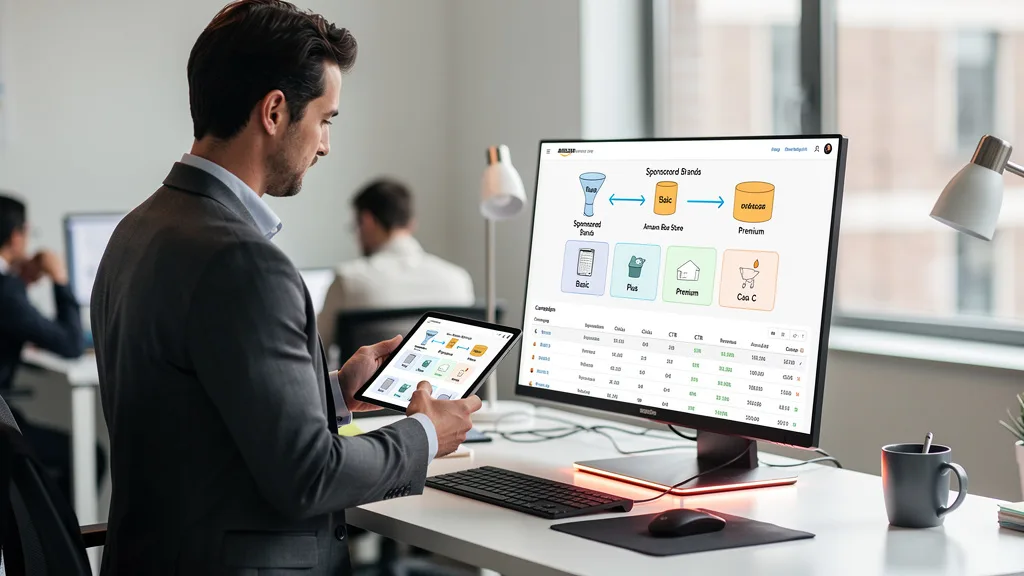
Sponsored Display ads take this a step further by allowing you to retarget audiences who have viewed your product detail pages or to target audiences based on shopping behaviors. You can use these ads to stay top-of-mind with procurement managers during their longer consideration cycles. A well-structured campaign is vital, and a comprehensive Amazon PPC management guide can help you navigate the complexities of setting up profitable campaigns.
Building Brand Awareness with Sponsored Brands
Sponsored Brands are powerful for building credibility and introducing your company to new business customers. Use the headline to communicate your core B2B value proposition, such as "Heavy-Duty Solutions for Professionals." Link these ads directly to your Brand Store to create a seamless journey where buyers can explore your entire B2B catalog. tracking key B2B metrics.
Sponsored Brands Video is particularly effective for B2B. A short, compelling video that shows your product in action within a commercial or industrial environment can communicate its value far more effectively than static images. It helps buyers visualize how your product can solve their specific operational challenges, building confidence and driving consideration.
Measuring ROI for B2B Ad Campaigns
Measuring success in B2B advertising goes beyond the standard Advertising Cost of Sale (ACoS). While ACoS is important, you should also track metrics like new-to-brand customers, which indicates how well your ads are expanding your B2B customer base. A high rate of new-to-brand orders suggests your top-of-funnel campaigns are working effectively.
Consider the lifetime value (LTV) of a B2B customer. A single initial purchase, even at a higher ACoS, can lead to years of repeat bulk orders. Therefore, evaluating your Total Advertising Cost of Sale (TACoS) in relation to overall B2B revenue growth provides a more holistic view of your advertising ROI. This long-term perspective is crucial for making smart investment decisions in your B2B ad strategy.
Effective Sales Tactics for Niche B2B Categories
General B2B strategies provide a strong framework, but true success comes from tailoring your tactics to the specific demands of your product category. Buyers in different industries have unique priorities, from regulatory compliance to technical compatibility, and your approach must reflect this.
For Industrial and Scientific Products
Buyers in this category are highly technical and risk-averse. Your primary goal is to provide exhaustive detail and proof of quality. Your product listings must include precise measurements, material composition data, performance tolerances, and operating temperature ranges. Use A+ Content to display schematics and technical diagrams.
Certifications are non-negotiable. Prominently display any relevant certifications such as ISO, ANSI, or RoHS compliance. Use the "Product Documents" section to upload spec sheets and certificates of analysis. Answering technical questions with precision and citing specific standards will build the trust needed to win over engineers and lab managers.
For Office Supplies and Equipment
Office supply buyers prioritize convenience, cost-effectiveness, and compatibility. Your strategy should center on making procurement as frictionless as possible. Emphasize bulk packaging and tiered quantity discounts to appeal to office managers stocking up for their entire organization. Use keywords like "bulk pack," "case of 24," and "office pack."
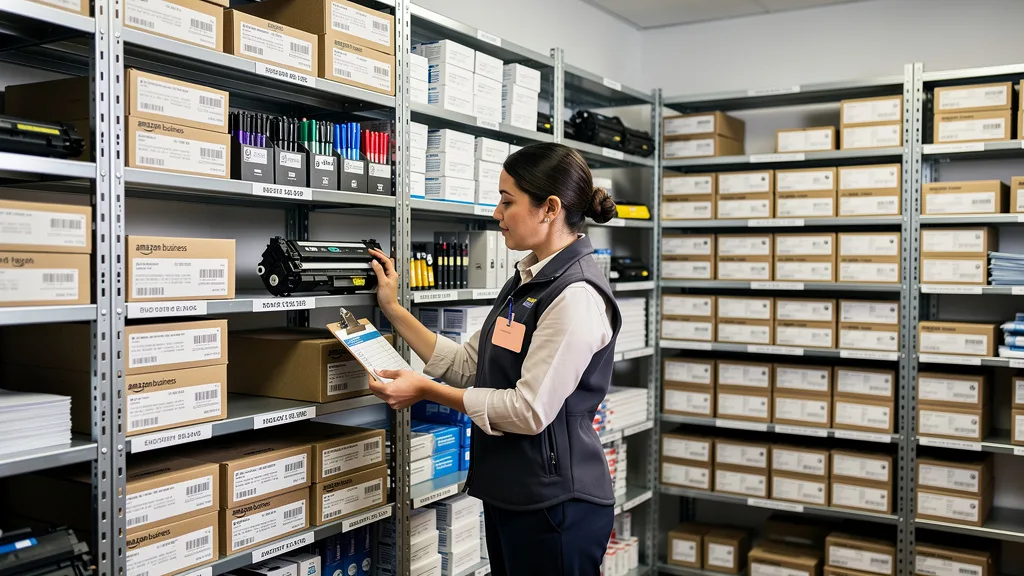
For equipment like printers or shredders, compatibility is key. Clearly list which cartridges, paper sizes, or accessories your product works with. Consider offering bundles, such as a printer packaged with its first set of ink cartridges. Leveraging Amazon's Subscribe & Save program for consumable supplies like paper and pens can also create a steady stream of recurring revenue.
For Healthcare and Medical Supplies
The healthcare sector is defined by strict regulations and a critical need for reliability. Trust and compliance are paramount. Your listings must clearly state any FDA clearances, classifications (e.g., Class I, Class II), and whether the product is suitable for clinical or home use. Sterility information and expiration dates are also essential details.
Use your product content to address the needs of different healthcare professionals, from hospital administrators to home care nurses. Highlight features like single-use packaging to prevent cross-contamination or durable construction for repeated use in a clinical setting. Given the stakes, proactively managing reviews and answering questions about product efficacy and safety is absolutely critical.
Top B2B Selling Trends on Amazon for 2026
The Amazon Business marketplace is continuously evolving. Staying ahead of the curve requires an awareness of the key trends shaping B2B ecommerce in 2026. Adapting your strategy to these shifts will not only keep you competitive but also position you as a forward-thinking partner for business buyers.
"In 2026, the most successful B2B sellers on Amazon won't just be suppliers; they'll be solution partners. This means embracing sustainability, leveraging data for personalization, and providing a seamless, digitally-native procurement experience. The bar for B2B excellence is rising, and adapting your Amazon sales growth strategies for B2B brands is no longer optional."
Here are some of the top trends influencing B2B sales on Amazon today:
- Focus on Sustainability and ESG: Business buyers are increasingly making purchasing decisions based on Environmental, Social, and Governance (ESG) criteria. Highlight your product's sustainable materials, recyclable packaging, and any eco-friendly certifications (e.g., FSC, Green Seal). Amazon's Climate Pledge Friendly badge can provide a significant competitive advantage.
- Demand for Personalization at Scale: B2B buyers expect a more personalized experience. This includes curated product recommendations, customized bundles, and dedicated customer support. Use your Brand Store and targeted email campaigns to create a more tailored journey for different customer segments.
- AI-Driven Procurement: Businesses are adopting AI tools to automate and optimize their purchasing. This means your listings must be perfectly optimized with structured data and accurate attributes so that these automated systems can easily find and evaluate your products.
- Rise of B2B-Specific Services: Value-added services are becoming a key differentiator. This could include offering product installation, extended warranties, or specialized training. While not always offered directly through Amazon, highlighting these services in your A+ Content can influence the purchase decision.
Essential Software Tools for Managing B2B Amazon Sales
Scaling your Amazon B2B operations manually is inefficient and prone to error. Leveraging the right software stack is essential for managing inventory, optimizing pricing, and gaining actionable insights from your sales data. These tools automate repetitive tasks, allowing you to focus on high-level strategy.
Key categories of software include inventory and order management systems, which sync your stock levels across multiple channels to prevent overselling. Analytics and keyword research tools provide the data needed to optimize your listings and ad campaigns for B2B-specific search terms. Finally, automated repricing tools can help you maintain competitive business prices and quantity discounts without constant manual adjustments. Finding the best Amazon listing optimization tools for B2B can give you a significant edge.
Key Takeaways
To accelerate your B2B sales on Amazon in 2026, it's crucial to move beyond a one-size-fits-all retail strategy. Here are the most important takeaways to implement:
- Optimize for the Business Buyer: Your product pages must be rich with technical specs, certifications, and professional use cases to earn the trust of procurement managers.
- Use B2B-Specific Features: Actively implement Business Prices and tiered Quantity Discounts to appeal directly to the purchasing habits of organizations.
- Choose Your Model Wisely: Carefully weigh the control of Seller Central against the scale of Vendor Central to align with your business goals and operational capabilities.
- Target Your Advertising: Run sophisticated ad campaigns that target B2B buyers through competitor ASINs, relevant categories, and video content that showcases your product in a professional context.
- Embrace Technology: Utilize specialized software for inventory management, analytics, and repricing to automate operations and make data-driven decisions.
Frequently Asked Questions
How much do Amazon's B2B-specific features cost?
For sellers on the Professional selling plan (which costs $39.99 per month), most of the core B2B features are included at no additional charge. This includes the ability to set Business Prices and Quantity Discounts, create a public business profile, and have your offers displayed to Amazon Business customers.
There are no extra subscription fees just for participating in the Amazon Business Seller Program. The standard referral fees and other selling fees still apply to each sale. This makes it a very cost-effective way to access the B2B market.
Are Amazon's B2B programs worth it for manufacturers?
Yes, for most manufacturers, Amazon's B2B programs are highly valuable. They provide direct access to a massive and growing market of business buyers, from small businesses to large enterprises, that would be very expensive and time-consuming to reach otherwise. It allows manufacturers to control their brand narrative and go direct-to-business.
The platform helps you build brand awareness, test new products, and gather direct feedback from end-users. While it requires a dedicated strategy, the potential for incremental sales and market expansion makes it a worthwhile investment for manufacturers looking to diversify their revenue streams.
What are some alternatives to Amazon Business for B2B ecommerce?
While Amazon Business is a dominant force, several other platforms serve the B2B ecommerce space. Vertical-specific marketplaces like Thomasnet for industrial products or Faire for wholesale retail offer more specialized communities. Large-scale platforms like Alibaba are a major alternative, especially for international sourcing.
Additionally, many businesses are finding success by building their own direct-to-business ecommerce sites using platforms like Shopify Plus or BigCommerce, which offer robust B2B features. According to industry analysis from sources like Gartner's research on digital commerce, a multi-platform approach is often the most resilient strategy for B2B brands.
How do I get started with the Amazon Business seller program?
Getting started is relatively straightforward. First, you need to have a Professional Seller account on Amazon. If you already have one, you can enable the Amazon Business features within your Seller Central settings. This is typically a simple opt-in process.
Once enabled, you will gain access to B2B-specific tools. You can then begin to upload quality and diversity certifications, set your business pricing and quantity discounts, and optimize your product listings for business customers. Following an Amazon listing optimization checklist can help ensure you cover all the essential steps.
Can I sell both B2B and B2C from the same Amazon account?
Yes, absolutely. One of the great advantages of the Amazon Business Seller Program is that it allows you to manage both your B2B and B2C sales from a single Seller Central account. Your products will be available to all Amazon customers, but verified business buyers will see the special business pricing and quantity discounts you set.
This integrated approach simplifies inventory management and operations. You don't need to maintain separate stock or listings. Amazon's system automatically displays the correct price and offers based on the buyer's account type, creating a seamless experience for both you and your customers.
Conclusion
Unlocking significant growth on Amazon in 2026 requires a deliberate and strategic focus on the business-to-business market. By implementing these Amazon sales growth strategies for B2B brands, you can transform your presence from a simple retail channel into a powerful B2B sales engine. The key is to optimize your content for professional buyers, leverage B2B-specific pricing and advertising tools, and choose the selling model that best fits your operational capabilities. Your next step is to audit your current listings and identify the single biggest opportunity for B2B optimization.
Ready to see how your listings stack up against the competition and uncover hidden B2B growth opportunities? Our experts can provide a detailed analysis of your brand's presence on Amazon. Get your Free Audit today.