
Table of Contents 8 sections
Are you leveraging every tool at your disposal to scale your Amazon brand from seven to eight figures? While optimizing your listings and running sharp PPC campaigns on Amazon is critical, many sellers overlook a powerful asset: a dedicated brand website built on WordPress. Combining a strong off-Amazon presence with your on-Amazon strategy creates a flywheel effect, boosting brand authority, driving high-quality traffic, and ultimately increasing sales.
Integrating your Amazon business with a WordPress site allows you to build a brand hub that you fully control. This guide provides actionable WordPress Tips SEO and PPC for Amazon Brand Sites, covering everything from on-page optimization and backlink building to aligning your Amazon PPC data with your content strategy. By mastering both SEO for your brand site and PPC on Amazon, you create a synergistic system that amplifies your marketing efforts and secures your brand's long-term growth beyond a single platform.
Why Use a WordPress Site for Your Amazon Brand?
Relying solely on Amazon for your brand's presence is like building a house on rented land. A WordPress website serves as your brand's digital headquarters, an asset you completely own and control. It allows you to tell your brand story in a way that Amazon's A+ Content and Storefronts can't fully capture. You can build a community, collect customer emails for direct marketing, and establish a direct line of communication with your audience, fostering loyalty that transcends a single marketplace.
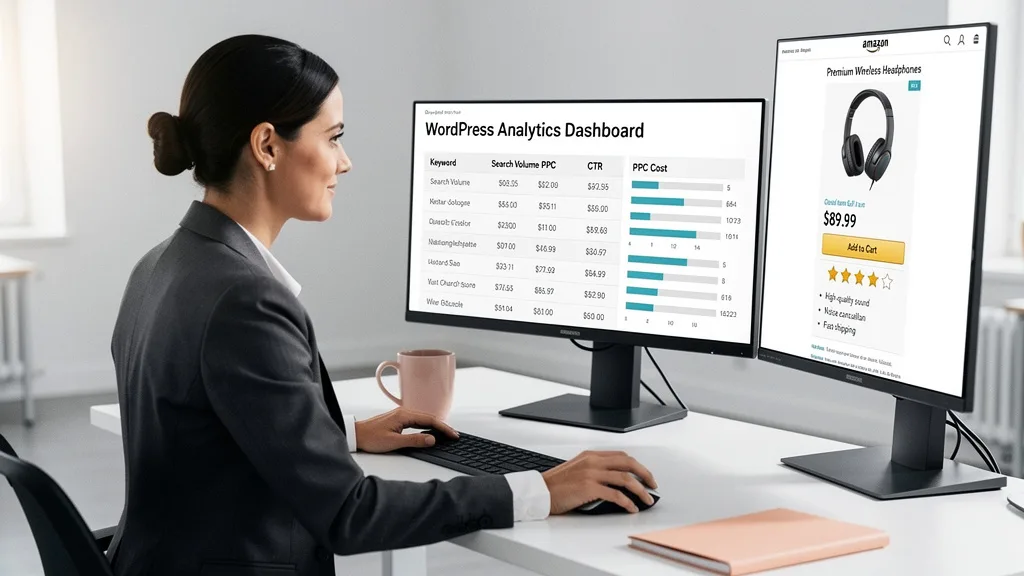
Furthermore, a brand website diversifies your traffic sources. Instead of being 100% dependent on Amazon's internal traffic, you can attract customers from Google search, social media, and other channels. This external traffic not only generates sales but can also positively impact your Amazon rankings through the Amazon Brand Referral Bonus program. Ultimately, a WordPress site solidifies your brand's legitimacy, which is crucial for everything from securing Brand Registry to building long-term enterprise value.
Essential WordPress SEO Tips for Amazon Sellers
Once your WordPress site is live, the next step is to optimize it to attract organic traffic from search engines like Google. A well-executed SEO strategy turns your website into a powerful customer acquisition channel that complements your Amazon efforts. This involves understanding what your potential customers are searching for and creating valuable content that answers their questions and solves their problems.
Keyword Research for On-Site and Off-Site Content
Effective SEO begins with thorough keyword research. Your goal is to identify terms your target audience uses when searching for information related to your products. Use tools like Ahrefs or Semrush to find two main types of keywords: informational keywords for blog posts (e.g., "how to use a yoga wheel") and commercial keywords for product-focused pages (e.g., "best cork yoga wheel").

This research should inform your entire content calendar. Create blog posts, guides, and how-to articles that address the informational queries. These pieces of content attract top-of-funnel traffic, build trust, and establish your brand as an authority in its niche. Within this content, you can naturally guide readers toward your products on Amazon.
On-Page SEO for Product-Related Blog Posts
On-page SEO involves optimizing individual web pages to rank higher and earn more relevant traffic. For each blog post, ensure you have a compelling title tag and meta description that includes your target keyword. Use a clear heading structure with one H1 tag and multiple H2s and H3s to organize your content and make it easy for both users and search engines to read.
Incorporate your primary keyword naturally in the introduction, a few times in the body, and in at least one subheading. Optimize your images by using descriptive file names and adding alt text that describes the image. Finally, use internal links to connect your new post to other relevant articles on your site, which helps distribute page authority and keeps users engaged. A comprehensive Amazon SEO strategy considers both on-Amazon and off-Amazon factors like these.
Building Backlinks to Your Brand's Website
Backlinks, or links from other websites to yours, are a critical ranking factor for Google. They act as votes of confidence, signaling to search engines that your content is valuable and trustworthy. One effective way to build backlinks is through guest posting on reputable blogs in your industry. This not only earns you a link but also exposes your brand to a new, relevant audience.
Other strategies include digital PR, where you create compelling stories or data that journalists and bloggers want to feature, and broken link building, where you find dead links on other sites and suggest your content as a replacement. Building a strong backlink profile is a long-term effort, but it's essential for establishing domain authority and competing for valuable keywords.
Integrating Your Amazon Storefront and Listings
Your WordPress site should act as a bridge to your Amazon presence. Strategically place links to your Amazon product listings and your brand's Storefront throughout your website. For example, a blog post about "10 Benefits of Meditation" could link directly to your meditation cushion on Amazon. This drives highly qualified, pre-sold traffic to your listings, which often results in higher conversion rates.
Make sure these links are clear and provide value to the reader. Use call-to-action buttons like "Shop on Amazon" or "View Product Details" to make the user journey seamless. Following Amazon Storefront best practices on your brand store ensures that the traffic you send from your website lands on a professionally designed and user-friendly page, maximizing the chances of a sale.
Setting Up Successful Amazon PPC Campaigns
While SEO builds your brand's long-term organic presence, Amazon PPC delivers immediate visibility and sales. A well-structured PPC campaign can accelerate product launches, defend your brand against competitors, and uncover valuable customer search data. Setting up your campaigns correctly from the start is crucial for achieving a profitable return on ad spend.
"Profit-focused Amazon PPC isn't about getting the most clicks; it's about getting the right clicks. Every dollar of ad spend should be an investment toward scaling your brand, and that starts with a meticulously structured campaign that aligns with your business goals."

Choosing the Right Campaign Type
Amazon offers several campaign types, each serving a different purpose. Understanding them is key to allocating your budget effectively. Sponsored Products are the most common, appearing in search results and on product detail pages, and are ideal for driving direct sales of specific items. Sponsored Brands appear at the top of search results and are great for building brand awareness and promoting a collection of products. Sponsored Display ads can retarget shoppers who have viewed your products or target audiences based on shopping behaviors, both on and off Amazon.
For a comprehensive strategy, you should use a mix of all three. Start with Sponsored Products to target high-intent keywords, use Sponsored Brands to promote your brand and top-selling items, and leverage Sponsored Display to re-engage potential customers and expand your reach.
Effective Keyword Targeting and Match Types
Keyword targeting is the core of your Sponsored Products and Sponsored Brands campaigns. You can start with an Automatic campaign, where Amazon targets keywords and products for you. This is an excellent way to discover what customers are searching for to find your products. After gathering data for a week or two, you can harvest the high-performing search terms and move them into a Manual campaign for more control.
In Manual campaigns, you'll use three keyword match types: Broad, Phrase, and Exact. Broad match provides the widest reach but can attract irrelevant traffic. Phrase match is more restrictive, showing your ad for searches that include the keyword phrase in order. Exact match is the most precise, showing your ad only when the search query matches your keyword exactly. A good strategy is to use all three and adjust bids based on performance to refine your targeting over time.
Structuring Ad Groups for Maximum Relevance
A common mistake sellers make is lumping too many different products and keywords into a single ad group. This leads to low relevance between the search term, the ad, and the product, resulting in a low click-through rate (CTR) and wasted spend. Instead, you should create tightly-themed ad groups. Ideally, each ad group should contain a small set of very similar products and a list of keywords that are highly relevant to them.
For even more control, some advertisers use the Single Keyword Ad Group (SKAG) structure, where each ad group targets only one keyword. This allows for maximum control over bids and makes it easy to match the ad creative to the keyword. While more labor-intensive to set up, this granular structure often leads to better performance and a lower Advertising Cost of Sale (ACoS). Proper Amazon PPC management requires this level of detail.
Key Strategies to Optimize Your Amazon PPC Ads
Launching your PPC campaigns is just the beginning. Continuous optimization is what separates profitable brands from those that just break even on their ad spend. Regularly analyzing performance data and making data-driven adjustments is essential to improve efficiency and scale your campaigns successfully. These key strategies will help you refine your campaigns and maximize your return.
Analyzing Search Term Reports to Reduce Wasted Spend
The Search Term Report is arguably the most important tool for PPC optimization. Found within your advertising console, this report shows you the exact search queries customers used before clicking on your ad. By regularly reviewing this report, you can identify irrelevant terms that are triggering your ads and costing you money.

For example, if you sell premium leather dog collars, you might find you're getting clicks from searches for "cheap nylon dog collars." These clicks are unlikely to convert and represent wasted ad spend. Identifying these mismatches is the first step toward plugging leaks in your advertising budget and improving your overall profitability.
Leveraging Negative Keywords Effectively
Once you've identified irrelevant search terms, the next step is to add them as negative keywords. This prevents your ads from showing up for those specific queries in the future. You can add negative keywords at either the campaign or ad group level. Using them at the ad group level provides more granular control.
There are two types of negative keywords: negative exact and negative phrase. Negative exact will block your ad only for that precise search term. Negative phrase will block your ad for any search term that contains that phrase. A proactive negative keyword strategy is one of the fastest ways to optimize Amazon PPC ads and improve your ACoS.
A/B Testing Ad Copy and Landing Pages
Continuous testing is vital for improving campaign performance. For Sponsored Brands, you can A/B test different headlines and ad creatives to see which ones generate a higher click-through rate. Test different messaging, such as highlighting a key benefit versus a product feature, to understand what resonates most with your audience.
Your Amazon product detail page is your landing page. You should constantly be working to optimize it for conversions. A/B test your main image, title, bullet points, and A+ Content using Amazon's Manage Your Experiments tool. A small increase in your conversion rate can have a massive impact on your PPC profitability, as it means you get more sales for the same number of clicks.
How SEO and PPC Work Together for Amazon Brands
SEO and PPC are not separate channels; they are two sides of the same coin. When used together, they create a powerful growth engine for your Amazon brand. The data from one can inform and improve the strategy for the other, creating a feedback loop that accelerates your results and builds a more resilient business.
Driving External Traffic to Boost Amazon Rankings
One of the most powerful synergies is using your WordPress site's SEO to fuel your Amazon success. As your blog posts start ranking on Google for relevant informational keywords, they will attract a steady stream of organic traffic. By strategically linking from these posts to your Amazon product listings, you send high-intent, external traffic to Amazon.
Amazon's A9 algorithm is known to favor listings that convert well from external traffic sources. This influx of qualified visitors can lead to an increase in sales velocity, which in turn can help boost your product's organic ranking within Amazon's own search results. This is a prime example of how your off-Amazon efforts directly impact your on-Amazon performance.
Using PPC Data to Inform Your SEO Strategy
Your Amazon PPC campaigns are a goldmine of data. The Search Term Report tells you exactly what words your customers are using to buy your products. These are commercially-proven, high converting keywords. This data is invaluable for your WordPress SEO strategy.
Take your best-performing keywords from your PPC campaigns and create in-depth blog posts or guides around them. Since you already know these terms convert to sales, ranking for them on Google can drive highly profitable organic traffic. This data-driven approach removes the guesswork from your content strategy and ensures you're focusing your SEO efforts on topics that have a direct path to revenue.
Creating Custom WordPress Landing Pages for Ads
While sending traffic directly to Amazon is effective, you can also use your WordPress site to build a long-term marketing asset: an email list. Instead of running Google Ads or Facebook Ads directly to an Amazon listing, you can direct that traffic to a custom landing page on your WordPress site. This page can offer a discount code in exchange for the user's email address.
After the user signs up, you can redirect them to the Amazon listing to make their purchase. This strategy, known as a "two-step URL" or "squeeze page" funnel, allows you to capture customer information before the sale. You now have a direct line of communication for future product launches, promotions, and brand-building content, something that is impossible when you rely solely on Amazon's customer data.
Key Takeaways
To effectively scale your Amazon brand, integrating a WordPress site with your SEO and PPC strategies is no longer optional, it's essential. Here are the key takeaways to implement for your business in 2026:
- Own Your Brand's Home: A WordPress site gives you full control over your brand narrative and customer relationships, reducing your dependency on Amazon.
- Synergize SEO and PPC: Use PPC data to find high-converting keywords for your SEO content strategy, and use your SEO traffic to boost your Amazon sales and rankings.
- Optimize Campaigns Relentlessly: Regularly analyze your Amazon PPC Search Term Reports to add negative keywords and reduce wasted ad spend. This is critical for maintaining profitability.
- Build a Long-Term Asset: Use your WordPress site to build an email list by driving external ad traffic to custom landing pages before sending shoppers to Amazon.
- Test and Refine: Continuously A/B test your ad creatives and your Amazon product listings to improve click-through rates and conversion rates, maximizing the return on every ad dollar.
Frequently Asked Questions
What are the best WordPress plugins for an Amazon brand site?
For an Amazon brand's website, a few plugins are essential for success. First, an SEO plugin like Yoast SEO or Rank Math is non-negotiable for optimizing your content for search engines. It helps you manage titles, meta descriptions, sitemaps, and more.
Second, a caching plugin such as WP Rocket or W3 Total Cache is crucial for improving your site's loading speed, which is a key ranking factor and important for user experience. Finally, you might consider a tool like AmaLinks Pro if you plan to use Amazon's affiliate program to monetize informational content, as it helps create compliant and attractive product links.
Can I drive traffic from Google Ads directly to my Amazon listings?
Yes, you can drive traffic from Google Ads directly to your Amazon product listings. However, this approach has significant drawbacks. You lose the ability to track conversions accurately since you cannot place a tracking pixel on Amazon's pages. This makes it difficult to calculate your true return on ad spend (ROAS).
A more effective strategy is often to send Google Ads traffic to a custom landing page on your WordPress site first. On this page, you can warm up the visitor, explain the product benefits, and capture their email address before sending them to Amazon. This method allows for better tracking and helps you build a valuable customer list.
How does a WordPress site help with Amazon Brand Registry?
Having a professional, live website is a key requirement for enrolling in the Amazon Brand Registry program. Amazon uses your website to verify that you are a legitimate brand owner with an established presence outside of the Amazon marketplace. Your site should clearly display your branding, logo, and product information.
Your website domain should also ideally match your trademarked brand name. A well-constructed WordPress site demonstrates brand seriousness and legitimacy, making the Brand Registry application process smoother and increasing your chances of approval. This unlocks powerful tools like A+ Content, Sponsored Brands, and Brand Analytics.
What is a good ACoS for Amazon PPC campaigns?
A "good" Advertising Cost of Sale (ACoS) is highly dependent on your goals and product profit margins. For a new product launch, a high ACoS (e.g., 50-100%) might be acceptable as the goal is visibility and sales velocity, not immediate profit. For mature products, you'll want your ACoS to be below your break-even point to ensure profitability. Typically, an ACoS between 15% and 30% is considered healthy for established products.
However, it's more important to focus on your Total ACoS (TACoS), which measures your ad spend relative to your total sales (both organic and ad-generated). A decreasing TACoS over time indicates that your PPC efforts are successfully boosting your organic sales. Understanding your Amazon PPC costs and goals is the first step to defining your target ACoS.
How long does it take for SEO to impact my Amazon sales?
SEO is a long-term strategy, and its impact on your Amazon sales is indirect and takes time. It typically takes 4-6 months, and sometimes longer, for a new WordPress site to start gaining significant traction and ranking for competitive keywords on Google. The traffic generated from these rankings will then begin to flow to your Amazon listings.
While you won't see an immediate sales spike like you would with PPC, the effects of SEO are cumulative and sustainable. The content you create and the backlinks you build today will continue to drive traffic for months and years to come, creating a stable and cost-effective channel for customer acquisition that supports your Amazon business.
Conclusion
Successfully scaling your Amazon business in 2026 requires a holistic approach that extends beyond the marketplace itself. By implementing these WordPress tips for SEO and PPC, you create a powerful, self-reinforcing system where your brand site builds authority and drives organic traffic, while your Amazon PPC campaigns provide immediate sales and invaluable keyword data. This integrated strategy not only boosts sales but also builds a defensible brand and a valuable, long-term asset that you fully control. Your next step is to audit your current strategy and identify the biggest opportunity for integration.
Ready to see how these strategies can be applied to your specific brand? As an Amazon consultant who has scaled multiple brands from 7 to 8 figures, I can help you identify profit leaks and growth opportunities in your PPC and listing strategy. Get your no-obligation Free Audit today and receive a custom action plan to accelerate your growth.