
For ambitious Amazon sellers, the debate between focusing on listing optimization or pouring budget into PPC ads is constant. So, when it comes to Amazon listing optimization vs PPC which comes first? The answer is clear: a fully optimized product listing is the non-negotiable foundation you must build before spending a single dollar on paid traffic.
A perfectly optimized listing acts as your 24/7 salesperson, converting both organic and paid traffic into customers. Without it, your PPC campaigns will suffer from low conversion rates, high ad costs, and wasted spend. By prioritizing listing optimization first, you ensure that every visitor, whether from an ad or organic search, has the highest possible chance of making a purchase, creating a profitable flywheel for sustainable growth on Amazon in 2026.
What Is Amazon Listing Optimization (SEO)?
Amazon listing optimization, also known as Amazon SEO, is the process of refining every element of your product detail page to improve its visibility in Amazon's search results, increase its click-through rate, and maximize its conversion rate. Think of it as preparing your digital storefront to be as appealing and effective as possible for both Amazon's A10 algorithm and human shoppers. The goal is to create a listing that not only ranks for relevant keywords but also persuades visitors to make a purchase.
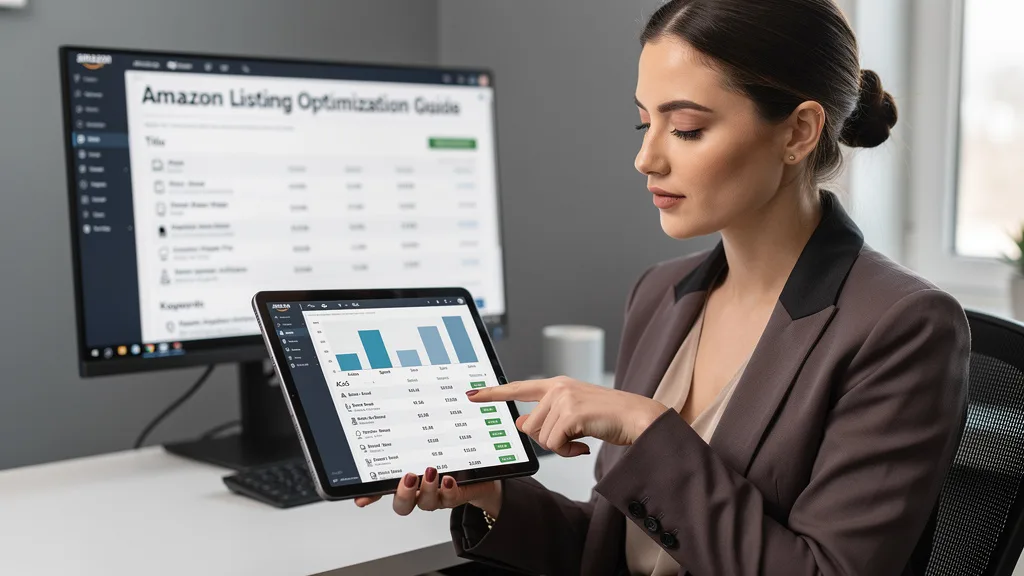
This is not a one-time task but an ongoing strategy that involves deep keyword research, compelling copywriting, and high-quality visual assets. A well-optimized listing communicates value, builds trust, and answers customer questions before they are even asked. It's the single most important asset for driving free, organic traffic and is the bedrock of any successful Amazon business. To dive deeper, you can explore a complete guide to ranking products on page one.
Key Elements of a High-Converting Listing
A high-converting listing is a blend of science and art, combining data-driven keyword integration with persuasive marketing. Every component must work together to guide the customer from discovery to purchase. Neglecting any one of these elements can create a weak link in your conversion chain, leading to lost sales and diminished ranking potential.
Key components include a keyword-rich title, five benefit-driven bullet points, a detailed product description with A+ Content, and a backend search term strategy. High-quality images and video are also critical, as they help customers visualize the product and its benefits. Getting these elements right is the core of a successful Amazon listing optimization playbook.
Here is a breakdown of the essential elements and their purpose:
| Element | Purpose & Best Practice |
|---|---|
| Product Title | Incorporate top keywords naturally while being readable. Should clearly state what the product is, its main benefit, and key specs. |
| Bullet Points | Use all five points. Start each with a capitalized, benefit-oriented phrase. Explain how features solve customer problems. |
| Product Images/Video | Use high-resolution images (at least 1500x1500 pixels) showing the product from all angles, in use, and with infographics. A product video drastically increases conversion. |
| A+ Content / Description | Leverage A+ Content to tell your brand story, compare products, and overcome objections with rich text and images. This significantly boosts conversion rate. |
| Backend Keywords | Fill out the backend search term fields with relevant keywords you couldn't fit into the frontend copy. Do not repeat keywords. |
| Reviews & Ratings | Social proof is critical. Actively manage customer feedback and aim for a rating above 4.5 stars to build trust. |
How Optimization Drives Organic Traffic and Sales
Amazon's A10 algorithm is designed to show customers the products they are most likely to buy. When you optimize your listing, you are sending direct signals to this algorithm. By including relevant keywords in your title, bullets, and backend, you tell Amazon exactly what your product is, enabling it to show your listing for those search queries. This increases your visibility and drives free, targeted organic traffic to your page.
Once a customer lands on your page, the optimization work continues. Compelling images, benefit-focused bullet points, and detailed A+ Content work together to increase your conversion rate. A higher conversion rate tells Amazon that your product is a good match for the search query. In response, Amazon rewards your listing with a better organic ranking, creating a positive feedback loop: better ranking leads to more traffic, which leads to more sales, which in turn solidifies your higher rank.
What Is Amazon PPC?
Amazon PPC (Pay-Per-Click) is Amazon's internal advertising platform, allowing sellers to create ads for their products that appear in search results and on competitor product pages. As the name implies, you pay a fee to Amazon every time a shopper clicks on your ad. It's a powerful tool for gaining immediate visibility, bypassing the time it takes to build organic rank, and reaching customers who are actively searching for products like yours.

These advertisements, often labeled as "Sponsored," are a primary method for driving initial sales, launching new products, and defending your market share from competitors. Managing PPC effectively requires a deep understanding of campaign types, bidding strategies, and keyword targeting. While it involves a direct ad spend, a well-run campaign can deliver a significant return on investment by generating sales that you would not have captured otherwise. For a full overview, consider exploring a complete guide to profitable PPC campaigns.
Understanding Sponsored Products and Ad Types
The Amazon advertising ecosystem offers several ad types, but the most common for sellers are Sponsored Products, Sponsored Brands, and Sponsored Display. Sponsored Products are the most widely used, appearing within search results and on product detail pages. They are keyword and product-targeted, allowing you to place your product directly in front of shoppers with high purchase intent.
Sponsored Brands ads appear at the top of the search results page as a headline banner, featuring your brand logo, a custom headline, and up to three of your products. These are excellent for building brand awareness and driving traffic to your Amazon Storefront. Sponsored Display ads take this a step further by allowing you to retarget shoppers who have previously viewed your product page, keeping your brand top-of-mind both on and off Amazon.
The Role of PPC in Boosting Initial Visibility
When you launch a new product, it has no sales history and therefore no organic rank. It's effectively invisible. This is where Amazon PPC becomes indispensable. By launching a targeted PPC campaign, you can immediately place your product on the first page of search results for your most important keywords. This initial visibility is crucial for generating your first sales and reviews.
Those first sales are powerful signals to Amazon's algorithm. They prove that your product is relevant and desirable, which begins the process of building sales velocity and organic ranking. Essentially, PPC acts as the catalyst that kickstarts the organic growth flywheel. It provides the initial traction needed to get your product noticed by both customers and the A10 algorithm, setting the stage for long-term, sustainable success.
The Verdict: Why Listing Optimization Must Come First
The debate over Amazon listing optimization vs PPC is decisively settled by one simple business principle: you must fix the bucket before you start filling it with water. Sending paid traffic to a poorly optimized product page is the fastest way to burn through your advertising budget with little to no return. Your product listing is your conversion engine; if it's not running efficiently, any fuel you add in the form of paid traffic is simply wasted.
Prioritizing listing optimization ensures that you are building your Amazon business on a solid foundation. It maximizes the value of every single click, whether it comes from an organic search or a paid ad. A fully optimized listing not only converts better but also improves your quality score for PPC campaigns, which can lead to lower ad costs and better ad placements. In short, optimization is not just a prerequisite for PPC; it's a multiplier for its success.
Why Paid Traffic Fails With a Poorly Optimized Listing
Imagine paying for a prominent billboard on a busy highway that directs customers to a store with broken lights, messy shelves, and no staff. That is precisely what happens when you run paid traffic to an unoptimized Amazon listing. Customers might click on your ad, but they will arrive on a product page that is confusing, unconvincing, or untrustworthy. They will see a weak title, unhelpful bullet points, and low-quality images, and they will quickly click away, likely to a competitor's page.
"Driving paid traffic to an unoptimized listing is like pouring water into a leaky bucket. You're paying for every drop, and most of it is lost before it can do any good. Your conversion rate is the biggest lever for PPC profitability, and that starts with your listing."
In this scenario, you have not only paid for the click but have also told Amazon's algorithm that your product is a poor choice for that keyword, as it did not result in a sale. This can harm your ad's relevance score, driving up your cost-per-click (CPC) and reducing your ad's visibility over time. Ultimately, you end up paying more for fewer sales, a recipe for unprofitability.
Building a Strong Foundation for Conversion Rate
Your listing's conversion rate is the single most important metric for Amazon success. It represents the percentage of visitors who make a purchase. A strong foundation for conversion is built upon three pillars: relevance, persuasion, and trust. Listing optimization addresses all three. Keyword optimization ensures you attract relevant traffic from shoppers looking for exactly what you sell.
Persuasion is handled through compelling copy and high-quality visuals. Your bullet points must articulate clear benefits, your A+ Content should tell a story, and your images must showcase the product's value. Trust is built through social proof, primarily in the form of customer reviews and a high star rating. By systematically improving each of these areas, your conversion rate increases naturally, which has a ripple effect across your entire Amazon business, from organic rank to PPC efficiency.
How Listing Optimization and PPC Work Together
While listing optimization must come first, the ultimate goal is not to choose one over the other but to create a symbiotic relationship between them. Once your listing is fully optimized, PPC becomes a powerful tool to accelerate and amplify its performance. The two strategies work in a continuous loop, with each one feeding and strengthening the other to create a dominant market position.
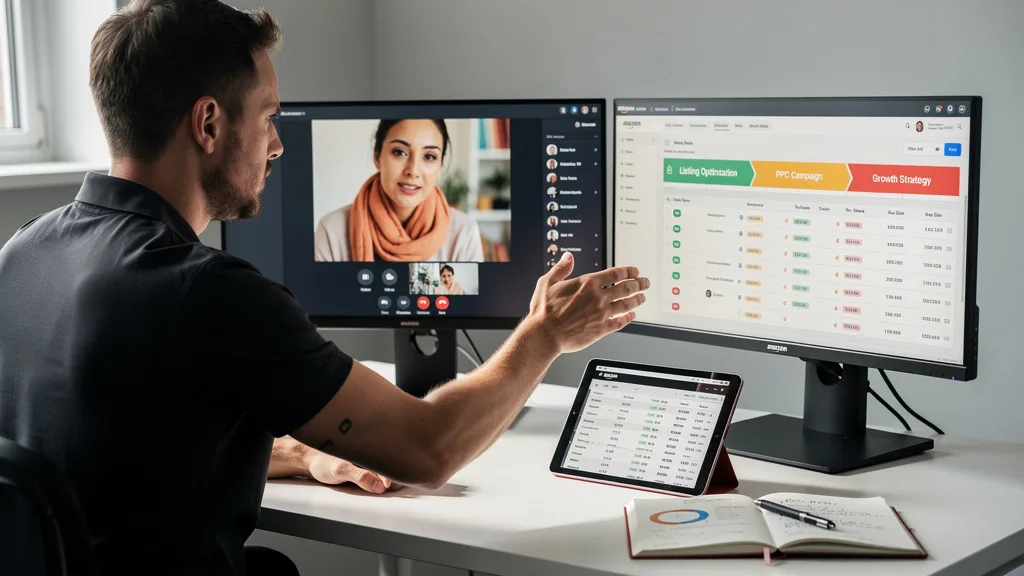
Think of it as a one-two punch. Listing optimization (SEO) builds the power and precision of your punch by ensuring your product page converts. PPC is the speed and reach, allowing you to land that punch in front of a massive audience instantly. When used together correctly, they create a growth engine that is far more powerful than either strategy could be on its own.
Using PPC Data to Refine Your Listing Keywords
One of the most valuable, yet often overlooked, benefits of running Amazon PPC campaigns is the wealth of data they provide. Your PPC search term reports are a goldmine of information, showing you the exact keywords customers are using to find and purchase your product. This data is real-world, purchase-driven, and far more reliable than any third-party research tool.
By analyzing these reports, you can identify high-converting keywords that you may have missed in your initial research. You can then integrate these proven keywords back into your listing's title, bullet points, and backend search terms. This process not only improves your listing's relevance for organic search but also increases your quality score for PPC, leading to lower costs and better ad performance. It's a perfect example of using paid data to enhance your free, organic traffic.
Leveraging a Strong Listing to Improve PPC Efficiency
A well-optimized listing directly improves your PPC campaign's performance and profitability. Amazon's advertising algorithm considers your listing's relevance and conversion rate when determining your ad rank and cost-per-click (CPC). A listing with a high conversion rate is seen as a better result for the customer, so Amazon is more likely to show your ad and may even charge you less per click than a competitor with a weaker listing.
This means your strong conversion rate leads to a higher click-through rate (CTR) and a better Advertising Cost of Sale (ACoS). Your ad budget goes further, generating more sales for the same amount of spend. This improved PPC spend efficiency allows you to bid more aggressively, win more ad placements, and accelerate your sales velocity even faster, all while maintaining profitability.
Creating a Flywheel Effect for Sustainable Growth
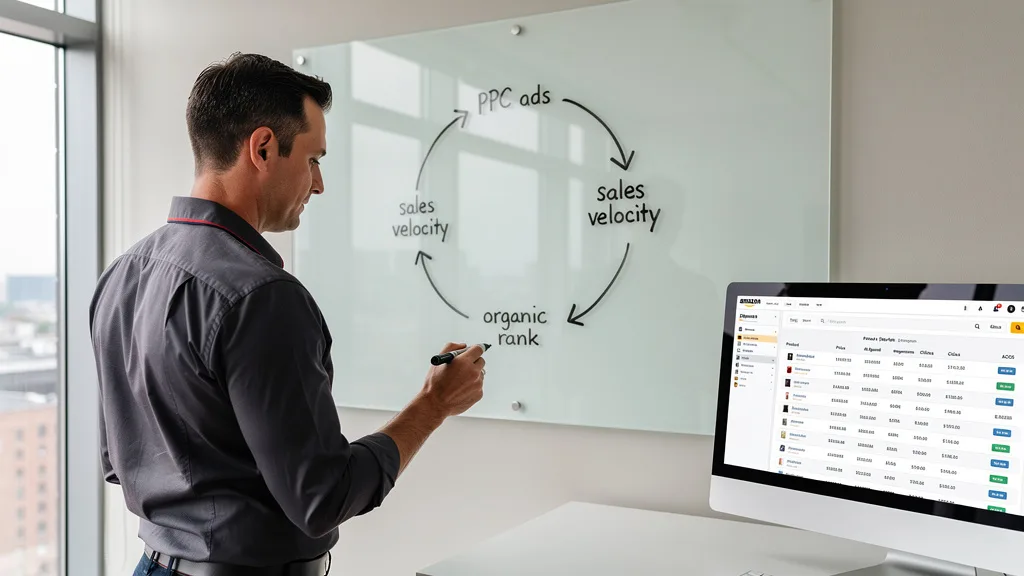
The ultimate synergy between listing optimization and PPC creates what is known as the Amazon flywheel effect. It starts with PPC driving traffic to your highly optimized listing. This traffic converts into sales, which increases your sales velocity. Higher sales velocity leads to more customer reviews and a better organic ranking from Amazon's algorithm.
This improved organic rank brings in more free, organic traffic, which generates even more sales. This entire cycle raises your product's overall authority and relevance on the platform. With this stronger foundation, your PPC campaigns become even more efficient, allowing you to reinvest profits to capture more market share. This self-reinforcing loop creates momentum that becomes increasingly difficult for competitors to stop, leading to long-term, sustainable, and profitable growth.
Structuring Your Amazon Strategy: A Phased Approach for 2026
To successfully scale on Amazon, you need a structured, phased approach that respects the foundational importance of optimization while strategically layering in paid advertising. Jumping straight to aggressive PPC without a solid base is a recipe for failure. For 2026, successful Amazon sellers will be those who master this sequence, ensuring their investment at each stage is maximized.
This methodical approach de-risks your investment and builds momentum logically. Each phase builds upon the success of the last, creating a stable and scalable business operation. Rushing this process almost always leads to wasted time and money, forcing you to go back and fix foundational issues later at a much higher cost.
Phase 1: Perfecting Your Product Listing
Before any other activity, your entire focus should be on creating a retail-ready product listing. This is your foundation. This phase involves deep keyword research to understand customer language, crafting a compelling title and bullet points, producing a full suite of high-resolution images and a product video, and building out robust A+ Content. You should also populate your backend search terms thoroughly.
During this phase, you are not spending any money on ads. The goal is to make your product page as effective as it can possibly be at converting visitors. This includes ensuring your product is priced competitively and has a plan to generate initial reviews. Only when your conversion rate is strong on its own are you ready to move to the next phase.
Phase 2: Launching Initial PPC Campaigns
With a fully optimized listing in place, you can now begin to strategically introduce paid traffic. Start with a modest budget focused on a few core campaign types. An automatic campaign is excellent for harvesting new, unexpected customer search terms. Alongside this, run a manual exact match campaign targeting your top 5-10 most relevant, high-volume keywords that you identified in Phase 1.
The goal of this phase is not immediate profitability but data collection and sales velocity. You are using PPC to kickstart the flywheel, generate initial sales, and gather real-world data on which keywords convert. Monitor your search term reports closely and use this information to refine both your campaigns and your listing copy.
Phase 3: Scaling and Balancing Both Channels Over Time
Once you have a baseline of performance and a steady stream of sales, you can enter the scaling phase. Here, you will gradually increase your PPC budget, expanding your keyword targeting to include broad and phrase match campaigns to capture more traffic. You will also use the data from your PPC to continuously refine your listing optimization, creating a feedback loop of constant improvement.
The goal in this phase is to find the optimal balance between paid and organic sales, aiming for a healthy Total Advertising Cost of Sale (TACoS). You will scale your ad spend as long as it remains profitable and contributes to your overall growth. This involves advanced strategies like brand defense campaigns, competitor targeting, and leveraging different ad types like Sponsored Brands and Display to maximize your presence on the platform.
Key Takeaways
Navigating the complexities of Amazon requires a clear strategy. When deciding between listing optimization and PPC, remember that one builds the foundation for the other to succeed. Here are the key points to guide your approach in 2026:
- Optimization First, Always: A fully optimized product listing is the non-negotiable first step. It is the engine of conversion for all traffic, both paid and organic. Never spend on ads before your listing is retail-ready.
- PPC is an Accelerator, Not a Fix: Amazon PPC is a powerful tool for driving immediate traffic and kickstarting sales velocity. However, it cannot fix a poor product or a listing that doesn't convert. It only amplifies what is already there.
- Data Creates a Flywheel: The most advanced sellers use PPC and listing optimization in a symbiotic loop. PPC provides real-world keyword and conversion data, which is used to refine the listing. A better listing then improves PPC efficiency, creating a powerful growth flywheel.
- Follow a Phased Approach: Build your strategy sequentially. Phase 1 is perfecting the listing. Phase 2 is launching initial PPC for data and velocity. Phase 3 is scaling and balancing both channels for long-term, profitable growth.
Frequently Asked Questions
What are the best Amazon listing optimization services?
The best Amazon listing optimization services are those that offer a comprehensive, data-driven approach rather than just simple copywriting. Look for a consultant or agency that begins with deep keyword and competitor research, has a proven track record of creating high-converting copy and A+ Content, and provides guidance on visual assets like images and video. A top-tier service will treat your listing as a complete conversion system, not just a set of keywords.
Ultimately, the best service is one that aligns with your brand's goals, whether that's scaling from 7 to 8 figures or launching a new product line. An expert consultant who understands the nuances of Amazon's algorithm and consumer psychology will provide a much higher return on investment than a generic content farm. Transparency and a focus on conversion rate are key indicators of a quality provider.
How do you optimize an Amazon PPC campaign?
Optimizing an Amazon PPC campaign is an ongoing process of refinement. It starts with a logical campaign structure, separating keywords by match type and intent. Regularly review your search term reports to find new keywords to target (and negative keywords to block) to prevent wasted spend. You should also adjust bids based on performance, increasing bids on profitable keywords and decreasing them on underperformers.
Beyond bids and keywords, optimization involves testing different ad copy and creative, especially for Sponsored Brands. For a deeper dive, learning How to Optimize Amazon PPC with advanced strategies can help you manage your ACoS and scale effectively. An Amazon PPC audit is also a great starting point to identify areas for improvement.
How long does it take for Amazon SEO to show results?
The effects of Amazon SEO can be seen in stages. You may notice an initial indexing improvement for new keywords within a few days to a week. However, seeing a significant, stable improvement in organic rank and sales typically takes 30 to 90 days. This timeline depends on your product's category, competition level, and sales velocity.
Amazon's algorithm needs time to gather data on your updated listing's performance, including click-through rate and conversion rate. Combining your optimization efforts with a strategic PPC launch can help accelerate this process by driving initial sales and proving to the algorithm that your listing is relevant and desirable.
Can you succeed on Amazon with only SEO and no PPC?
It is possible, but it is extremely difficult and slow in 2026, especially in competitive niches. Relying solely on Amazon SEO means you are completely dependent on the algorithm discovering and ranking your product organically. Without PPC, you lack the tool to kickstart initial sales velocity, test keyword conversion, and defend against competitors who are bidding on your brand terms.
While a perfectly optimized listing in a low-competition niche might gain traction over many months, a strategy that excludes PPC forgoes a critical lever for growth and market intelligence. For any brand serious about scaling, a combination of both SEO and PPC is the standard for success.
What is a good ACoS for Amazon PPC in 2026?
A "good" Advertising Cost of Sale (ACoS) is highly dependent on your profit margins and business goals. There is no single magic number. A common benchmark for established products is often between 25-40%, but this can vary widely. For a new product launch, you might accept a higher ACoS (e.g., 50-100%) as an investment to gain sales velocity and reviews.
The most important metric is your break-even ACoS, which is your profit margin before ad spend. Your target ACoS should be below this number to ensure profitability. Ultimately, a good ACoS is one that aligns with your strategic objective for that specific campaign, whether it's profitability, growth, or brand awareness. Understanding your Amazon ACoS targets is crucial for managing campaigns effectively.
Conclusion
In the final analysis of Amazon listing optimization vs PPC which comes first, the verdict is clear and unchanging: optimization is the essential, non-negotiable starting point. Building a powerful, conversion-focused product listing is the most critical investment you can make in your Amazon business. It ensures that every dollar you eventually spend on advertising has the greatest possible chance of turning into profitable revenue.
The key takeaway is to view these two powerful tools not as competitors for your budget, but as sequential partners in growth. First, you build the engine with meticulous listing optimization. Then, you add the fuel with strategic PPC campaigns. This phased approach mitigates risk, maximizes your return on investment, and creates the virtuous flywheel of traffic, sales, and ranking that separates 7-figure sellers from 8-figure brands.
By mastering this synergy, you move from simply participating on Amazon to dominating your category. You create a resilient business that isn't solely reliant on ad spend, but is instead built on a foundation of organic strength, amplified by intelligent advertising. This is the blueprint for sustainable, profitable scaling in the competitive Amazon marketplace of 2026 and beyond.
If you've optimized your listing and are ready to scale with a profit-focused PPC strategy, or if you're unsure if your foundation is strong enough, expert guidance can provide the clarity you need. I help 7-figure brands build the systems to reach 8-figures with transparent, data-driven management. To see where your opportunities lie, I invite you to get a Free Audit.