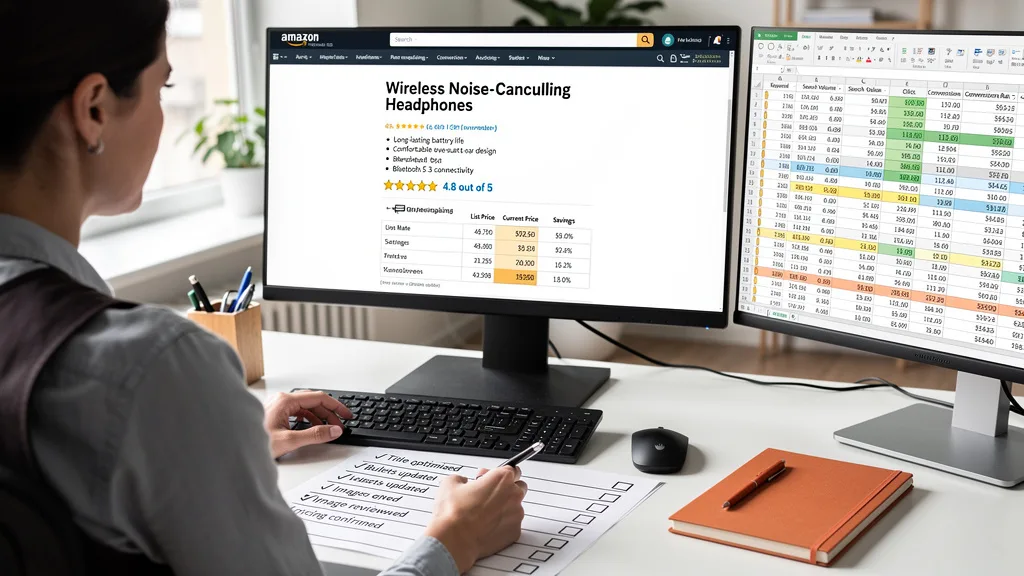
The most common Amazon listing optimization mistakes include neglecting in-depth keyword research, writing uncompelling titles and bullet points, using low-quality images, ignoring A+ Content, and disregarding customer feedback. Correcting these five areas can significantly improve your product's search ranking, click-through rate, and ultimately, your sales growth on the platform in 2026.
Navigating the competitive landscape of Amazon requires more than just a great product. It demands a strategic approach to how you present that product to millions of potential buyers. Many sellers, however, unknowingly make critical errors that keep their listings buried on page ten of the search results. In this guide, we will break down the 5 common Amazon listing optimization mistakes to avoid and provide actionable steps to transform your product pages into high-converting assets.
Why Common Listing Optimization Mistakes Reduce Sales Growth
Common listing optimization mistakes directly impact your sales growth by making your products harder for customers to find and less appealing to purchase. When you neglect proper keyword research, your listing fails to appear in relevant search results, effectively making you invisible to your target audience. Even if shoppers find your product, uncompelling titles and poor-quality images can cause them to click away in seconds, tanking your click-through and conversion rates.
These errors create a negative feedback loop within Amazon's A10 algorithm. Low traffic and poor conversion signals tell Amazon that your product is not a good match for customer searches, causing your organic ranking to drop further. This reduced visibility leads to fewer sales, which in turn reinforces your low ranking. Addressing these fundamental content and keyword issues is the only way to break the cycle and build momentum for sustainable sales growth.
Mistake 1: Neglecting In-Depth Keyword Research
One of the most frequent and damaging errors is failing to conduct thorough keyword research. Many sellers either guess which terms customers are using or select overly broad, highly competitive keywords. This leads to a disconnect between your listing and the actual language of your target shoppers. Effective research involves identifying a mix of high-volume primary keywords and more specific, long-tail keywords that signal strong purchase intent.
Using Irrelevant or Low-Volume Keywords
Populating your listing with irrelevant keywords confuses both customers and Amazon's algorithm. For example, stuffing a listing for a "leather dog collar" with terms like "cat harness" will attract the wrong traffic, leading to low conversion rates that hurt your ranking. Similarly, focusing only on obscure, low-volume keywords means you miss out on the vast majority of potential customers. The goal is to find the sweet spot of relevance and search volume, which is a core principle of a solid Amazon SEO strategy.

A balanced approach involves using tools to uncover what your ideal customers are actively searching for. Analyze competitor listings to see what terms they are ranking for and identify gaps in their strategy. Look for synonyms and related phrases that capture different facets of customer intent. By aligning your language with shopper behavior, you ensure your product appears in front of the right people at the right time.
Forgetting to Utilize Backend Search Terms
Many sellers focus exclusively on the keywords visible in the title, bullets, and description, completely forgetting the powerful backend search terms field. This section in Seller Central allows you to add keywords that you don't want to include in the customer-facing copy. It's an ideal place for synonyms, common misspellings, and competitor brand names (use with caution) that can drive relevant traffic without cluttering your main listing content.
The backend search terms are indexed by Amazon's algorithm and give you an extra opportunity to rank for a wider array of queries. Leaving this field blank or filling it with redundant keywords already used in your title is a massive missed opportunity. Maximize your reach by strategically filling this space with relevant terms that you couldn't fit elsewhere, ensuring you don't repeat words and stay within the character limit provided by Amazon.
Mistake 2: Uncompelling Product Titles and Bullet Points
Your product title and bullet points are your primary sales pitch. They are often the first pieces of content a shopper reads and are critical for both search visibility and conversion. A common mistake is writing vague, uninspired copy that fails to communicate the product's value or include essential keywords. Your title should be a clear, concise, and keyword-rich summary of your product, while your bullet points should expand on its key benefits.
Writing Vague Titles That Lack Key Information
A title like "Blue Water Bottle" is a recipe for failure. It lacks the essential details that shoppers and the Amazon algorithm need, such as material, size, key features, and brand. A much stronger title would be: "BrandName Insulated Stainless Steel Water Bottle, 32 oz, Leak-Proof Spout Lid, BPA-Free, for Gym & Outdoor - Sky Blue." This version includes multiple keywords, specifies critical attributes, and immediately answers key customer questions.

Your title is the most heavily weighted field for keyword ranking, so it must be optimized for both search engines and humans. Front-load the most important keywords and information, as titles are often truncated on mobile devices. Avoid keyword stuffing or using all caps, as this can appear spammy and deter clicks. A well-crafted title is one of the fastest ways to improve your listing's performance.
Failing to Highlight Benefits Over Features
Sellers often get caught up in listing technical specifications (features) instead of explaining how those features improve the customer's life (benefits). A feature is what your product *is* or *has*, while a benefit is what the customer *gets* or *feels*. For example, "10,000 mAh battery" is a feature. "Charges your phone three times so you never worry about running out of power" is a benefit. Customers buy solutions to their problems, not just product specs.
Your bullet points are the perfect place to translate features into compelling benefits. Start each bullet with a benefit-driven statement that grabs the reader's attention and then support it with the corresponding feature. This approach connects with the customer on an emotional level and makes a much stronger case for why they should choose your product over a competitor's. These are some of the 12 Expensive Amazon Selling Mistakes that can be easily avoided with a shift in perspective.
| Product Feature (What it is) | Customer Benefit (What it does for them) |
|---|---|
| Made of 100% organic cotton | Enjoy ultra-soft, breathable comfort that's gentle on sensitive skin. |
| Noise-cancelling technology | Focus on your music or work without distractions from the outside world. |
| Waterproof to 50 meters | Wear your watch worry-free while swimming, showering, or washing hands. |
| Collapsible design | Save space in your backpack or luggage for easy travel and storage. |
Mistake 3: Using Low-Quality or Non-Compliant Images
In e-commerce, your product images are your storefront. They are the single most important factor in a customer's purchasing decision. Despite this, many sellers upload low-resolution, poorly lit, or non-compliant photos. This not only creates a terrible first impression but can also get your listing suppressed by Amazon. High-quality images build trust, communicate value, and are essential for driving conversions.
How Poor Images Reduce Visibility and Conversions
Images that don't meet Amazon's technical requirements, such as having a non-white background for the main image, can cause your listing to be suppressed from search results. Even if your listing is visible, blurry or unprofessional photos make your product look cheap and your brand untrustworthy. Shoppers can't touch or feel the product, so they rely entirely on your images to judge its quality. If your photos are poor, they will assume your product is too and will quickly move on to a competitor with better visuals.
Furthermore, a low click-through rate and conversion rate caused by bad images will signal to Amazon's algorithm that your listing is not relevant or appealing. This leads to a lower organic ranking over time, creating a downward spiral in visibility and sales. Investing in professional photography is not a cost; it's an essential investment in the success of your Amazon business.
Missing Opportunities with Lifestyle and Infographic Images
Many sellers stop after uploading one or two basic product shots on a white background. This is a missed opportunity to tell a story and answer customer questions visually. Your secondary image slots should be filled with a mix of lifestyle images and infographics. Lifestyle photos show your product in use by your target customer, helping them envision themselves using and benefiting from it. This creates an emotional connection and demonstrates the product's real-world application.
Infographics are images that use text and graphics to highlight key features, benefits, dimensions, or instructions. They are an incredibly effective way to communicate important information quickly and visually. A well-designed infographic can explain a complex feature, compare your product to a competitor's, or showcase a unique selling proposition in a way that is much more engaging than a simple bullet point. Using all available image slots with a strategic mix of formats is key to maximizing conversions.
Mistake 4: Ignoring A+ Content and Brand Story
For brand-registered sellers, the A+ Content (formerly Enhanced Brand Content) section is a powerful tool for increasing conversions and telling your brand story. It allows you to replace the standard text description with a visually rich layout of images, custom text, and comparison charts. A common mistake is either leaving this section blank or creating underdeveloped content that fails to engage the shopper. A well-executed A+ Content module can significantly lift conversion rates.
Leaving Your A+ Content Section Underdeveloped
An underdeveloped A+ Content section is a huge waste of prime digital real estate. This often involves using low-resolution images, writing generic copy, or simply not using the available modules to their full potential. Your A+ Content should be an extension of your brand, reinforcing your messaging and visually demonstrating your product's value. It's your chance to answer common customer questions, overcome objections, and differentiate yourself from the competition in a compelling, visual format.
Use high-quality imagery and professionally written copy to guide the customer through a narrative. Highlight your brand's mission, showcase your product line with cross-selling modules, and use comparison charts to make it easy for shoppers to choose the right product for their needs. A thoughtful A+ layout builds brand equity and provides the final push a customer needs to click "Add to Cart."
"Think of your A+ Content as your in-store salesperson. It's your opportunity to engage, educate, and persuade. Neglecting it is like leaving your store unattended. Proper Amazon listing optimization requires you to treat this section with the attention it deserves to build a strong customer experience."
Not Aligning Content with Your Target Customer Experience
Effective A+ Content isn't just about looking pretty; it must be strategically aligned with your target customer's needs and pain points. A mistake sellers make is creating content that talks about themselves rather than focusing on the customer. Before designing your layout, you must deeply understand your audience. What are their biggest questions? What problems are they trying to solve? What features are most important to them?
Your content should address these points directly. Use language and imagery that resonates with your ideal buyer persona. For example, if you sell high-performance athletic gear, your A+ Content should feature dynamic images of athletes in action and use language that speaks to performance and durability. If you sell baby products, your content should evoke feelings of safety, comfort, and trust. This customer-centric approach ensures your content is not just informative but also highly persuasive.
Mistake 5: Disregarding Customer Reviews and Questions
Your customers are providing you with a goldmine of free, actionable feedback in the form of reviews and questions. Ignoring this feedback is a critical error that can lead to a decline in rankings and sales. Negative reviews can quickly sink a listing, while the Q&A section offers invaluable insights into customer concerns and information gaps in your listing. Actively managing and learning from this feedback is essential for long-term success.
How Negative Feedback Can Hurt Rankings
Negative reviews have a direct and powerful impact on your listing. Firstly, a low star rating is a major deterrent for potential buyers, drastically reducing your conversion rate. Secondly, Amazon's algorithm considers customer satisfaction a key ranking factor. A product with consistently poor reviews will be deemed a bad customer experience and will be demoted in search results. This is one of the most common Top 7 Common Amazon FBA mistakes sellers make.
It's crucial to monitor your reviews daily. Respond professionally to negative feedback where possible, and more importantly, use the feedback to identify product flaws or listing inaccuracies. If multiple customers complain about the same issue, it's a clear signal that you need to either improve the product or update your listing to manage expectations better. Proactively addressing these issues can turn a negative trend around.
Missing Key Insights from the Q&A Section
The "Customer questions & answers" section is often overlooked by sellers, but it's a direct line to your customers' thought processes. The questions asked here reveal what information is missing or unclear on your product page. If multiple people ask about the product's dimensions, it's a sign you need to add a clear infographic showing its size. If they ask about compatibility, you need to make that information more prominent in your bullet points or title.
By proactively answering these questions yourself, you control the narrative and ensure accurate information is provided. You can also "upvote" the most important questions and answers to keep them visible. Furthermore, the language customers use in their questions can be a great source for new keywords to add to your listing or your Amazon PPC Management campaigns. This section is not just for customer service; it's a powerful market research tool.
Proven Tips for Optimizing Your Amazon Listing
Avoiding common mistakes is the first step, but continuous optimization is what separates top sellers from the rest. The Amazon marketplace is dynamic, with customer trends, competitor strategies, and the algorithm itself constantly evolving. To stay ahead, you must adopt a proactive and data-driven approach to managing your listings. This involves regular audits, systematic testing, and a commitment to ongoing improvement.
Conduct Regular Keyword and Competitor Audits
Set a schedule, perhaps quarterly, to perform a full audit of your listings. This involves re-evaluating your keywords to see if search trends have changed and analyzing your top competitors' listings. Are they using new keywords? Have they updated their images or A+ Content? Use third-party tools to check your keyword indexing and ranking, and identify new opportunities to capture traffic. A regular audit prevents your listings from becoming stale and ensures you remain competitive.
A/B Test Your Titles and Main Images
Don't just guess what works best. Use data to make informed decisions about your most critical listing elements. Amazon's "Manage Your Experiments" tool allows brand-registered sellers to A/B test their titles, main images, and A+ Content. You can run a test to see if a different main image results in a higher click-through rate or if a new title structure improves conversions. Even small, incremental improvements from these tests can add up to a significant increase in sales over time.
Continuously Update Listings Based on Performance Data
Treat your Amazon listing as a living document, not a set-it-and-forget-it task. Pay close attention to your performance data within Seller Central's Business Reports. Monitor your unit session percentage (conversion rate), page views, and other key metrics. If you notice a drop in performance, investigate the cause. Use the insights you gain from these reports, customer reviews, and A/B tests to make continuous updates. A successful strategy involves a cycle of analyzing, testing, and refining.
- Monitor Conversion Rates: Track your unit session percentage to understand how well your page converts visitors into buyers.
- Analyze Customer Feedback: Regularly read new reviews and Q&As to find recurring themes or new issues.
- Track Keyword Rankings: Use tools to see where you stand for your most important search terms and adjust your strategy if you see a decline.
- Update Imagery: Refresh your lifestyle images and infographics seasonally or as your product evolves to keep the listing feeling current.
- Refine Copy: Tweak your bullet points and description to address new questions or highlight benefits you've discovered through customer feedback.
Key Takeaways
Achieving success on Amazon in 2026 requires a diligent and strategic approach to listing optimization. By understanding and avoiding the most common pitfalls, you can significantly improve your product's visibility and sales performance. Here are the key points to remember:
- Keyword Research is Non-Negotiable: Use a mix of relevant, high-volume, and long-tail keywords in both your frontend copy and backend search terms to maximize visibility.
- Compelling Copy Sells: Write clear, keyword-rich titles and focus on customer benefits, not just product features, in your bullet points.
- Images are Everything: Invest in high-quality, compliant images, including a mix of product shots, lifestyle photos, and infographics to build trust and drive conversions.
- Leverage A+ Content: Use A+ Content to tell your brand story, showcase product value visually, and increase your conversion rate.
- Listen to Your Customers: Actively monitor and learn from customer reviews and questions to improve your product, your listing, and your rankings.
- Optimization is an Ongoing Process: Regularly audit your listings, A/B test key elements, and use performance data to make continuous improvements.
Frequently Asked Questions
Is selling on Amazon still worth it in 2026?
Yes, selling on Amazon is still incredibly worthwhile in 2026 for businesses that approach it strategically. While the marketplace is more competitive than ever, its massive customer base and sophisticated fulfillment infrastructure offer unparalleled access to global consumers. Success is no longer about simply listing a product; it requires a deep understanding of the platform's algorithm, a commitment to quality, and a data-driven approach to marketing and listing optimization.
The key is to find a profitable niche, create a high-quality product, and build a strong brand presence. Sellers who invest in professional branding, excellent customer service, and continuous optimization can build highly profitable and sustainable businesses. The opportunities are still vast for those willing to do the work.
What is Amazon's biggest weakness for sellers?
For sellers, Amazon's biggest weakness is the lack of control and the ever-present risk of dependency on a single platform. You are essentially a guest in Amazon's house and must play by their rules, which can change with little notice. Account suspensions, algorithm changes, and increased fees are constant risks that can cripple a business overnight.
Another significant weakness is the intense competition and the prevalence of black-hat tactics from malicious competitors. This environment requires constant vigilance. To mitigate this weakness, smart sellers focus on building a brand that exists beyond Amazon and work to diversify their sales channels over time, so their entire business isn't reliant on one platform.
What kinds of products are restricted on Amazon?
Amazon has a long list of restricted product categories to ensure compliance with laws and maintain a safe marketplace. This list can vary by country but generally includes items like alcohol, firearms and weapons, prescription drugs, gambling and lottery products, and certain hazardous materials. Other categories may require pre-approval before you can sell in them, such as dietary supplements, medical devices, and collectible coins.
It is absolutely critical for sellers to thoroughly review Amazon's Restricted Products policy in Seller Central before sourcing any inventory. Attempting to sell a restricted product can lead to immediate account suspension and other penalties. The list is updated periodically, so ongoing awareness is essential.
How often should you update an Amazon product listing?
There is no single correct frequency, but you should not treat your listing as a static asset. A good practice is to conduct a full review and audit of your listings at least quarterly. This involves checking keyword performance, analyzing competitor changes, and ensuring all information is current. However, you should be prepared to make updates more frequently based on specific triggers.
For instance, if you receive a new batch of customer questions about a specific feature, you should update your listing immediately to address them. If you notice a sudden drop in conversion rate, it's time to investigate and potentially test new images or copy. The best approach is one of continuous monitoring and agile response to data and customer feedback.
Does A+ Content actually increase sales?
Yes, according to Amazon, A+ Content can increase sales by an average of 3-10%. By providing a richer, more engaging shopping experience, it helps customers make more informed purchasing decisions, which leads to higher conversion rates. The visual storytelling and branding capabilities of A+ Content help build trust and differentiate your product from competitors who only have a plain text description.
The impact of A+ Content is most significant when it is well-designed and strategically aligned with the customer's needs. It provides an opportunity to visually demonstrate product benefits, answer common questions, and overcome purchase barriers. For brand-registered sellers, investing the time to create high-quality A+ Content is one of the highest-return activities for boosting sales.
Conclusion
Navigating the complexities of the Amazon marketplace can be challenging, but avoiding these five common listing optimization mistakes provides a clear roadmap for growth. By shifting your focus from a passive listing approach to an active, data-driven optimization strategy, you place your brand in a position of strength. It begins with foundational work in keyword research and compelling copywriting, ensuring customers can both find your product and understand its value.
The journey continues with a commitment to high-quality visual assets, including professional images and robust A+ Content, which build trust and drive conversions. Finally, embracing customer feedback from reviews and Q&As transforms your listing from a static page into a dynamic conversation that fuels continuous improvement. Each of these elements works together to create a superior customer experience, which is what Amazon's algorithm is ultimately designed to reward.
Correcting these errors isn't just about fixing problems; it's about unlocking the hidden potential in your products. If you're feeling overwhelmed or unsure where to start, getting an expert eye on your listings can reveal critical opportunities you might have missed. A thorough analysis can provide the clarity needed to prioritize your efforts and accelerate your sales growth.
Ready to see how your listings stack up against the competition and uncover your biggest opportunities for growth? Request a comprehensive and completely Free Audit today to get a detailed action plan tailored to your brand.